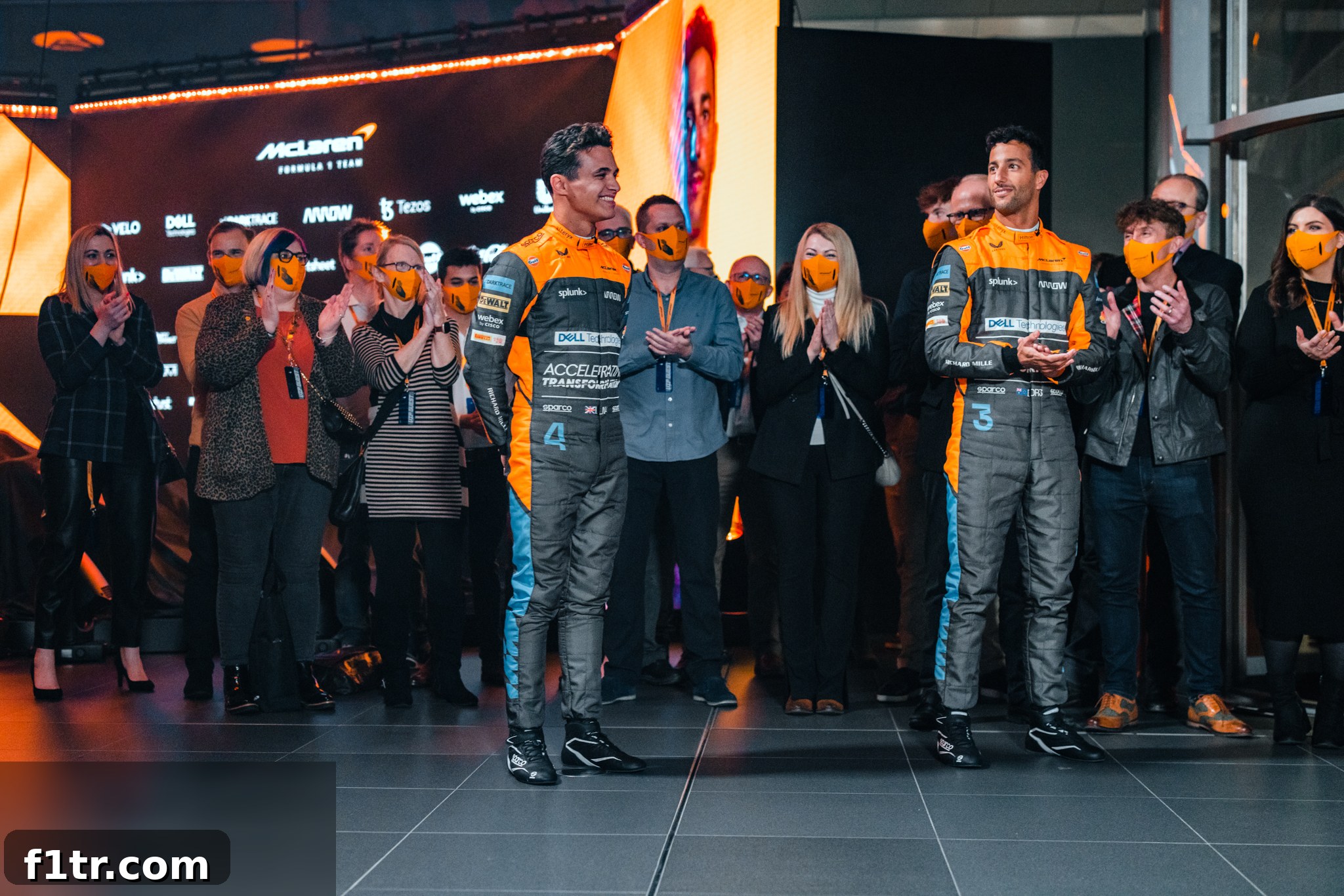
McLaren star Lando Norris believes that the radically overhauled Formula 1 regulations for the 2022 season will significantly amplify the impact of individual driver performance on race outcomes. The monumental technical changes introduced by Formula 1 are designed to usher in a new era of racing, featuring cars that are a stark departure from their predecessors in both aesthetic and dynamic characteristics. These innovative designs are fundamentally aimed at improving the spectacle of Grand Prix racing by enabling cars to follow each other more closely and facilitating more wheel-to-wheel battles, thereby placing a renewed emphasis on driver skill and adaptability.
The transition to this new generation of machinery presents an unprecedented challenge for all competitors. Norris anticipates that the nuanced differences in handling between the high-downforce, conventional cars of last year and the ground-effect-focused challengers of 2022 will create a substantial competitive advantage for those drivers who can decipher and master the new dynamics quicker than their rivals. This period of learning and adaptation, according to Norris, is where the true potential for a driver to stand out will emerge, irrespective of their car’s baseline performance.
“This is absolutely a massive opportunity,” Norris articulated during the unveiling of McLaren’s latest contender, the MCL36. “To hit the ground running with a strong understanding and execution will always be beneficial, particularly in a season where you will undoubtedly need to adjust your driving style. The speed at which you can make these critical adjustments, and then continually evolve that style, will be key to unlocking incremental improvements and climbing the performance ladder. Drivers who can quickly adapt their approach and refine their technique stand to gain a considerable edge.”
Norris further elaborated on the potential for individual brilliance, suggesting that the new rules allow for a greater differentiation based on pure driving ability than in recent memory. “Potentially, you can make a more significant impact as a driver than in previous years,” he explained. “If you grasp how to truly extract the maximum from these cars, and comprehend their unique characteristics, it presents a substantial opportunity for us as drivers. It’s no longer solely about the car being the ultimate factor; it’s about us maximizing that opportunity, adapting our driving style where necessary, and turning it into a competitive advantage. This era demands a profound understanding of the new physics and a willingness to reinvent one’s approach to racing.”
The 2022 technical regulations represent one of the most drastic overhauls in Formula 1 history. Designed with the primary goal of enhancing racing, these rules mandate a shift towards ground effect aerodynamics, simplified front wings, larger 18-inch wheels, and a significant reduction in ‘dirty air’ that previously hindered close-quarter following. These changes mean the new cars generate most of their downforce from underneath the chassis, rather than relying heavily on complex over-car aero elements. While intended to foster closer racing, this fundamental shift also means drivers will be experiencing vastly different aerodynamic behaviour and mechanical grip characteristics, requiring them to fundamentally rethink their approach to cornering, braking, and managing tyre degradation.
For drivers like Norris, who have grown up racing under the previous regulations, this transition is akin to learning a new language of speed. The ground effect philosophy brings back an element of car design last seen in F1 decades ago, promising cars that are inherently more stable when running closely behind another. However, it also introduces a new set of challenges in terms of setup, balance, and how a driver can confidently push the car to its absolute limit. The precision required to maintain optimal ground effect and manage the unique airflow characteristics will test even the most seasoned competitors, making the initial phase of the season a fascinating period of discovery and intense competition.
Despite his optimism, Norris has, like all other drivers, only experienced the MCL36 within the confines of the team’s advanced simulator. This virtual environment provides invaluable data and initial insights into the car’s behaviour, but it cannot fully replicate the nuances, forces, and sensory feedback of driving a Formula 1 car at race pace on a real circuit. Consequently, Norris remains uncertain about the precise degree to which he will need to recalibrate his renowned driving style to fully exploit the capabilities of McLaren’s all-new challenger once he hits the track for pre-season testing.
“I don’t have all the answers just yet,” Norris confessed, acknowledging the inherent limitations of simulator work. “While we’ve gathered substantial ideas and data from our simulator sessions, the true test will come when we actually drive the car on track. Until then, the exact adjustments required for my driving style, and the overall feel of the car, remain an open question. This is a critical period of learning and adaptation that every driver and team will undergo.” The anticipation for the first pre-season tests is palpable, as it will provide the initial real-world glimpse into how these revolutionary cars perform and how drivers begin to wrestle them into submission.
Beyond the technical challenges, Norris is also acutely aware of the personal journey ahead. “Of course, significant opportunities remain for me to build upon the progress I made last year,” he stated, reflecting on his commendable performances and a maiden pole position in the 2021 season. “I am absolutely committed to making that crucial next step in my development as a driver, both individually and as an integral part of the McLaren team. The new regulations provide a clean slate, and my aim is to leverage this reset to demonstrate even greater consistency, speed, and racecraft, pushing myself and the team forward in what promises to be an incredibly competitive era of Formula 1.”
The unpredictability introduced by the 2022 regulations is not just a challenge for drivers but also a strategic dilemma for teams. Those who can most effectively translate simulator data into real-world performance, and provide their drivers with a car that is both quick and adaptable, will hold a significant advantage. The initial races will be a high-stakes test of engineering ingenuity and driver aptitude, potentially shuffling the established pecking order and creating thrilling, unexpected results. This renewed focus on fundamental driving skills and rapid adaptation is precisely what Formula 1 hoped to achieve, promising a season where the human element behind the wheel could be more influential than ever before.
The competitive landscape of Formula 1 is poised for a dramatic shift with the 2022 season. Lando Norris’s insights underscore a widely held belief within the paddock: driver skill, adaptability, and the ability to quickly master the nuances of these groundbreaking cars will be paramount to success. As teams and drivers prepare to embark on this new chapter, the excitement builds for what promises to be a captivating season where the human touch might just outweigh pure machinery in determining who comes out on top. Fans around the globe eagerly await to see which drivers will rise to the occasion and etch their names into the annals of this bold new era.
2022 F1 season
- Mercedes told me “you’re wrong” about 2022 car’s problems – Hamilton
- FIA confirms all 10 F1 teams complied with 2022 cost cap
- Steiner “not ashamed” of panning “slow” Schumacher in Drive to Survive
- Albon believes year out of F1 improved him as a driver
- Hamilton sees diversity gains in F1 years on from his ‘traumatising’ experience of racism
Browse all 2022 F1 season articles