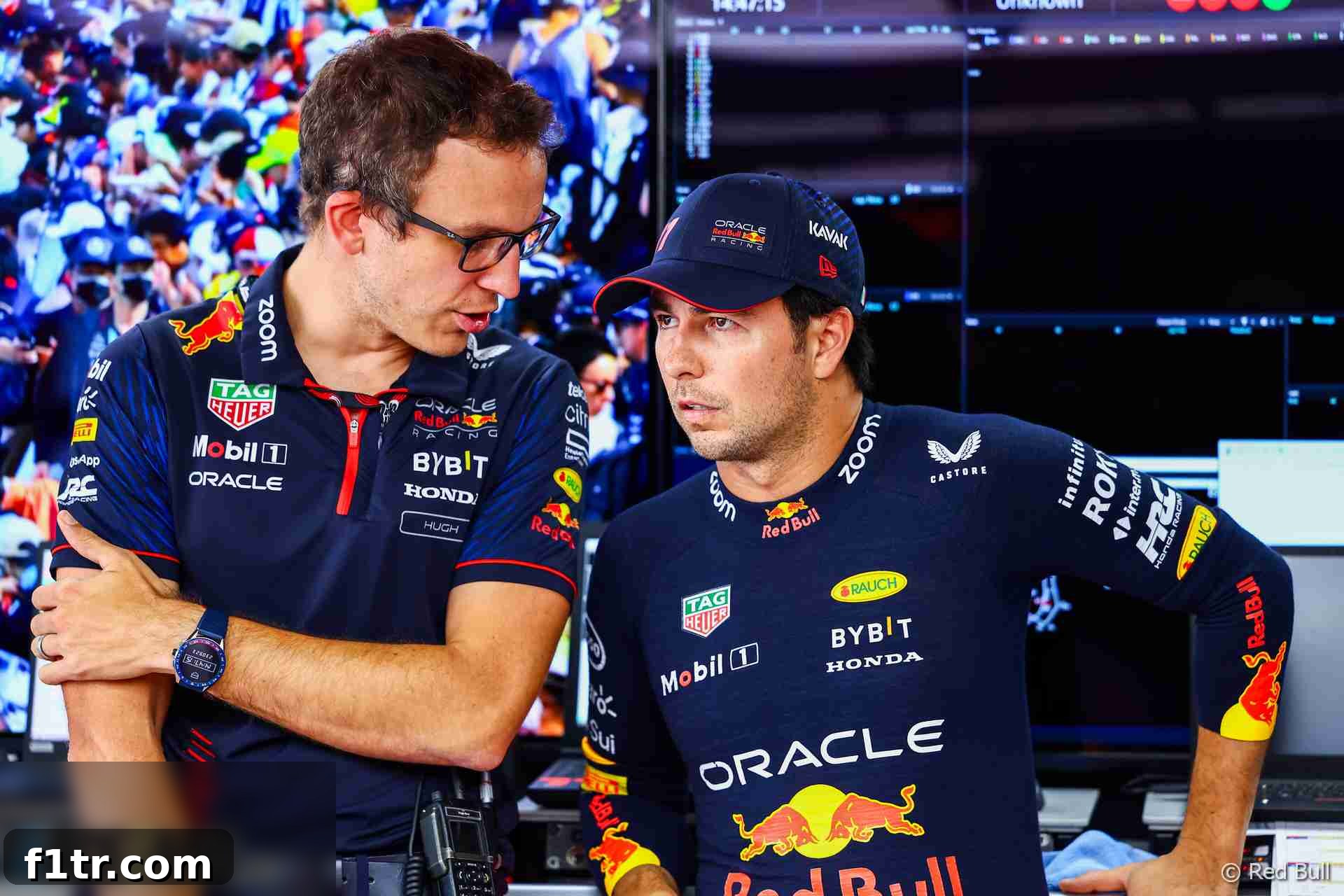
Sergio Perez has openly admitted to encountering significant challenges in matching the blistering pace of his Red Bull Racing teammate, Max Verstappen, throughout the 2023 Japanese Grand Prix weekend at Suzuka.
Perez’s Qualifying Struggles and the Verstappen Gap
The stark reality of the performance disparity was evident from the outset, with the two dominant Red Bull drivers consistently separated by a margin exceeding half a second during both practice sessions and the crucial qualifying rounds. While Max Verstappen delivered another masterclass to secure pole position, Perez found himself 0.773 seconds adrift of his teammate’s benchmark, ultimately placing him fifth on the grid for Sunday’s race. This considerable gap underscores the difficulties Perez faced in extracting maximum performance from his RB19 on the demanding Suzuka circuit, renowned for its high-speed corners and technical layout.
Following qualifying, Perez reflected on the session, stating, “I think definitely P2, front row, was on the cards today.” However, he quickly pointed to a critical strategic decision concerning tyre allocation as a contributing factor to his eventual grid position. The Mexican driver highlighted that only having one new set of soft tyres available for the decisive Q3 session put him at a distinct disadvantage compared to his rivals, especially those who had preserved an additional fresh set.
“Just missing that second set in Q2, when he [Verstappen] used an extra set was not ideal and that put us on the back foot to the McLaren mainly by just having a one set of new tyres. That was not ideal,” Perez elaborated. In Formula 1 qualifying, the optimal use and conservation of fresh tyre sets are paramount. Sacrificing a new set in Q2 to ensure progression often means compromising the availability of pristine rubber for the final, fastest runs in Q3. This tactical imbalance meant Perez had to push harder on a slightly older set or rely on a single new set, whereas competitors like McLaren could deploy their full arsenal of fresh softs, giving them a crucial edge in the ultimate battle for grid positions. This scenario significantly impacted Perez’s ability to extract the absolute maximum from his car, particularly on a circuit like Suzuka where confidence and outright grip are essential for shaving off precious milliseconds.
The Persistent Pace Deficit: “Two Steps Behind”
Perez openly confessed that maintaining Verstappen’s pace had been an uphill battle for much of the weekend. “It was hard,” he told the official F1 website. “We did struggle through the weekend.” He pinpointed a recurring issue with car balance and stability, particularly impacting his ability to attack the circuit’s challenging corners.
“We kind of were always two steps behind and we just couldn’t get the entry stability I was looking to get over a single lap,” he explained. Suzuka’s iconic S-curves and high-speed sections demand immense confidence in the car’s front end and predictable turn-in characteristics. A lack of ‘entry stability’ means the car feels unsettled as the driver initiates the turn, forcing them to be more cautious and costing crucial tenths of a second through these critical phases of the lap. This fundamental handling characteristic, or lack thereof, significantly hampered Perez’s ability to commit fully and exploit the RB19’s inherent aerodynamic prowess, especially when pushing for a qualifying lap time. It’s a subtle but profound difference that separates the absolute peak performers on circuits demanding razor-edge precision.
High-Speed Corner Challenge at Suzuka
The data from qualifying further illuminated Perez’s struggles, showing he lost over four tenths of a second to Verstappen in the first sector alone. This sector is notoriously demanding, comprised largely of sweeping, high-speed corners that test a car’s aerodynamic grip and a driver’s bravery to their limits. Red Bull team principal Christian Horner provided insight into this particular aspect of the performance gap, noting Verstappen’s unparalleled ability to consistently raise the benchmark in these fastest sections of the Suzuka circuit.
“He’s slightly under the car compared to Max in those high-speed turns,” Horner observed during an interview with Sky Sports. “He’s closed the gap in high-speed turns but Max keeps moving it.” This suggests that while Perez has made efforts to improve his comfort and confidence in the fastest corners, Verstappen’s extraordinary talent means he continually finds new limits, effectively shifting the goalposts for his teammate. This dynamic creates a challenging environment for any driver paired with a generational talent like Verstappen, where even significant improvements can feel insufficient against a continually ascending standard. The sheer precision and commitment required to navigate Suzuka’s quick bends, such as the Esses and the Dunlop Curve, are where milliseconds are gained or lost, and where Verstappen has consistently demonstrated his unique mastery.
Optimism for Race Day: The Degradation Battle
Despite the qualifying setback, Perez expressed a palpable sense of optimism regarding his prospects for Sunday’s race. He believes that the longer runs and different demands of race day will play more into his strengths and the characteristics of his car setup. This confidence often stems from a car that might not excel in single-lap pace but demonstrates superior consistency and tyre management over extended stints.
“But come race day I think we are looking a lot better. I think that tomorrow is going to be such a degradation tyre battle that hopefully tomorrow we can still be able to do a one-two,” Perez stated confidently. His focus shifts from outright single-lap pace, which proved elusive, to managing tyre wear and maintaining consistent speed over a race distance. Suzuka is known for being hard on tyres, particularly with its high-speed corners generating significant energy through the compounds. A ‘degradation tyre battle’ implies that drivers who can best manage their tyres – either through driving style or car setup – will gain a significant advantage as the race progresses. This scenario often allows drivers who struggled slightly in qualifying to demonstrate stronger race pace and execute effective overtaking strategies, turning a mid-grid start into a strong points finish or even a podium challenge.
Christian Horner echoed this sentiment, suggesting that Perez’s performance over longer stints indicated a stronger potential for the race. “But P5 for Checo, I think he’ll have strong race pace, we saw that yesterday so I think he’ll be okay in the race,” Horner affirmed. This confidence stems from observations during Friday’s practice sessions where teams conduct long runs to simulate race conditions and assess tyre wear. If Perez demonstrated good tyre management and sustained performance during these simulations, it bodes well for his ability to climb through the field and challenge for a podium, or even help secure a cherished Red Bull one-two finish. The team’s strategy engineers will be meticulously analyzing all data to give Perez the best possible chance to convert his projected race pace into a tangible result.
The Importance of Tyre Management at Suzuka
The Suzuka International Racing Course, with its unique figure-eight layout and a relentless sequence of high-speed changes of direction, places immense lateral and longitudinal loads on the tyres. This makes tyre degradation a significant factor in strategy and race outcome. Drivers must delicately balance outright speed with the need to preserve their rubber for critical junctures of the race. A car with good entry stability and predictable handling characteristics, even if not the absolute fastest over one lap, can often be kinder to its tyres over a race distance. If Perez has indeed found a setup that offers better tyre preservation, his P5 starting position could become a platform for a strong recovery drive, potentially challenging the McLarens and Ferraris ahead, and even aiming to join Verstappen at the sharp end of the field. The ability to push hard without overheating or excessively wearing the tyres will be the key to success on Sunday.
The prospect of a Red Bull one-two, despite Perez’s qualifying struggles, highlights the team’s overall confidence in their RB19 package and the strategic prowess they often exhibit on race day. For Perez, converting his anticipated race pace into a significant points haul, and ideally a podium finish, will be crucial not only for the team’s championship ambitions but also for his own standing as a consistently competitive driver within the pinnacle of motorsport. His ability to navigate the challenges of Suzuka’s race conditions will be a testament to his resilience and the team’s capacity to optimize performance under pressure, aiming to solidify Red Bull’s dominant season with another strong collective result.
2023 Japanese Grand Prix Coverage
- Norris: Red Bull’s dominance down to ‘small things which make a big difference’
- Mercedes must halve deficit to Red Bull before 2024 season starts – Hamilton
- Mercedes expect “tight” fight for second in championship after Ferrari gains
- Norris breaks Hulkenberg’s record for most points without a win in F1
- Transcript: What Alonso really meant by being “thrown to the lions” at Suzuka
Browse all 2023 Japanese Grand Prix articles