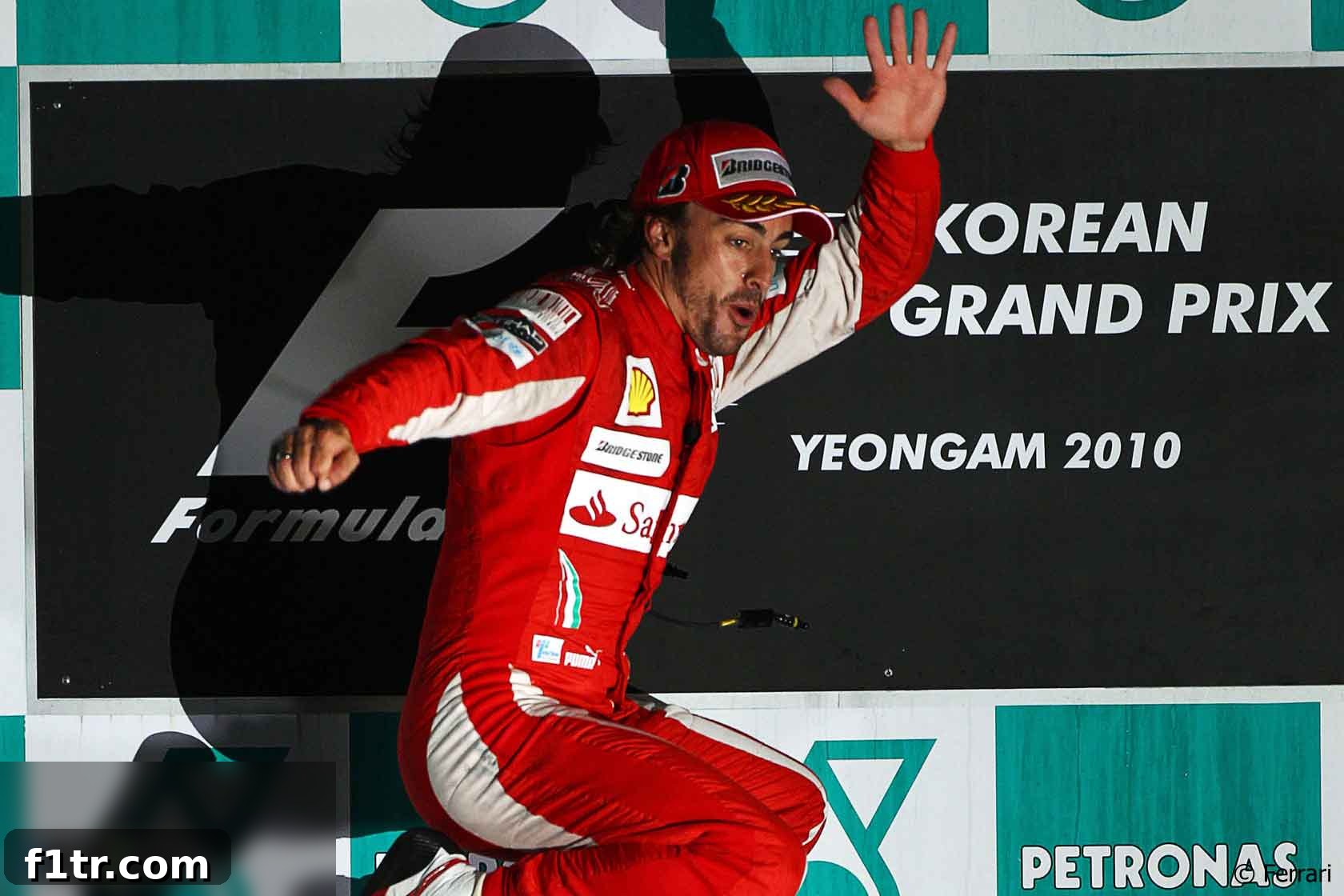
In a thrilling and rain-soaked spectacle that defined the 2010 Formula 1 season, Fernando Alonso delivered a masterclass performance in treacherous conditions to secure a pivotal victory at the inaugural Korean Grand Prix. This hard-fought win not only marked his third triumph of the season but also significantly reshaped the championship landscape. While Alonso showcased exceptional skill and composure, his path to victory was undeniably aided by a dramatic car failure suffered by championship rival Sebastian Vettel in the late stages of the race, adding yet another twist to an already unpredictable season.
The race itself was a testament to the unpredictable nature of motorsport, with the challenging Yeongam circuit becoming a battleground against both rivals and the elements. Lewis Hamilton, after a spirited drive, ultimately finished second, but not without a moment of regret. A crucial error saw him run wide off the track after the third and final safety car restart, costing him a genuine chance at the top step of the podium. This mistake, though minor in its immediate consequence, highlighted the fine margins that define victory and defeat at the pinnacle of racing.
Advert | Become a Supporter & go ad-free
The lead-up to the highly anticipated Korean Grand Prix was dominated by torrential rain, which relentlessly lashed down on the newly constructed circuit. This resulted in an agonizing delay of over an hour before the race could even commence under safety car conditions. The extended wait triggered a heated debate over the team radios, a microcosm of the differing philosophies within the paddock. Drivers like Hamilton vehemently urged for the race to begin, eager to get on with the competition, while others, notably the Red Bull drivers, Alonso, and Robert Kubica, expressed grave concerns about safety and visibility, advocating for a more cautious approach. The tension was palpable as race control grappled with the difficult decision of when to unleash the cars.
A Chaotic Start and Early Drama
After an interminable 17 laps behind the safety car, the conditions were deemed just safe enough for racing to begin in earnest. The initial restart saw the Red Bulls assert their dominance, with Vettel confidently leading his teammate Mark Webber, followed closely by Alonso. Hamilton, who had been so vocal about wanting an earlier start, paradoxically struggled off the line, losing a vital position to Nico Rosberg almost immediately. Little did he know, this seemingly setback would prove to be an unforeseen stroke of luck.
Just two laps into green flag racing, the championship battle exploded with dramatic intensity. Championship leader Mark Webber, under immense pressure and in the treacherous conditions, astonishingly lost control of his RB6 at Turn 14. His car spun violently, collecting Rosberg who had been in a strong position, in a double retirement that sent shockwaves through the paddock. This incident highlighted the extreme difficulty of the conditions and the high stakes involved, instantly changing the complexion of the race and the championship standings. The safety car was deployed once more, resetting the field and offering new opportunities for those who had survived the chaos.
Advert | Become a RaceFans supporter andgo ad-free
The second safety car period saw Alonso elevate to second place behind Vettel, with Hamilton now promoted to third. Their respective teammates, Felipe Massa and Jenson Button, followed close behind. Button, a master of wet weather racing, appeared to be struggling significantly on his full wet tyres and opted for an early switch to intermediates, hoping to gain an advantage. However, fate intervened once again. Just two laps later, the safety car was deployed for a third time, creating a crucial strategic window. This allowed the cars ahead of Button to pit for intermediate tyres without the usual time loss or risk of falling behind him, effectively neutralizing his early gamble and bringing the field even closer together.
Strategic Pit Stops and Shifting Fortunes
The third safety car period became a flurry of activity in the pit lane. Lewis Hamilton demonstrated McLaren’s quick thinking, making a last-minute dash into the pits for intermediates, just as Vettel and Alonso were passing the pit lane entry. This swift action saw Hamilton emerge in a strong position. The safety car strategically allowed Vettel and Alonso to pass, preventing a repeat of the controversial Valencia incident where unlapped cars caused confusion. However, a comparatively slow pit stop for Alonso allowed Hamilton to momentarily snatch second place, setting up a thrilling battle once the safety car peeled in.
Hamilton’s tenure in second place was short-lived. Even before the safety car had exited the track, he radioed his team, expressing concerns about a lack of grip. At the restart, those fears materialized as he ran wide at the notoriously tricky first corner, surrendering second place to a relentless Fernando Alonso. Hamilton then found himself defending robustly from Felipe Massa, indicating the precarious nature of his position and the fine margins separating the front-runners. The top three – Vettel, Alonso, and Hamilton – initially maintained their positions, with Vettel building a lead, only for Hamilton to begin reeling them back in, hinting at a spectacular three-way fight for victory.
Advert | Become a RaceFans supporter andgo ad-free
However, this anticipated showdown was abruptly extinguished by yet another dramatic turn of events. As Sebastian Vettel, who had been in complete control and seemingly on course for a dominant victory, passed the pit lane entry, his Red Bull RB6 suddenly slowed. Fernando Alonso, ever opportunistic, did not hesitate, diving past at Turn 1 to seize the lead. Vettel’s car agonizingly coasted to a halt on the approach to Turn 3, his engine failing him. For the second time in the 2010 season, Vettel was cruelly robbed of a likely win by a car failure, a devastating blow to his championship aspirations and a gift to his rivals.
Alonso’s Triumph and Championship Implications
With Vettel out of the picture, Fernando Alonso now found himself in the lead, a position he would not relinquish. In the closing stages of the race, tyre wear became a critical factor on the still-damp but drying track. Alonso, displaying exceptional tyre management, appeared to have preserved his intermediates beautifully. As the race neared its conclusion, his pace surged, and he was consistently four seconds per lap faster than the cars behind him, a testament to his skill and strategic approach. This allowed him to manage his lead comfortably, even tiptoeing around the final lap to avoid any last-minute mishaps.
Alonso’s victory in the inaugural Korean Grand Prix was not just a personal triumph; it secured a priceless 25 points on a day when both Red Bull drivers, his primary championship rivals, failed to score. This dramatic swing in fortunes catapulted Alonso to the top of the drivers’ championship, significantly boosting his chances with only two races remaining. Hamilton, despite his earlier error, salvaged a respectable second place. His only consolation, perhaps, was the admission that Alonso’s superior pace in the closing stages would likely have seen him passed anyway, even without his off-track excursion after the final safety car.
Felipe Massa secured a quiet but important third place, solidifying Ferrari’s strong showing. He too had a moment of concern, coming close to spinning off at the same spot as Webber, underscoring the tricky nature of the circuit. Michael Schumacher delivered his best finish of the year with a solid fourth, showcasing flashes of his old brilliance. Robert Kubica executed a smart move in the closing stages to snatch fifth from Rubens Barrichello, while Vitantonio Liuzzi followed suit for an excellent sixth place, scoring valuable points for Force India.
Advert | Become a RaceFans supporter andgo ad-free
Kamui Kobayashi was fortunate to finish eighth after being involved in an incident with Adrian Sutil, demonstrating his tenacity in adverse conditions. The final championship point went to Nico Hulkenberg, despite a late pit stop for fresh intermediate tyres after an off-track excursion, highlighting his determined drive.
The race saw several other notable incidents and disappointments. Jaime Alguersuari finished 11th, just ahead of Jenson Button, whose championship chances were left in tatters after failing to score points. Button was another victim of Adrian Sutil, who bundled him off the track at Turn 5. Sutil’s eventful race later culminated in race-ending contact with Kobayashi. The tail-enders included Heikki Kovalainen and the two HRTs, with Bruno Senna finishing ahead of Sakon Yamamoto. Vitaly Petrov also crashed out, spinning into the barriers at the final corner. Yellow flags remained at the spot for several laps, but race control judiciously avoided deploying the safety car again, a decision that ensured the race could reach its full distance.
Indeed, if the safety car had been deployed once more, the race almost certainly would not have gone the distance. Darkness had fallen dramatically over the circuit, and there were only a few precious minutes left on the clock when Fernando Alonso finally crossed the finish line on the 55th lap, bringing an end to a race that had lasted over two and three-quarter hours. This epic encounter, marked by delays, multiple safety cars, and high drama, etched itself into the annals of Formula 1 history. The Ferrari driver now held a crucial advantage, pulling 11 points clear in the championship standings with just two nail-biting races remaining in the thrilling 2010 season.
Advert | Become a RaceFans supporter andgo ad-free
2010 Korean Grand Prix Race Review and Analysis
The inaugural Korean Grand Prix was more than just a race; it was a saga of endurance, strategy, and pure racing talent. The treacherous conditions tested every driver and team to their limits, separating the contenders from those who faltered. Alonso’s victory, while fortunate in some respects due to Vettel’s retirement, was ultimately a reward for his unwavering focus, exceptional car control, and astute tyre management throughout a truly demanding event. His ability to maintain a cool head amidst the chaos, navigating the constantly changing track conditions and capitalizing on every opportunity, underscored why he was a two-time world champion.
The race also served as a stark reminder of the fragile nature of championship battles. Vettel’s second car-related retirement from a commanding lead was a bitter pill to swallow, highlighting the critical importance of reliability in the fight for the title. For Webber, his uncharacteristic error further complicated Red Bull’s internal championship dynamics, throwing open the door for Alonso and Hamilton. As the F1 circus moved towards the final two races, the 2010 season had never been more finely balanced, with multiple drivers still in contention, promising an exhilarating climax.
- Mercedes Deny Massa Held Up Schumacher for Alonso
- Korea Reports 168,000 Attended First F1 Race, Many Tickets Gifted
- Alonso Not Considering Brazil Title Win Yet
- Hamilton: Alonso Would Have Passed Me Anyway
- Button: “I Will Fight Until It’s Impossible”
- Horner Hits Back Over Webber Criticism
- Korean International Circuit: Your Verdict
- Montezemolo: “We Haven’t Won Anything Yet”
- 2010 Korean Grand Prix: The Complete Race Weekend Review
- Who Was the Best Driver of the Korean Grand Prix Weekend? (Poll)
Browse all 2010 Korean Grand Prix articles and deeper insights into the race weekend.