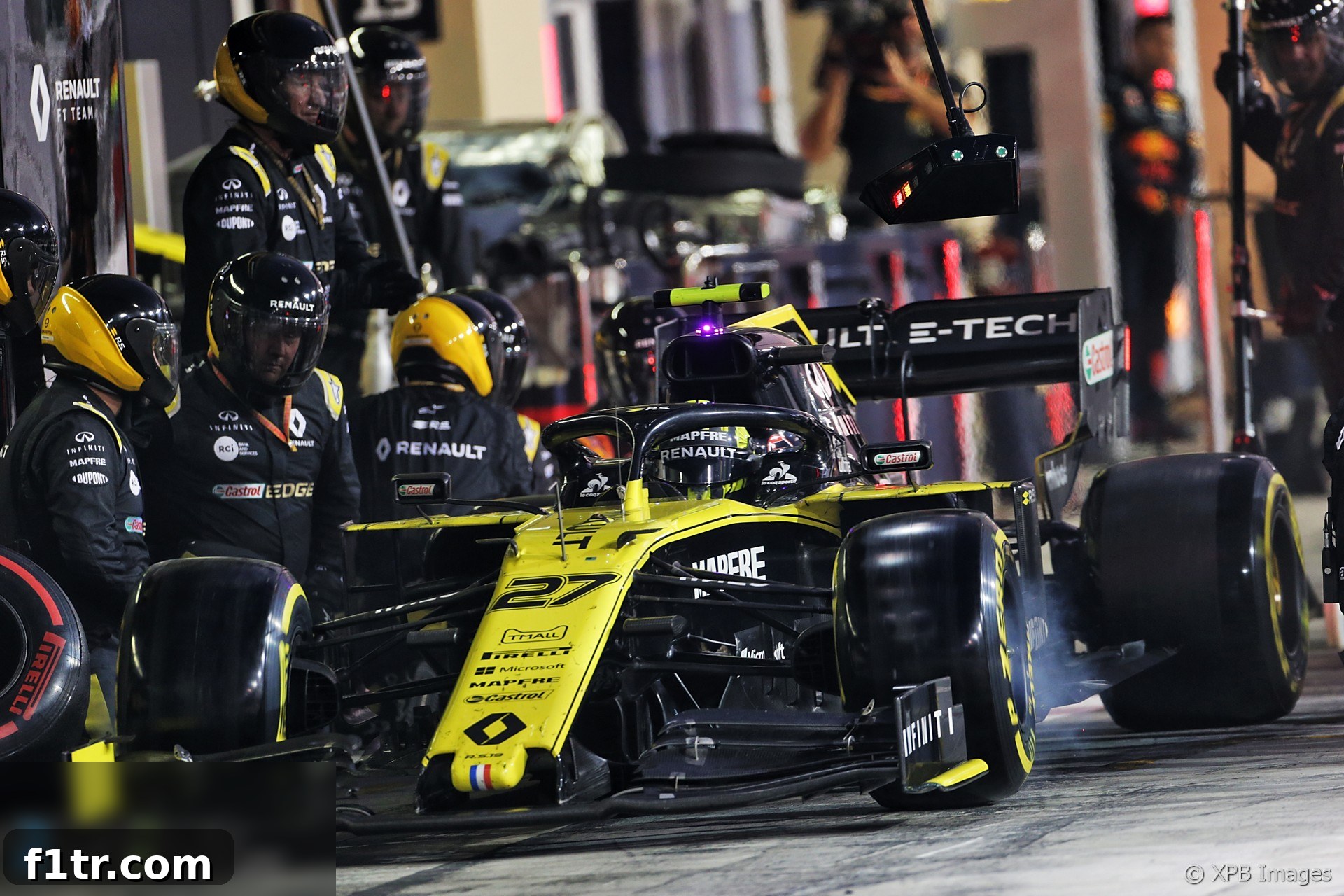
Nico Hulkenberg, a veteran of over 200 Formula 1 starts, found himself at a crossroads during the 2019 Abu Dhabi Grand Prix. This race, widely believed to be his final appearance in the sport, was a poignant moment for the German driver. He felt strongly that a significant points finish, a fitting end to a long career, was within his grasp, had it not been for an ill-timed incident involving Valtteri Bottas. Hulkenberg, known for his consistent performances and often unlucky breaks, was chasing a strong result, showcasing his enduring talent amidst the uncertainty of his future in the sport.
Advert | Become a Supporter & go ad-free
A Strategic Gamble at Yas Marina
The Yas Marina Circuit, renowned for its challenging layout and strategic complexity, was the backdrop for Hulkenberg’s intense battle. Driving for Renault, a team that had endured a somewhat inconsistent 2019 season, Hulkenberg was keen to maximize every opportunity. His strategy was a bold one: a lengthy first stint on the softer compound tyres, aiming to build a substantial enough gap to rival Lando Norris of McLaren. The objective was to emerge ahead of Norris after his single planned pit stop, placing him in clean air and a prime position to score valuable championship points.
This ‘long first stint’ approach is a high-stakes play in Formula 1. It relies on the driver’s ability to manage tyre degradation meticulously while maintaining competitive lap times. If executed perfectly, it can allow a driver to leapfrog competitors who pit earlier, capitalizing on their fresh rubber while maintaining a strong track position later in the race. For Hulkenberg, this strategy was not just about performance; it was about pride and a final statement in what many considered to be his last dance in F1.
The Bottas Conundrum: A Costly Overtake
However, the meticulously crafted plan encountered an unforeseen obstacle in the form of Valtteri Bottas. The Mercedes driver, who started from the back of the grid due to engine penalties, was on a relentless charge through the field. While Bottas’s recovery drive was impressive, it inadvertently disrupted Hulkenberg’s race. As Bottas caught and overtook Hulkenberg, the Renault driver lost precious time – a critical two seconds that ultimately proved decisive.
“It could have been really good actually,” reflected Hulkenberg after the race, still grappling with the ‘what if’ scenario. “If it hadn’t been for Bottas who kind of overtook me too early, that made me lose two seconds. That’s where the two seconds that I missed to get ahead of Lando after my stop went.”
These two seconds were not merely a minor inconvenience; they were the difference between strategic success and falling short. The timing of Bottas’s overtake, while a standard racing maneuver, shattered Hulkenberg’s carefully calculated window. Upon pitting, instead of emerging ahead of Norris in clear air, Hulkenberg found himself behind the McLaren. This placed him immediately into the detrimental ‘dirty air’ of Norris’s car, a phenomenon where turbulent air off a leading car severely compromises the aerodynamic performance and tyre life of the following car.
The Gripping Battle for Track Position and Tyre Degradation
Being stuck behind Norris had a cascading negative effect on Hulkenberg’s race. In Formula 1, track position is paramount, and the ability to run in clean air allows drivers to extract maximum performance from their car and manage tyre wear effectively. Trapped in Norris’s wake, Hulkenberg’s tyres began to degrade at an accelerated rate. The constant turbulence and lack of optimal airflow meant his car struggled for grip and aerodynamic efficiency, forcing him to push harder on his tyres just to keep pace.
“If I would have had that position and clean air, I could have pulled off a great strategy there on soft [and] medium. Going long on the soft would have really paid off. But unfortunately that wasn’t possible,” Hulkenberg lamented. “Then I was 40 laps in his dirty air and that just eats tyres. The pace was very high.” This admission highlights the brutal reality of modern F1 racing, where even a slight strategic misstep or external interference can unravel an entire race plan. The inability to manage tyre degradation effectively in dirty air meant Hulkenberg was fighting an uphill battle, losing vital pace as the race wore on.
Advert | Become a RaceFans supporter andgo ad-free
The Dramatic Final Lap Showdown
The pressures on Hulkenberg intensified as the race neared its conclusion. With heavily degraded tyres and competitors pushing relentlessly from behind, his hold on a points-scoring position became increasingly tenuous. The final lap, in particular, proved to be a nail-biting spectacle that encapsulated the raw intensity of Formula 1. He found himself under immense pressure from two determined rivals: Carlos Sainz Jnr of McLaren and his former Renault teammate, Daniel Ricciardo.
“Carlos and Daniel were pushing on from behind so there was no time to rest and save tyres so it was quite intense. And at the end we just paid the price. The tyres degraded. And at the end unfortunate I couldn’t hang on to that P10,” he recounted. The dwindling grip from his worn tyres made defending an almost impossible task against drivers on fresher or better-preserved rubber.
The climax arrived at Turn 11, a crucial corner at Yas Marina, where Sainz made his move. “Carlos passed Hulkenberg on the inside at turn 11,” Hulkenberg described. Attempting a desperate counter-attack, Hulkenberg pushed his car to the absolute limit. “I tried to come back on him but I cut [turn] 13 quite aggressively and I almost spun because I hit that kerb very hard and I almost lost the car. And that’s where Daniel slipped through.” This overcorrection, a testament to his fighting spirit but also his compromised car, allowed Ricciardo to seize the opportunity and also pass him, dropping Hulkenberg out of the points altogether in the dying moments of the race.
Reflections on a Career and the Cruelty of F1
The disappointment was palpable for Hulkenberg. Missing out on points by such a narrow margin, and due to circumstances largely beyond his control, was a bitter pill to swallow. His reflections after the race highlighted the cruel nature of Formula 1, where fortunes can turn on a single moment or an external factor. “Had it not been for Bottas, had he started without the back of the grid [penalty], I would have probably got ahead of Lando and I would be here now with six points. But that’s just racing, that’s life,” he philosophized.
This race perfectly encapsulated much of Nico Hulkenberg’s career: immense talent, strong performances, often overshadowed by a string of unfortunate events or strategic misfires that prevented him from achieving a coveted Formula 1 podium finish. Despite his reputation as one of the most capable drivers in the midfield, a combination of team circumstances and racing incidents consistently conspired against him.
The 2019 season itself had been a challenging one for Renault, as they battled for supremacy in the highly competitive midfield. Every point was hard-fought, and Hulkenberg’s consistent efforts were vital for the team’s championship standing. His aggressive strategy in Abu Dhabi was a final testament to his determination to deliver for his team, even when his own future in the sport was uncertain.
While the Abu Dhabi Grand Prix of 2019 marked what many believed was his final bow in F1, Nico Hulkenberg’s story didn’t end there. He would later make a remarkable return to the grid, proving his resilience and continued passion for the sport. However, the memory of that almost-perfect strategy, thwarted by a twist of fate involving Bottas, remains a poignant chapter in the career of one of Formula 1’s most respected and enduring talents.
Advert | Become a RaceFans supporter andgo ad-free
Related articles from the 2019 F1 season:
- Crying in the Melbourne car park at 2019 grand prix was my career low – Ocon
- McLaren Racing reports reduced £71 million loss in 2019
- Kvyat: Hockenheim podium last year was “my biggest achievement” so far
- How the FIA’s new encrypted fuel flow meter targets Ferrari’s suspected ‘aliasing’ trick
- “He smashed my office door”: 23 must-see moments from ‘Drive to Survive’ season two
Browse all 2019 F1 season articles