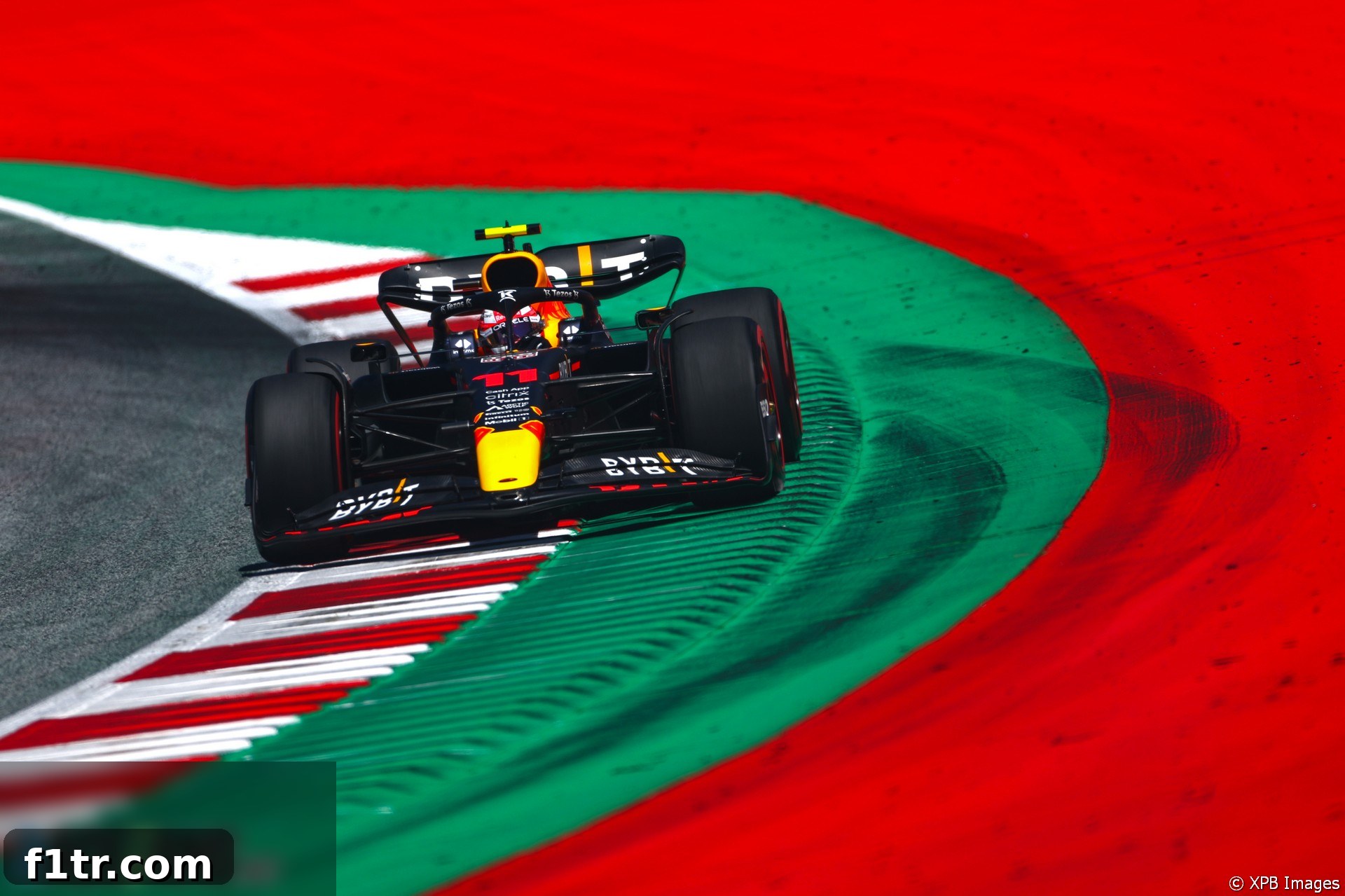
Sergio Perez faced a significant setback at the Austrian Grand Prix sprint race, as he was slated to start from 13th on the grid. This drastic change came after race stewards deleted all of his lap times from Q3 and his fastest lap from Q2, following a crucial track limits infringement. The incident sparked considerable debate and highlighted the strict enforcement of Formula 1 regulations, particularly concerning track boundaries during the high-stakes qualifying sessions.
Sergio Perez Penalized for Track Limits Infringement at Austrian GP Qualifying
The Red Bull Racing driver, Sergio Perez, found himself in hot water after being found in violation of track limits at Turn 8 during his final flying lap in Q2. This particular corner at the Red Bull Ring has historically been a challenging spot for drivers, often leading to infringements. While other drivers who committed similar violations during the session also had their lap times deleted, Perez’s situation evolved into a more complex scenario due to the timing of the stewards’ discovery.
Normally, such infringements are identified and penalized almost immediately, with the affected lap time being deleted before a driver can progress to the next qualifying segment. However, in Perez’s case, his violation was not noticed by the race stewards until after he had already begun to participate in Q3. This delay set the stage for an unusual and far-reaching decision by the stewards, who ultimately determined that all of his Q3 lap times, along with the offending Q2 lap time, had to be erased.
Originally, Perez had put in a strong performance, qualifying in an impressive fourth position on the grid. However, with the subsequent deletion of his critical lap times, his starting position for Saturday’s sprint race plummeted to 13th. This dramatic shift not only impacted Perez’s immediate race prospects but also ignited discussions across the paddock about the consistency and real-time monitoring of track limits in Formula 1.
The Stewards’ Stance: A Delayed Discovery, a Firm Consequence
The race stewards provided a detailed explanation for their decision, noting, “Perez left the track at turn eight on his last flying lap of Q2, just prior to the end of the session.” They further clarified the unusual circumstances: “As this was not identified until the moment before Q3 started, the lap was not deleted prior to the start of Q3 and Perez started Q3.” This statement underscored the procedural challenge they faced, acknowledging the delay in identifying the infringement.
The stewards also highlighted the sheer volume of incidents they must scrutinize during each session, contributing to such delays. They recorded a total of 16 track limits infringements at four different corners throughout the qualifying session, excluding Perez’s. This statistic alone illustrates the intense scrutiny and the fine margins within which Formula 1 drivers operate, where even a slight deviation from the white lines can have severe repercussions.
Red Bull’s Argument and the Principle of “Leaving the Track Without Justifiable Reason”
Red Bull Racing presented an argument in defense of their driver, contending that Perez had not gained a clear and lasting advantage by cutting the inside of Turn 8. They supported their claim with data, aiming to demonstrate that the slight excursion beyond the track limits did not significantly improve his lap time or race performance. This argument often forms the basis of appeals against track limits penalties, as drivers and teams seek to differentiate between a minor error and a deliberate attempt to gain an unfair edge.
However, the stewards firmly ruled that Red Bull’s argument, while acknowledged, was not sufficient grounds to waive the penalty. “The video was clear and there is no doubt of the breach, which the team admitted,” the stewards stated, leaving no room for ambiguity regarding the physical violation. They further elaborated on the specific rule being applied: “The team made the point that leaving the track at this point is not a clear advantage and brought data to support that point.”
Crucially, the stewards clarified the distinction within the regulations. They emphasized that this particular incident was not assessed under the provision of “gaining a lasting advantage.” Instead, it fell under the broader category of “leaving the track without a justifiable reason,” which is a distinct and equally enforceable part of the same rule, particularly relevant to qualifying sessions where the objective is to set the fastest legitimate lap. This interpretation highlights the zero-tolerance policy for track limit violations, irrespective of whether a perceived advantage was gained.
Setting a New Precedent: Fairness to All Competitors
The unique aspect of Perez’s situation – a driver progressing to a subsequent round of qualifying only to have an earlier infringement identified – prompted the stewards to declare that they had to “examine this as a new situation.” Such circumstances, where a track limits breach is discovered after a driver has already participated in the next qualifying segment, are indeed rare in recent Formula 1 history. This incident, therefore, serves as a significant precedent for how similar situations might be handled in the future.
Red Bull also raised a valid point concerning the resources expended, noting that they “took both risk and expended resources to compete in Q3.” The team highlighted the financial and logistical efforts involved in preparing and running a car in Q3, suggesting that these efforts were effectively nullified by a belated penalty. The stewards acknowledged this perspective, stating, “The stewards accept this point.”
Despite this acknowledgment, the overarching principle of fair play and consistency ultimately guided their decision. The stewards maintained that “in assessing a penalty after a session, this is no different than any other situation.” The standard penalty for a track limits violation in qualifying is the deletion of the lap time concerned. However, in this unique case, simply deleting the infringing Q2 lap was insufficient, as it would not accurately reflect the fact that Perez should not have advanced to Q3 in the first place.
Therefore, to ensure fairness to all other competitors who adhered strictly to the rules and did not progress if they had similar infringements, the stewards determined that “all the lap times for Q3 for the driver also are deleted.” This comprehensive deletion of lap times from Q3, combined with the removal of his fastest Q2 lap of 1’05.805, left Perez with his next best legitimate Q2 time of 1’06.458. This time was then used to determine his final grid position of 13th for the sprint race.
Implications and the Broader Track Limits Debate in F1
The penalty for Sergio Perez at the Austrian Grand Prix served as a stark reminder of the rigorous standards and intricate regulations governing Formula 1. Dropping from a promising fourth place to 13th for the sprint race significantly altered his prospects for the weekend, forcing him to fight through the field on a circuit known for its challenging overtaking opportunities. This incident had immediate implications for Red Bull Racing’s strategy and Perez’s championship aspirations, adding another layer of complexity to an already intense season.
Beyond the immediate consequences for Perez, this event reignited the broader debate surrounding track limits in Formula 1. Critics and fans often express frustration over the perceived inconsistencies in enforcement or the delays in identifying infringements. However, the stewards’ detailed explanation in this instance underscored the immense pressure they face, managing a multitude of rules and incidents in real-time. The use of advanced technology and video evidence is crucial, yet human judgment and the sheer volume of data still present challenges.
The Austrian Grand Prix qualifying incident underscores the critical importance of precision driving at the pinnacle of motorsport. Every millimeter counts, and adherence to the white lines is not merely a suggestion but a strict mandate, with severe consequences for even the slightest transgression. The stewards’ decision, while tough on Perez and Red Bull, firmly upheld the principle of equitable competition, ensuring that all drivers operate under the same clear and consistently applied rules.
This episode is likely to be referenced in future discussions about F1 regulations, particularly concerning real-time monitoring technology and the procedural flow of qualifying sessions. It reinforces the notion that in Formula 1, the smallest errors can lead to the biggest penalties, forever shaping the narrative of a Grand Prix weekend and, potentially, the championship outcome.
2022 Austrian Grand Prix Related Articles
- FIA affirms three sprint races on 2023 Formula 1 calendar
- “Oh, so unlucky!” How Alonso’s cursed Austrian Grand Prix unfolded on his radio
- Ferrari believe their performance deficit to Red Bull is now “negligible”
- Another fan’s experience of harassment last weekend – and why F1 must act
- AlphaTauri “desperately” need upgrades after “disaster” weekend, urges Gasly
Browse all 2022 Austrian Grand Prix articles