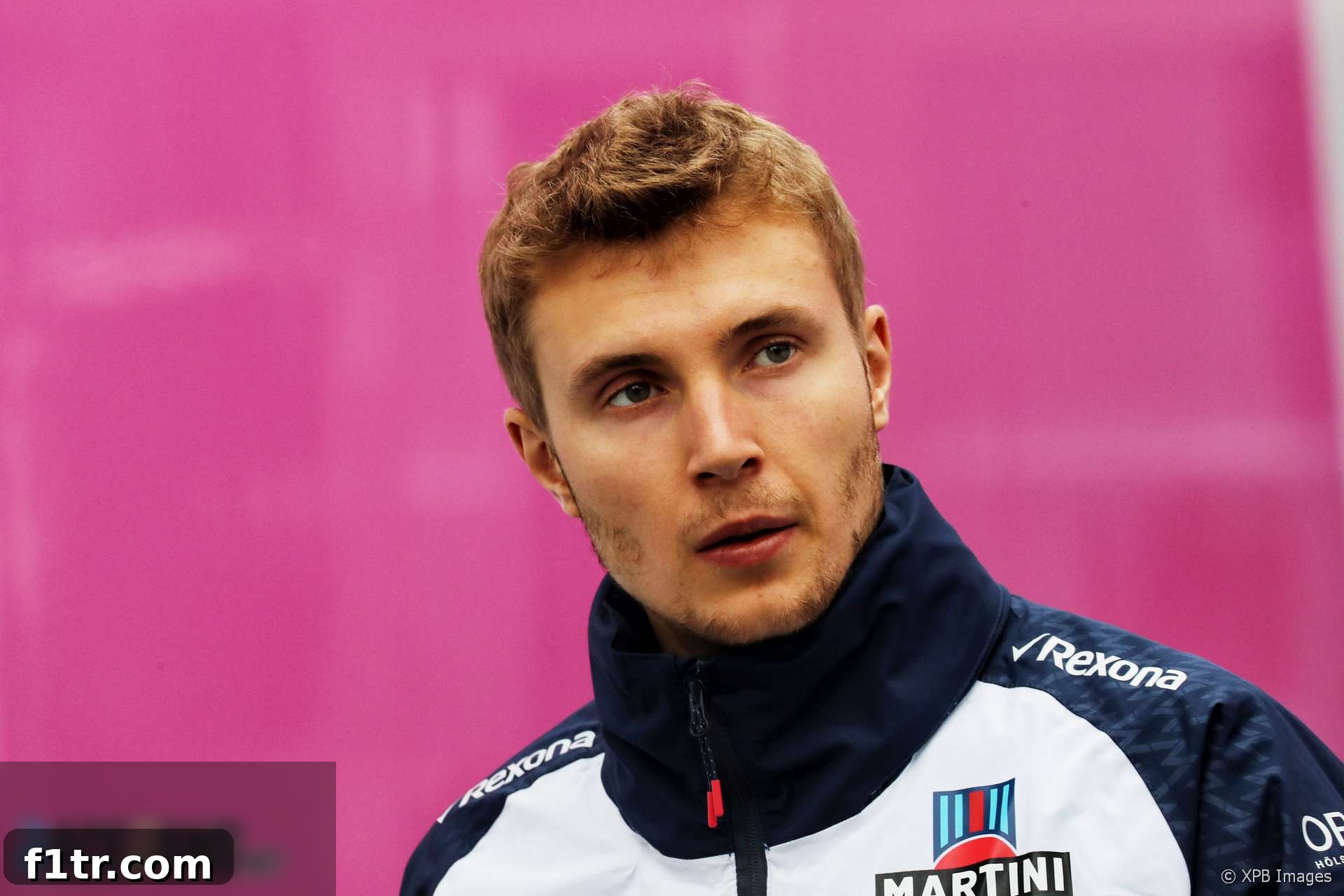
In the latest Formula 1 news roundup, we delve into significant developments from the world of motorsport, starting with candid reflections from Williams Racing. Paddy Lowe, then Chief Technical Officer at Williams, expressed his sincere regret regarding the team’s decision not to retain Sergey Sirotkin for the highly anticipated 2019 F1 season. This change marked a pivotal moment for the historic British outfit as they prepared to introduce a completely new driver lineup.
Williams’ Perspective on Driver Changes
The decision surrounding Sergey Sirotkin’s future at Williams was undoubtedly a difficult one, especially given the young Russian driver’s dedicated efforts during his rookie year. Despite the challenging circumstances faced by the team, Sirotkin consistently demonstrated a professional attitude and a strong commitment to his role. RaceFans had the opportunity to ask Paddy Lowe about this transition, where he offered insightful comments into the rationale behind the team’s choices:
“It’s crucial to remember that this was Sergey’s rookie year in Formula 1, and throughout it, he proved to be an exceptional team player right from the start. His support for his colleagues, both within his immediate engineering team and the broader Williams family, was unwavering. He is an incredibly hard worker, demonstrating immense dedication to his personal development—be it through rigorous training or adherence to the demanding programme required of a Formula 1 driver. It’s genuinely a shame that Formula 1 regulations limit us to only two drivers on the grid.”
“We have, however, finalized our driver lineup for the upcoming season, and I genuinely believe it’s a fantastic combination. We are incredibly excited to welcome George Russell, the reigning Formula 2 champion, into our team. His championship victory was a truly fantastic achievement, and having the F2 champion join us speaks volumes about his talent. Complementing George, we have the legendary Robert Kubica, whose story and determination are known throughout the motorsport world. We are very enthusiastic about this pairing and the potential it brings. Nevertheless, this excitement doesn’t diminish our feeling that it’s a genuine pity we won’t be continuing with Sergey for 2019.”
Lowe’s remarks highlight the complexities of Formula 1 team management, where strategic decisions about driver lineups must balance existing talent, future potential, and the harsh realities of a competitive sport. Sirotkin’s commitment in a difficult car was commendable, but the lure of a proven F2 champion and a returning legend proved irresistible for Williams looking to rebuild.
Quotes courtesy of: Dieter Rencken
Advert | Become a RaceFans supporter andgo ad-free
Engaging with the F1 Community: Social Media Highlights
Social media continues to be a vibrant hub for Formula 1 fans and professionals alike, offering real-time updates, insightful commentary, and a direct connection to the sport. Here, we present notable posts from Twitter, Instagram, and other platforms that captured the attention of the F1 community:
5. Writers (F1). @SportmphMark columns for @Motor_Sport are essential reading, as are those by @ScottAutosport at Autosport, who’s done a mega job in year 1 in F1. @RacingLines brilliantly continues to write the political stuff few others touch, now for @racefansdotnet.
— Jamie O’Leary (@mrjamieoleary) December 30, 2018
Beyond specific embeds, platforms like Twitter are also crucial for sharing official announcements and engaging with a wider audience. For instance, the official F1 account often provides significant updates and behind-the-scenes content:
https://twitter.com/F1/status/1079342585959768064
- For those looking to expand their F1 social media feed, explore more official accounts and key figures in the sport through our comprehensive F1 Twitter Directory.
Further Reading and Key Motorsport Links
Stay informed with a curated selection of intriguing articles and discussions from across the motorsport landscape. These links offer deeper insights into driver perspectives, technical advancements, and broader industry challenges:
Advert | Become a Supporter & go ad-free
Ricciardo Reflects on the F1 Driver Market’s Intricacies (ESPN)
Daniel Ricciardo, a driver known for his candid personality and broad smile, opened up about the often-stressful and confusing nature of the Formula 1 driver market. His reflections highlight the intense pressure and strategic games involved when a top driver is seeking a new seat. “I guess on one hand I had teams that really wanted me, and then on the other there were teams that were kind of half the foot in the door but not really… so Mercedes and that. At times it was confusing for sure, and obviously you’re trying to figure out what is real and what isn’t, who’s genuine and who is not.” Ricciardo’s experience underscores the opaque dealings and political maneuvering that often take place behind the scenes, making career decisions for drivers incredibly complex and emotionally taxing.
Honda’s Remarkable Reliability Turnaround in 2018 (Autosport)
After years of widely documented struggles with their hybrid power units, particularly during their ill-fated partnership with McLaren, Honda achieved a significant milestone in 2018. The Japanese manufacturer demonstrated vastly improved reliability, a crucial step in their renewed commitment to Formula 1 with Toro Rosso. An Autosport report quoted a key figure stating, “We are comfortable with the reliability of the unit. It was completely different from previous years.” This turnaround was not just a technical triumph but also a psychological boost, paving the way for their subsequent partnership with Red Bull Racing, promising a more competitive future for the engine supplier in the pinnacle of motorsport.
Carlos Ghosn’s Daughters Pinpoint a Nissan Revolt Behind His Arrest (The New York Times)
The dramatic arrest of Carlos Ghosn, the former chairman of the Renault-Nissan-Mitsubishi alliance, sent shockwaves through the global automotive industry. His daughters offered a powerful, alternative narrative to the official charges of financial misconduct, suggesting that Ghosn was a victim of a corporate power struggle. Caroline Ghosn was quoted saying, “‘Wow,’ Caroline Ghosn said. ‘He didn’t even waste a breath. He didn’t even try to cover up the fact that the merger had something to do with this.'” This perspective implies that Ghosn’s efforts to further integrate the alliance, potentially leading to a full merger, may have been met with resistance from within Nissan, ultimately leading to his downfall. The case highlighted the complex interplay of corporate governance, national interests, and individual power within multinational conglomerates.
Reflecting on the Michael Schumacher Ski Crash: A Journalist’s Perspective (Sky Sports)
The tragic ski accident involving Formula 1 legend Michael Schumacher in late 2013 captivated the world and unleashed an unprecedented media frenzy. A Sky Sports article reflects on the intense week of reporting from Grenoble, where journalists grappled with the severity of Schumacher’s injuries and the immense public interest. The piece recalls how “The hospital allowed selected media to speak off-camera with members of the medical team who had actually operated on Schumacher. It was a guidance briefing, but it felt obvious what the key question now was. Could Michael Schumacher ever fully recover? Most of the surgeons were reluctant to speculate but one told me given the nature of his injuries it was hard to see that there would not be severe, long-lasting and indeed perhaps permanent consequences.” This poignant reflection underscores the human fragility even of sporting heroes and the ethical challenges journalists face when covering such deeply personal tragedies.
We always endeavour to credit original sources and provide accurate information. If you come across a compelling article or have a tip for a link to feature in an upcoming RaceFans round-up, please don’t hesitate to send it in here:
- Contact RaceFans with your suggestions
Advert | Become a RaceFans supporter andgo ad-free
Debating Performance: The ‘Fastest’ vs. ‘Faster’ Car for a Champion
A recurring debate in Formula 1 centers on the interplay between driver skill and car performance. How much does the machinery dictate success, and how much can a truly exceptional driver overcome its limitations? Today’s comment delves into this very topic, using Sebastian Vettel as a prime example, pondering whether a champion needs the absolute ‘fastest’ car or merely a ‘faster’ one to return to winning ways.
“When Vettel expressed his need for more speed from his cars, I don’t interpret that as him demanding a vehicle that was unequivocally the fastest on the grid. Rather, I see it as a request for sufficient additional speed to achieve greater competitiveness. This would, in turn, reduce the necessity for him to take excessive risks in an attempt to compensate for any inherent speed deficit.”
“In other words, while we all revel in witnessing a driver push an ostensibly slower car to victory through seemingly superhuman driving skills, we should temper our expectations. It’s unfair to blame Vettel if he simply cannot consistently conjure that level of extraordinary skill throughout an entire grueling season. The margins in F1 are incredibly fine, and even the most gifted drivers require a car that at least allows them to contend for victory without constantly operating at the absolute razor’s edge of what’s mechanically possible.”
Chuck Lantz (@Chuckl8)
Chuck Lantz’s insightful comment touches upon a crucial nuance in F1 strategy and driver psychology. The difference between a ‘fastest’ car—one that dominates the field—and a ‘faster’ car—one that is competitive enough to fight at the front—is profound. A driver in the fastest car can often afford to be less aggressive, relying on the car’s inherent pace. Conversely, a driver with a ‘faster’ car needs to extract every last tenth, often pushing the limits of both car and driver, which inevitably introduces higher risks and more opportunities for error over a long season. This discussion highlights the delicate balance between engineering excellence and raw driving talent required to conquer the pinnacle of motorsport.
Celebrations: Happy Birthday to Our Community Members!
We love celebrating our dedicated readers! A very Happy Birthday goes out to Alvink and Bryce Metzger today. We hope you both have a fantastic day filled with joy and perhaps some F1 excitement!
If you’d like to receive a special birthday shout-out in our round-up, simply let us know when your birthday is via our contact form, or by adding your details to our community list here. We’re always thrilled to share in your special day.
Motorsport History: On This Day in F1 and Beyond
Delving into the annals of motorsport history, we mark significant events and notable figures who have left an indelible mark on the sport:
- Born on this day in 1974: Tony Kanaan, a revered figure in open-wheel racing, celebrated for his triumphs, including the prestigious 2013 Indianapolis 500 victory and the 2004 IndyCar Series championship. His enduring career and charismatic presence have made him a fan favorite across the globe.
Reflecting on these moments reminds us of the rich tapestry of talent and thrilling competition that defines the world of motorsport, both in Formula 1 and other iconic racing series.