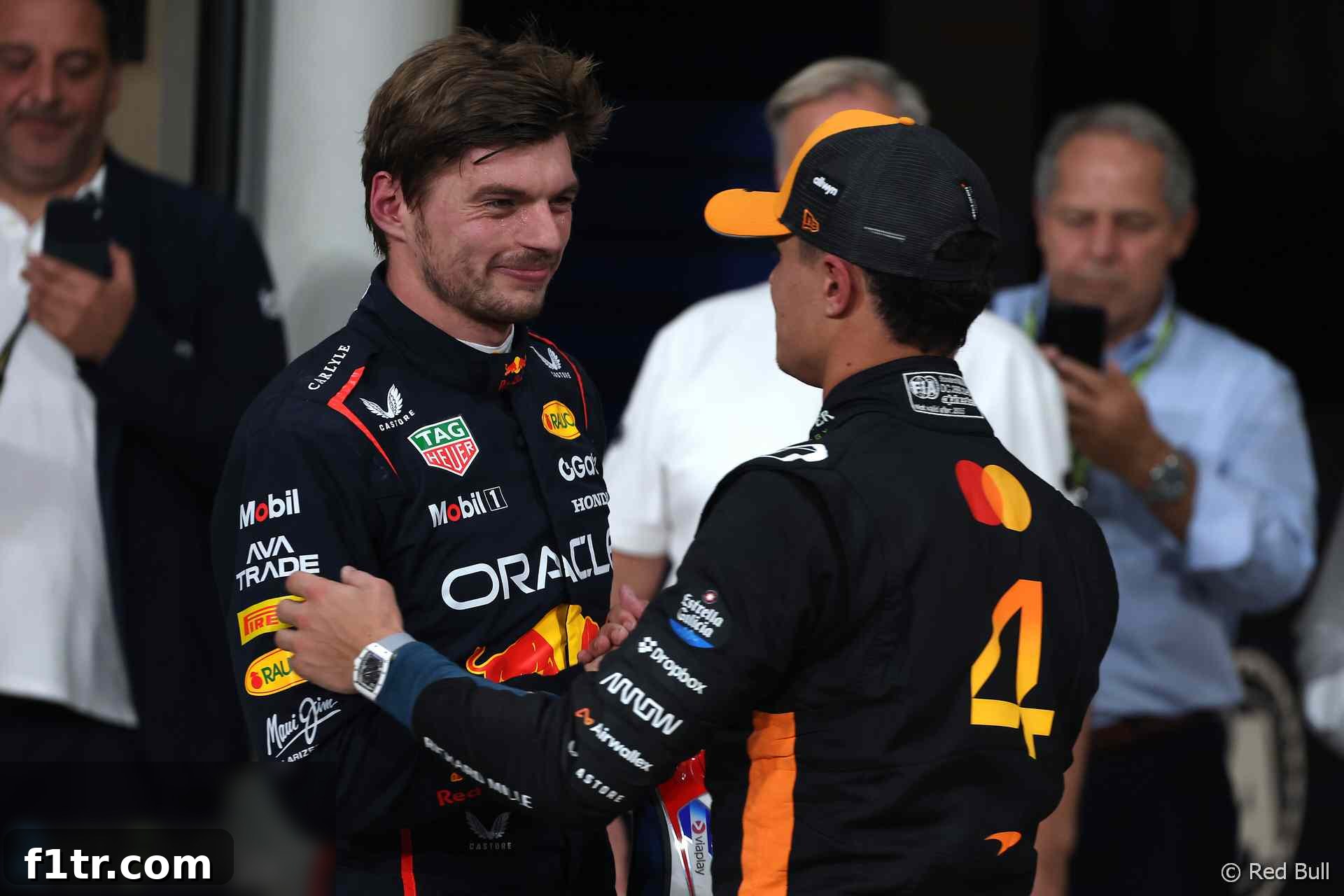
Max Verstappen acknowledges a bold strategy could be on the table to secure the Formula 1 world championship at the upcoming Abu Dhabi Grand Prix. The Red Bull star has openly discussed the controversial possibility of deliberately slowing his rival Lando Norris, a tactic famously attempted by Lewis Hamilton in the 2016 season finale. As the championship heads to its thrilling conclusion, all eyes are on the Yas Marina Circuit and the high-stakes battle between Verstappen and Norris.
Max Verstappen Considers Tactical Slowdown Against Norris in Abu Dhabi F1 Title Decider
The Shadow of 2016: Hamilton’s Controversial Tactics Against Rosberg
The echoes of the 2016 Abu Dhabi Grand Prix finale resonate strongly as Verstappen weighs his options for the impending championship decider. Nine years ago, Mercedes teammates Lewis Hamilton and Nico Rosberg arrived at the very same circuit locked in a fierce battle for the drivers’ title. Hamilton, who needed Rosberg to finish lower than second while he himself won the race, strategically attempted to slow the pace at the front of the field. His objective was to compress the pack, bringing other faster cars into play behind Rosberg, with the hope that they would overtake his teammate and cost him crucial championship points.
Hamilton’s audacious move saw him drive deliberately below his car’s maximum potential, creating a tight train of vehicles behind him. Rosberg, fully aware of the tactic, found himself under immense pressure from cars like Sebastian Vettel’s Ferrari and Verstappen’s Red Bull. While Hamilton’s strategy was highly controversial and sparked widespread debate about sporting ethics and the role of team orders, it ultimately proved unsuccessful in preventing Rosberg from securing the championship. Rosberg steadfastly maintained his position, crossing the line in second place behind Hamilton, thereby clinching his maiden and only Formula 1 title. Verstappen, then a promising young driver on the grid, was among those caught in the tightly packed Mercedes sandwich, ultimately unable to make a decisive move against Rosberg and being passed by Vettel before the race concluded.
Verstappen’s Championship Scenario: Win and Hope for Norris’s Placement
For Max Verstappen, the path to the championship is clear-cut yet fraught with challenges. He must win tomorrow’s race, and critically, Lando Norris must finish no higher than fourth position. Starting from pole position, just one place ahead of Norris, Verstappen holds the crucial initial advantage. However, the complexities of race strategy, tire management, and the ever-present threat of his determined rival mean nothing is guaranteed until the chequered flag waves.
A victory for Verstappen coupled with Norris finishing fifth or lower would undeniably crown the Dutchman champion. Should Norris finish third, Verstappen would need to win and also secure the fastest lap point to clinch the title, assuming a specific points scenario that puts him just ahead. The simplest, and arguably most direct, route for Verstappen is to win the race and rely on external factors or Norris’s own race performance to keep him outside the top three. This high-pressure scenario places a premium not just on raw speed, but also on cunning race craft, meticulous strategy, and potentially, psychological warfare, as both drivers vie for the sport’s highest honor.
Evolving Dynamics: Why 2016 Tactics are Harder in Today’s F1
Despite acknowledging the historical precedent and the allure of Hamilton’s 2016 tactics, Verstappen believes that emulating such a move now would be significantly more challenging. He points to fundamental changes in both the Yas Marina circuit layout and the characteristics of modern Formula 1 cars. “It was a different layout,” Verstappen stated, reflecting on the 2016 race. “I feel like now you get towed around a lot more around the lap, so it’s probably not as easy to do something like that.”
The Transformed Yas Marina Circuit: Faster and More Open
The Yas Marina circuit underwent extensive revisions in 2021, dramatically altering its flow and racing dynamics. Several slow, technical corners were replaced with quicker, simpler bends specifically designed to improve overtaking opportunities and promote closer racing. For instance, the removal of the chicanes at Turns 5-6 and the slow Turns 11-14 section, replaced by a long, sweeping Turn 9, created longer straights and more high-speed sections. These changes inherently increase the “tow” or slipstream effect, making it considerably harder for a leading car to intentionally slow down without immediately being vulnerable to an overtake. The increased speed and reduced technicality in certain sectors mean that backing up the entire pack is less effective, as trailing cars can more easily maintain speed and position themselves for an attack.
Modern F1 Cars: Wider, Draggy, and More Durable Tyres
Beyond the circuit modifications, the evolution of Formula 1 cars themselves presents another significant barrier to repeating 2016-style tactics. The current generation of F1 cars, particularly those since the 2022 regulations overhaul, are “completely different to back then,” as Verstappen explained. These cars are wider, produce considerably more aerodynamic drag, and crucially, operate with more durable Pirelli tyres. The 2016 cars were known for their highly sensitive tyres, which overheated quickly when closely following another car. This characteristic made it easier for a leader to slow the pace, as the cars behind would struggle more with tire temperature and grip when forced to run in turbulent air, making them less effective at attacking.
“I felt like it was a lot easier back then to back it up because the tyres would overheat a lot when you would get close,” Verstappen recalled. “I remember in 2016, even in some qualifying laps you couldn’t go flat-out in sector one [in order] to keep the tyres alive in the last sector – [such as] here, for example.” This stark contrast in tire degradation and thermal management means that intentionally slowing the field now might not have the same detrimental effect on the following cars’ tyres, potentially allowing them to stay closer and more aggressively attack. While the wider cars do create more “dirty air” which can make following difficult, the increased straight-line speed facilitated by the circuit changes might mitigate this effect when the overall pace is deliberately reduced.
Verstappen’s “All Out” Mentality: A Champion’s Resolve
Despite the inherent difficulties in replicating the 2016 tactics, Verstappen’s mindset remains unwavering: he is prepared to go “all out” to clinch the title. His declaration of having “nothing to lose” underscores a fierce determination to win, whatever it takes within the bounds of the rules. “So for me, of course, I’m going to try to win the race,” he affirmed. “I’m going to defend, if I need to attack, I’ll attack, because what can happen? You’re either second or third – or you win. That would be fantastic.”
This aggressive stance suggests Verstappen will exploit every single opportunity to gain an advantage. His starting position on pole gives him the strategic initiative, allowing him to dictate the early pace. Whether this involves a blistering start to pull away from the pack, or a more controlled, tactical approach to manage Norris and the cars behind him, remains to be seen. His statement about “defending” and “attacking” implies a fluid and adaptive race strategy, one that will evolve and react to the unfolding events and Norris’s performance throughout the Grand Prix. The high stakes of the championship mean that even marginal gains, or unexpected strategic disruptions, could prove decisive in the final outcome.
The psychological aspect of such a critical race cannot be overstated. Verstappen’s inherent confidence, coupled with his well-known willingness to push the boundaries, could exert immense pressure on Norris. Every move, every pit stop decision, every moment of the race will be scrutinized under the global spotlight, and the mental fortitude of both drivers will be tested to its absolute limits.
Beyond the Slowdown: Broader Strategic Considerations for Race Day
While much of the focus has been on the dramatic tactic of slowing the field, the championship decider will involve a multitude of sophisticated strategic considerations. Tire strategy will be paramount. With multiple dry compounds available – soft, medium, and hard – choosing the optimal pit windows and tire allocations can make or break a race. Red Bull and McLaren’s strategists will be working overtime, running countless simulations to predict various race scenarios, considering the likelihood of safety cars, potential penalties, and the inherently unpredictable nature of Formula 1. An early pit stop for an aggressive undercut, or a longer first stint to capitalize on fresher tires later in the race, could be crucial to gaining or maintaining track position.
Furthermore, the role of team orders, even if subtle, could play a significant part. While neither Red Bull nor McLaren might issue direct “slow down” orders, secondary drivers could be strategically utilized to assist their championship-contending teammates. For instance, a driver like Sergio Perez for Red Bull or Oscar Piastri for McLaren could be used to create roadblocks for the opposing team, or to provide a crucial tow on long straights to help their teammate gain an advantage. These nuanced tactics, while less overt than a deliberate slowdown, are equally important elements in the high-stakes chess match that defines a championship finale, adding layers of complexity to an already thrilling race.
The Thrilling Conclusion Awaits at Abu Dhabi
As the Formula 1 circus descends upon Abu Dhabi, the stage is impeccably set for a monumental championship showdown. Max Verstappen, starting from pole position, carries the hopes of securing another world title, but faces a formidable challenge from Lando Norris, who is equally determined to claim his maiden championship. Verstappen’s contemplation of controversial 2016-style tactics highlights the extreme pressures and lengths drivers are willing to go to claim motorsport’s ultimate prize. Yet, the evolving nature of the Yas Marina Circuit and the advanced design of modern F1 cars suggest that such a strategy would be far from straightforward, possibly even counterproductive.
Instead, the 2025 Abu Dhabi Grand Prix is likely to be an intense test of pure speed, unwavering determination, ingenious strategy, and impeccable execution. Verstappen’s declaration of an “all out” approach promises a thrilling spectacle, as he navigates the complex dance between defending his pole position and attacking for outright victory. This race is poised to deliver a memorable chapter in Formula 1 history, where champions are forged and legends are made, all under the dazzling lights of Yas Marina, culminating in a dramatic conclusion to the season.
Related Articles: 2025 Abu Dhabi Grand Prix
- McLaren’s Las Vegas disqualifications cost them record points score in 2025
- 2025 Abu Dhabi Grand Prix weekend F1 driver ratings
- Antonelli asked team how many points Verstappen lost title by after online abuse
- Norris vs Verstappen vs Piastri: Full radio transcript from their championship showdown
- Norris’s engineer told him Tsunoda’s move was “classic Red Bull s***housing”
Browse all 2025 Abu Dhabi Grand Prix articles