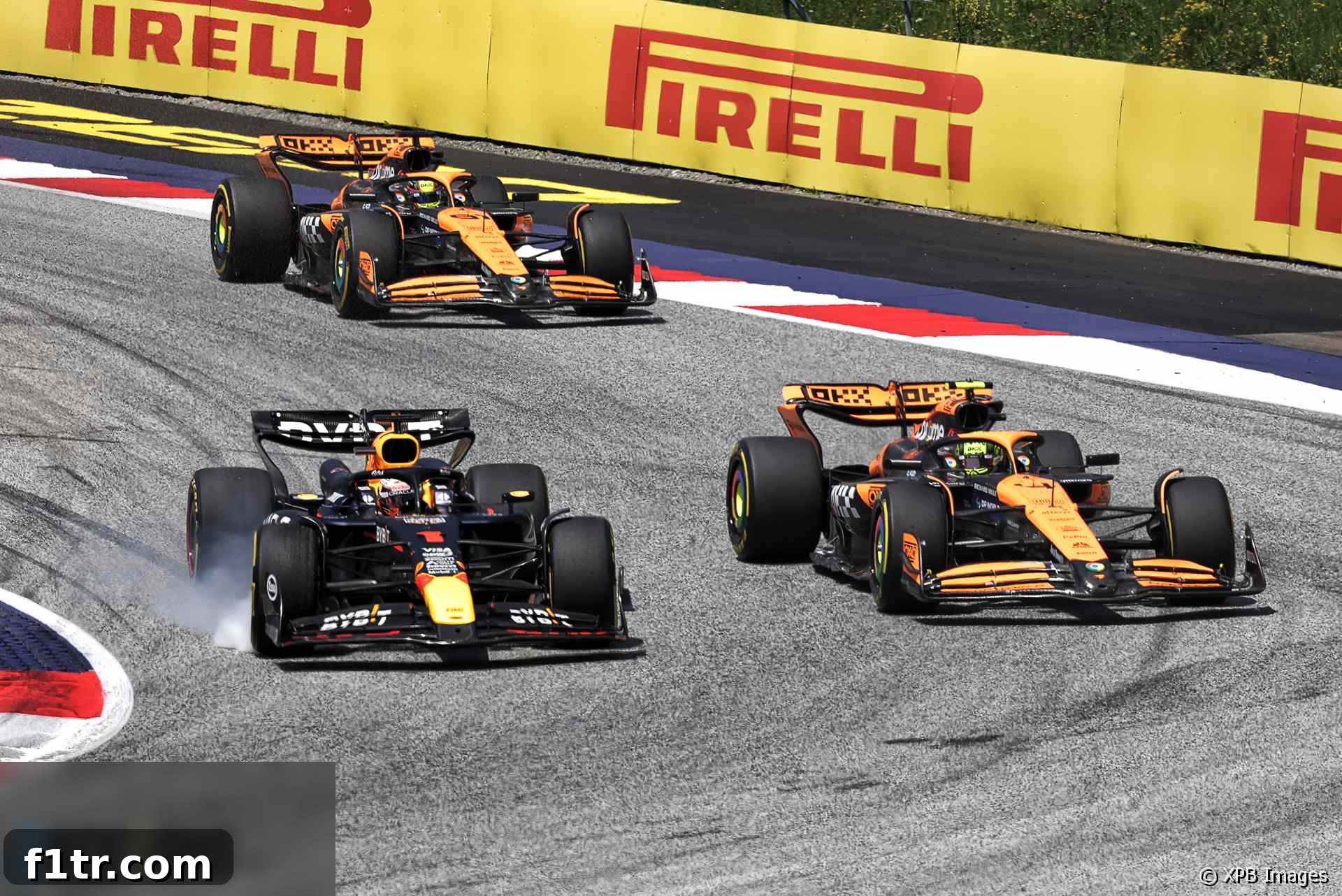
In the high-stakes environment of Formula 1, where every millisecond and every tactical decision can alter destiny, even the most seasoned drivers can fall prey to self-inflicted errors. This was a hard lesson learned by Lando Norris during the recent Red Bull Ring Sprint Race. The McLaren ace openly acknowledged and took full responsibility for a pivotal misjudgment that saw him lose a hard-earned lead to Max Verstappen, swiftly followed by relinquishing second place to his own teammate, Oscar Piastri. Norris’s raw and candid self-assessment highlighted the razor-thin margins at the pinnacle of motorsport and offered a poignant glimpse into the relentless pursuit of perfection that defines a top F1 competitor. The incident, unfolding dramatically on lap five, became a defining moment of the sprint, shaping not only the immediate outcome but also providing crucial insights and lessons for the upcoming main Grand Prix.
Advert | Become a Supporter & go ad-free
The Defining Lap: From Triumph to Tribulation in Mere Moments
The Red Bull Ring, renowned for its compact layout, elevation changes, and high-speed sections, consistently delivers exhilarating wheel-to-wheel action, and the sprint race format amplifies this excitement. Lando Norris, starting from a promising grid position, immediately showcased the formidable pace and improved capabilities of the McLaren MCL38. As the race progressed into its fifth lap, Norris, sensing a prime opportunity, executed a brave and impeccably timed maneuver. He dove down the inside of Max Verstappen at Turn 3, a bold move born of supreme skill and calculated aggression. For a glorious, albeit fleeting, moment, the young British driver found himself leading the pack, igniting fervent hopes among McLaren fans worldwide for a potential sprint victory. The roar from the grandstands was deafening as the vibrant orange car surged ahead of the reigning world champion’s dominant Red Bull.
However, the elation of leading was cruelly cut short, evaporating almost instantly on the subsequent long straight. Verstappen, leveraging the raw power and superior top-end speed of his Red Bull, coupled with the aerodynamic advantage of DRS (Drag Reduction System), rapidly closed the gap. As both cars hurtled towards Turn 4, Norris was faced with a split-second, critical decision: aggressively defend the inside line to retain his position, or concede the immediate battle to focus on the longer race ahead. Opting not to defend, a choice he would later deeply regret and critically analyze, proved to be profoundly costly. Verstappen, without hesitation, seized the opportunity, swiftly reclaiming the lead. But the consequences didn’t end there; Norris suffered a double blow as his McLaren teammate, Oscar Piastri, also capitalized on the situation. Sensing Norris’s compromised line and the momentum lost in the exchange, Piastri expertly swept past, demoting Norris further down to third place. This single, intense sequence of corners perfectly encapsulated the brutal, unforgiving nature of Formula 1, where a momentary lapse in judgment or a minor tactical misstep can dramatically alter a race’s trajectory and a driver’s fortunes.
Norris’s Candid Self-Assessment: Admitting the “Amateur” Error
In the aftermath of the race, Norris demonstrated remarkable honesty and a rare degree of self-criticism. He did not attempt to sugarcoat his error, explicitly describing his tactical misjudgment as having left the door open “like an amateur.” Such raw, unvarnished honesty from a driver operating at the pinnacle of global motorsport is not only refreshing but also deeply indicative of his unyielding desire for perfection and constant improvement. He elaborated on his rationale, explaining, “Like I saw at the end, once things settle into much… once the tyres get too hot it’s difficult to do too much. So I had to make the most of my opportunity.” This statement underscores a fundamental strategic imperative in sprint races: seize and capitalize on opportunities decisively when they arise, because tyre degradation and the inevitable settling of the pack make subsequent overtakes exponentially more challenging as the laps rapidly tick by.
His further, more pointed reflection, “Then I messed it up and left the door open, like an amateur,” vividly highlights a profound level of self-awareness and accountability. Crucially, this wasn’t an attempt to shift blame onto the car, the team, or any external factors; it was a direct and unequivocal admission of a personal mistake. He went on to articulate, “There’s probably some things I definitely should have done a bit better in my battle but I understand that.” This sentiment reveals a maturity and introspection that is particularly impressive for a young driver, demonstrating his ability to critically evaluate his own performance, even in moments of disappointment. In a sport where maintaining an unshakeable belief in oneself is paramount, Norris’s capacity to objectively scrutinize his actions, even in the face of defeat, serves as a powerful testament to his ongoing growth as a driver and his unwavering commitment to mastering the intricate nuances of modern F1 race craft.
McLaren’s Performance: A Glimmer of Hope for the Main Event
Despite Norris’s personal frustration and the immediate disappointment of slipping from first to third, the overarching narrative for McLaren following the sprint race was one of cautious optimism. The consistent and robust pace demonstrated by the MCL38 throughout the sprint was undeniably strong, particularly evident in the latter stages of the race. Norris himself affirmed this positive aspect, stating, “The pace of the car was very strong, especially at the end of the race.” This robust and sustained performance bodes exceptionally well for the longer, more strategically complex Grand Prix, where consistent pace, diligent tyre management, and adaptability are even more critical factors for success. The team’s ongoing development and strategic approach appear to be yielding tangible results, enabling their drivers to contend consistently at the sharp end of the grid – a significant and encouraging step forward from their challenges in previous seasons.
The intense internal battle between Norris and Piastri, while ultimately costing Norris a higher individual finish, collectively contributed to a strong and valuable points haul for McLaren. The team secured an impressive second and third position, a significant addition to their constructors’ championship tally. Norris openly acknowledged the inherent challenge of racing against his own teammate, remarking, “I had a good battle trying to get past Oscar, but just didn’t have enough speed with how much you lose in the middle sector with the dirty air.” This observation highlights a persistent and well-documented issue in modern Formula 1 – the profound and detrimental impact of dirty air on a trailing car’s ability to overtake, especially in high-downforce, corner-heavy sections like the middle sector of the Red Bull Ring. While he was ultimately unable to reclaim P2 from Piastri, their combined effort ensured McLaren maximized their potential from the sprint. “So it was a good race. A good load of points for us as McLaren. So, a good job to the team,” Norris concluded, skillfully balancing his personal disappointment with a commendable sense of team pride and acknowledgment.
Advert | Become a RaceFans supporter andgo ad-free
Looking Ahead: Can McLaren Truly Challenge Verstappen in the Grand Prix?
The most pressing question emanating from the sprint race was whether McLaren could realistically pose a genuine and sustained threat to the formidable Max Verstappen and Red Bull in the main Grand Prix. Norris remained characteristically pragmatic and realistic in his assessment. “It was just too difficult to get past,” he admitted, referring not only to his struggle to overtake Piastri but implicitly acknowledging the even greater challenge of contending with Verstappen. While he was quick to laud the car’s undeniably good pace, he also candidly conceded, “I don’t think we would have had probably the pace to go with Max. I think he was maybe that little bit too quick for us today.” This realistic outlook suggests that while McLaren has demonstrably closed the performance gap significantly, Red Bull and Verstappen still maintain a discernible edge, particularly over the longer distances of a full Grand Prix and with their often-optimized race strategies.
However, the sprint race offered more than just a podium finish; it provided invaluable data, crucial competitive insights, and a significant confidence boost. The McLaren pair had successfully managed to keep Verstappen under considerable pressure during the opening laps, a clear demonstration of their growing capability to genuinely contend with and hang in close proximity to the dominant force in current F1. This sustained pressure, even if relatively short-lived, undoubtedly instilled a renewed sense of belief within the team and Norris himself. “But tomorrow is another day and I will try again,” he vowed, embodying the relentless and never-say-die spirit of a true championship contender. The critical lessons learned from the sprint, particularly concerning effective tyre management, decisive defensive strategies, and maximizing fleeting overtaking opportunities, will be meticulously reviewed, analyzed, and applied to the more complex and demanding Grand Prix ahead. “Like I said, there’s some things to improve, but we’re there and we can definitely give them a fight tomorrow,” Norris affirmed, confidently setting the stage for what promises to be an enthralling and fiercely contested main event.
The Dynamics of Sprint Races: A Crucial Testbed for Grand Prix Success
The modern Formula 1 sprint race format, specifically engineered to inject more dynamic action and unpredictability into a race weekend, often functions as a highly compressed, intense version of a full Grand Prix. It places a heightened emphasis on immediate driver reactions, raw car performance, and aggressive strategy, with slightly less focus on the intricate, multi-layered strategic gambits of a longer race. For drivers of Lando Norris’s caliber, the sprint offers a crucial and accelerated learning opportunity under full race conditions, crucially without the full championship points risk that accompanies the main event. Mistakes, while invariably disappointing and frustrating in the moment, can serve as invaluable teachers in this high-pressure environment. The Red Bull Ring sprint vividly demonstrated how absolutely critical early-race aggression, combined with impeccable defensive precision, truly is, especially when battling against formidable rivals of Max Verstappen’s extraordinary talent and experience. The incident at Turn 4 was therefore not merely a lost position; it was a potent data point, a moment of real-time feedback that Norris and his dedicated team will meticulously analyze to refine their approach for future races and, more immediately, for the challenging Grand Prix that lies directly ahead.
The remarkable ability of McLaren to sustain considerable pressure on Verstappen, even if only for a limited number of laps, stands as a resounding testament to the significant and encouraging strides the Woking-based team has made in recent seasons. The close and intense fight that unfolded between Norris and Piastri, while certainly adding an element of internal rivalry, ultimately serves to showcase the team’s growing strength in depth, the robust performance of their car, and the fiercely competitive spirit that thrives within their garage. Sprint races, in essence, provide a compelling microcosm of the larger Formula 1 season, where every gain made, every loss suffered, and every nuanced strategic decision contributes profoundly to the overarching narrative of a team’s championship aspirations. For Lando Norris, this particular sprint race was a complex blend of personal frustration and undeniable collective encouragement, a potent and timely reminder that enduring success in Formula 1 is not a destination, but rather a continuous, arduous cycle of learning, adapting, relentless pursuit of excellence, and unwavering resilience.
Miss nothing from RaceFans
Get a daily email with all our latest stories – and nothing else. No marketing, no ads. Stay informed with exclusive F1 insights and news from the heart of the action.
Email address (required)
First name (optional)
Last name (optional)
By signing up, you agree to our privacy policy. For more information, please see our privacy rules.
Subscribe to our newsletter
Please check your junk email folder to ensure you receive our emails.
Advert | Become a RaceFans supporter andgo ad-free
2024 Austrian Grand Prix Related Articles
- Austrian GP clash will have taught Norris how to race Verstappen – Ricciardo
- Verstappen was “lucky” tyre damage didn’t force him to retire like Norris
- Pirelli introducing new C6 tyre to improve racing on street tracks next year
- Norris admits ‘overreacting’ but queries why Verstappen avoided track limits penalty
- Norris and Verstappen’s Austrian GP collision “blown out of proportion” – rivals
Browse all 2024 Austrian Grand Prix articles