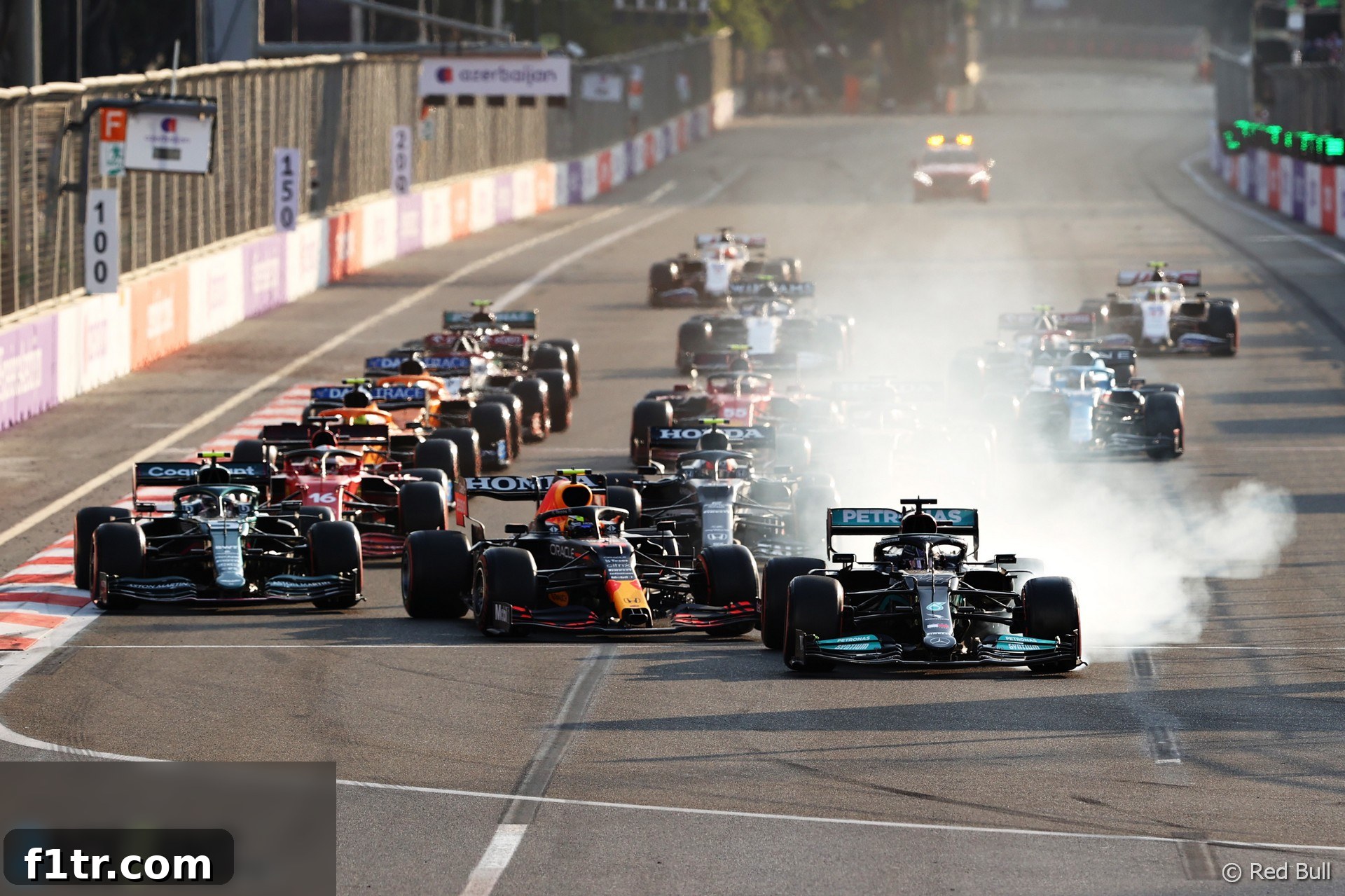
The dramatic spectacle of Formula 1 cars lining up for a standing start ahead of a thrilling two-lap sprint in Azerbaijan ignited considerable discussion among fans, pundits, and competitors alike. This contentious decision, made during a red flag period, transformed what might have been a subdued finish into a high-stakes, action-packed conclusion to a Grand Prix already brimming with incident.
As the cars idled in the pit lane, shrouded in a tense silence following Max Verstappen’s dramatic crash, only three laps remained of the race. The logistics of a restart dictated that an additional tour of the circuit would be necessary to guide the field back to the start-finish line, effectively leaving just two laps of flat-out racing. This unusually short sprint ignited a fierce debate: was it a stroke of genius for entertainment, or a questionable manipulation of sporting integrity?
The reaction from the drivers was mixed but undeniably revealing. When the top three finishers were queried about their thoughts on performing a standing restart for such a brief period, third-place finisher Pierre Gasly’s response captured the prevailing mood with a hint of playful cynicism. “The Americans took over so I wasn’t really surprised that we go first with the entertainment,” he quipped, subtly referencing Formula 1’s expanding global reach and its continuous drive for compelling action.
Despite the jibe, Gasly quickly clarified his genuine enthusiasm for the format. “No, I was quite happy,” he continued, his tone shifting to one of exhilaration. “It always brings a bit more excitement. It creates some sort of adrenaline inside you. I knew there would be some opportunities because you start only for two laps, everybody is a bit like lions out of the cage and everybody goes for everything and tries to make up as many positions as they can in a very short time.” His words perfectly encapsulated the raw, unadulterated thrill that such an intense, short-burst restart can generate, turning cautious strategists into daring opportunists.
Formula 1’s intricate rulebook largely dictated that a restart was, in fact, always likely. The sport has long moved past eras where races might be abandoned after reaching 75% distance or where final results were decided by confusing ‘aggregate times’ from separate race segments. These historical anomalies are firmly in the past, with the latter not having been employed since the rain-affected 1994 Japanese Grand Prix, which saw a controversial split-race format.
While this particular area of the regulations was comprehensively rewritten many years ago, the lingering expectation among some that races might not always be allowed to go the full distance in exceptional circumstances has persisted, even though such abandonments are now exceedingly rare. Today, it requires truly dire and unforeseen events – such as Jules Bianchi’s tragic crash at Suzuka in 2014, or the monumental deluge that forced a halt at Sepang in 2009 – for a Formula 1 Grand Prix to be prematurely halted and declared complete.
A critical subplot to the Baku restart involved the alarming tyre failures suffered by both Max Verstappen and Lance Stroll, which precipitated the red flag. Whether these incidents constituted sufficient grounds to consider not restarting the race was a serious concern that Pirelli’s subsequent investigation aimed to address. However, from the perspective of the existing sporting regulations, Formula 1 race director Michael Masi clearly articulated that there were no legitimate reasons not to resume Sunday’s race.
“Thankfully, for a number of years now, we’ve had the race suspension regulations,” Masi explained, emphasizing the established framework governing such situations. “With the race suspension elements, yes there is an option to not restart, but within the timeframe and within the format of the regulations, we can restart and there was no reason not to.” His statement highlighted the regulatory imperative to attempt a restart whenever feasible, prioritizing a racing conclusion over an early cessation.
While the decision to restart the Baku Grand Prix might have caught some casual viewers off guard, the same could not be said for the Formula 1 teams themselves. Even Red Bull, the team with potentially the most to lose from a restart given Verstappen’s retirement, seemed to anticipate the decision. Their sporting director, Jonathan Wheatley, was famously heard conversing with Masi during the race broadcast, strategically making the case for a red flag and restart: “Consider a red flag and the opportunity to change tyres,” he advised, revealing the tactical calculations already in motion.
This particular decision to red flag a race and then restart it so close to its conclusion established a significant precedent for future occasions, especially when the Safety Car is deployed with only a handful of laps remaining. In such a scenario, teams now have a tangible reason to expect that race control will seriously consider red-flagging the event in order to ensure it concludes ‘under green flag conditions,’ prioritizing entertainment and a racing finish over a processional end behind the Safety Car. This marks a subtle but impactful shift in race management philosophy.
Masi himself openly admitted that Sunday’s race was red-flagged precisely for this reason – to allow for a proper racing finish. “We weren’t confident that the recovery on the pit straight and the amount of debris that was everywhere could be cleaned up in the appropriate time,” he explained. “So I thought it was in the best interests of the sport to suspend and then restart in that circumstance.” This acknowledgement underscores the deliberate choice to enhance the sporting spectacle, even if it entails pausing the race.
The implications of this precedent are far-reaching. In any future races where the Safety Car is deployed near the end, it is virtually guaranteed that every team not currently leading the race will aggressively lobby Masi and race control to deploy a red flag. As former F1 world champion Jacques Villeneuve insightfully explained in an interview for RaceFans that week, this creates an undesirable element of randomness and potential inconsistency.
“Ultimately, with the restart at the end, there’s an issue with that red flag because it’s random,” Villeneuve articulated, pinpointing the core problem. “So if you want to give a red flag at the end of the race then it should be in the rules that if it’s under caution with three laps to go, there will be a red flag. So it’s not ‘one race yes’, ‘one race no’.”
His argument for clearer, more consistent rules is compelling: “Because then teams will complain that, ‘oh, you helped that team that one time, but not us the other time’. So I think there has to be a fixed rule. It’s either there is no red flag or there is one with three laps to go.” Villeneuve concluded by emphasizing the importance of predictability: “That way it’s always the same and there’s no bickering afterwards.” His perspective highlights a critical tension between the desire for dramatic finishes and the need for unimpeachable sporting fairness.
A poignant example from another prominent American racing series serves as a powerful illustration of why such a rule change might be not just desirable, but essential. In IndyCar, the previous year’s iconic Indianapolis 500 controversially concluded ‘under caution,’ leaving several drivers deeply dismayed. Many had fully expected the race to be restarted, especially given that previous editions had seen restarts under similar circumstances. The inconsistency led to widespread dissatisfaction and questions about the fairness of the finish.
As red flag restarts become an increasingly common feature and a strategic tool in Formula 1, this inherent scope for inconsistency and discretionary decision-making could easily escalate into a major flashpoint for controversy. Without clear, predefined rules governing when and how such restarts occur, the sport risks undermining its own credibility and generating unnecessary friction among teams and fans. The balance between delivering thrilling entertainment and upholding the integrity of competition remains a delicate and ongoing challenge for Formula 1’s custodians.
Quotes: Dieter Rencken
Explore More on the 2021 F1 Season
- Masi ‘basically gifted the championship’ to Verstappen says 2021 FIA steward Sullivan
- Las Vegas race backers looking to extend F1 deal beyond 2025
- Why Mercedes put ‘a reminder of joy and pain’ on display in their factory lobby
- Verdict on error in GT race suggests Mercedes would have lost 2021 Abu Dhabi GP appeal
- Title ‘stolen’ from Mercedes made us ‘underdogs people cheer for’ – Wolff
Browse all 2021 F1 season articles