In a memorable weekend that sent ripples through the 2019 Formula 1 season, Red Bull Racing, powered by Honda, achieved a remarkable victory at the Austrian Grand Prix. This triumph was significant not just for the team but for the sport, as it marked the first time any constructor had broken Mercedes’ dominant stranglehold on success that year. The car that crossed the finish line in Spielberg, however, was a sophisticated blend of cutting-edge new developments and well-optimized existing components, showcasing a meticulously crafted strategy by both the chassis and power unit departments.
While the Red Bull Ring is renowned as a power-sensitive circuit, attributing this monumental win solely to a complete equalization of power unit performance between Honda, Mercedes, and Ferrari would be an oversimplification. Indeed, the Austrian GP victory was a confluence of several critical factors. Mercedes, a typically unflappable force, grappled with significant heat management issues during the scorching race day, which severely compromised their performance. Concurrently, the Red Bull chassis demonstrated exceptional synergy with the Pirelli tyres, allowing Max Verstappen to extract superior grip and longevity from the rubber in the intense heat, a testament to its finely tuned aerodynamic and suspension characteristics.
Honda’s Resurgent Journey: From Tribulation to Triumph
This victory was, without question, a watershed moment for Honda. It marked their first win in the challenging V6 hybrid turbo era, a period characterized by years of arduous lessons and relentless development. Their journey through Formula 1’s modern hybrid age began with a tumultuous partnership with McLaren, where reliability and performance issues were frequently in the spotlight. Following that, a period of rebuilding and learning with Toro Rosso (now AlphaTauri) proved invaluable, providing the Japanese manufacturer with crucial data and a platform to refine their power unit. By 2019, having partnered with Red Bull, Honda’s research and development programme had accelerated dramatically, demonstrating an impressive pace of innovation.
The commitment to rapid progress was evident through a series of significant power unit updates introduced throughout the season. A major upgrade package was first deployed at the Azerbaijan Grand Prix in Baku, followed by another substantial revision at the French Grand Prix. This aggressive development trajectory, while yielding significant performance gains, also meant that Red Bull had already utilized three 2019-specification power units. Consequently, any further performance-enhancing updates would inevitably incur grid penalties, a strategic trade-off that highlights Red Bull’s unwavering determination to extract every possible ounce of speed. The clear signal from Red Bull was a strong push for more performance, even if it came with some reliability risks or grid drops, placing immense pressure and providing vast scope for Honda to continue their impressive progress throughout the remainder of the season.
The Evolving RB15 Chassis: A Masterclass in Aerodynamic Refinement
Beyond the power unit, the Red Bull RB15 chassis itself underwent a significant evolution. Initially characterized by its challenging handling traits, the car transformed through a series of targeted aerodynamic revisions. One of the most impactful changes was a complete overhaul of the front wheel, upright, and brake duct package. This comprehensive redesign was crucial for mitigating the performance loss resulting from the ban on blown axles, which had previously allowed teams to generate aerodynamic “outwash” by directing air from the brake ducts over the front wheel. To compensate, Red Bull ingeniously altered the design to blow air *through* the wheel, effectively retrieving some of that crucial outwash effect. This intricate flow manipulation is vital for guiding airflow around the front tyres and along the car’s flanks, optimizing the performance of downstream aerodynamic components like the bargeboards and floor.
Aside from this major front-end modification, the RB15’s development path was marked not by revolutionary changes but by a continuous, meticulous stream of small, detail-oriented updates. These incremental refinements were strategically applied across key aerodynamic surfaces: the front wing, the complex bargeboard area, the underfloor, and the diffuser. Each subtle adjustment aimed to optimize airflow, reduce drag, and incrementally increase downforce, showcasing Red Bull’s philosophy of marginal gains that collectively contribute to significant performance improvements over the course of a season.
Paul Ricard’s Aerodynamic Leap: Floor, Diffuser, and Exhausts
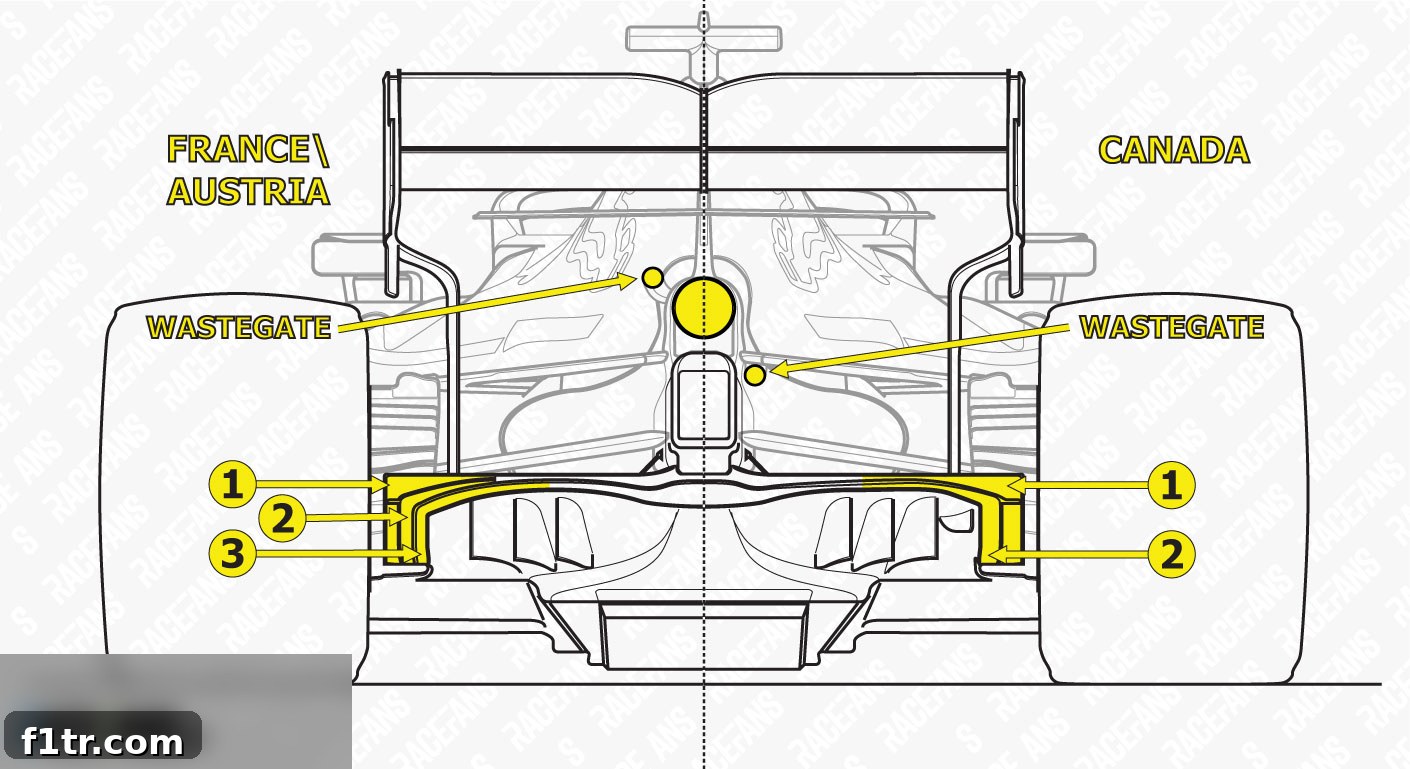
The French Grand Prix at Paul Ricard saw another crucial step in the RB15’s ongoing development. Red Bull introduced a new floor design, featuring a reworked outer corner to the diffuser. The diffuser, a critical component at the rear of the car, is responsible for accelerating airflow beneath the car and expanding it at the exit, creating a low-pressure area that effectively sucks the car to the track surface, generating immense downforce. While F1 regulations strictly cap the diffuser’s height and width, teams gain performance by intricately sculpting the bodywork around its perimeter, influencing how air interacts with this vital component. By refining the outer corner, Red Bull aimed to further enhance the efficiency of the diffuser, increasing the overall downforce generated.
In conjunction with the floor, a more sophisticated treatment was introduced for the diffuser’s perimeter flap. Previously, Red Bull had employed a two-element vertical flap surrounding its diffuser. This flap serves to lower pressure directly behind the diffuser, thereby pulling more air through the undercar tunnel and augmenting downforce. Even after a detail change to the old format in Canada, a much more advanced three-element perimeter flap was unveiled in France. This modification also necessitated a subtle change in the shape of the inner diffuser’s top edge to accommodate the new configuration. An intriguing detail was the small side extension carried by the middle of these three perimeter flaps. This element is not, strictly speaking, an aerodynamic device in itself but serves a crucial regulatory purpose: it ensures compliance with the 200mm maximum height rule for the diffuser, as the diffuser’s height is measured from its lowest point. The inclusion of this strip strategically provides more freedom for shaping the outermost perimeter flap, allowing Red Bull to extract greater aerodynamic performance within the technical constraints.
Above this intricate diffuser area, the power unit’s exhausts also underwent significant repositioning. Formula 1 regulations mandate separate exhaust outlets for the turbocharger and the wastegate(s). Most teams typically opt for three exhausts: one for the turbo’s main exhaust and two smaller pipes for the wastegates, even if only a single wastegate is fitted. Earlier in the season, Honda’s single wastegate setup branched into two pipes, which Red Bull had initially mounted very low, routing them past the ‘V’ of the upper rear wishbone to exit discreetly behind it. In contrast, Toro Rosso, utilizing an identical Honda power unit and gearbox, had mounted their wastegate pipes higher, passing over the upper wishbone.
Wastegate Exhausts: Seeking a Blown Advantage
The new setup implemented by Red Bull saw the two smaller wastegate pipes raised significantly, now positioned over the top of the central tailpipe. This strategic placement, bringing the wastegate pipes into close proximity to the rear wing’s under-surface, strongly suggested an intention to gain a ‘blown effect’. The concept of a blown effect involves utilizing the high-energy exhaust gases to condition the airflow over aerodynamic surfaces, essentially energizing the air to prevent flow separation and increase downforce. This technique has been explored by various teams in the past, with Renault notably attempting something similar in the previous season.
However, this aerodynamic pursuit immediately ran into regulatory scrutiny. The FIA (Fédération Internationale de l’Automobile) had issued a series of technical directives in France, some of which directly addressed and sought to restrict the use of ‘blown’ engine maps – specifically, how engine settings could be manipulated to generate exhaust gases for aerodynamic benefit. These new directives were not set to come into effect until the British Grand Prix at Silverstone, providing engine manufacturers a crucial window to recalibrate their engines to meet the revised demands. Consequently, any performance advantage Red Bull might have gained from blowing its exhausts onto the rear wing would likely be short-lived. It was widely anticipated that, in response to the tightening regulations, the wastegate tailpipes might be repositioned back to their lower configuration in future races, highlighting the constant cat-and-mouse game between F1 engineers and the governing body.
Strategic Reversions: Front Wing and Nose Tweaks
While France introduced significant floor and exhaust changes, other adjustments to the RB15 were smaller, and intriguingly, some were even “retrograde.” The most noticeable visible change was a return to an older front wing specification. This simpler version featured five aerofoil elements that spanned the full width of the wing, contrasting with the more complex, split-flap design that had been introduced earlier in Bahrain. Teams often revert to older specifications if a new design isn’t performing as expected in certain conditions, or if the older version offers a better overall balance for a specific circuit’s demands. The wing also retained the “spec three” sloped top to the endplate, a design previously introduced in Spain and used again in Canada, suggesting its effectiveness in managing front tyre wake.
Adding to these strategic reversions, Red Bull also opted to return to the pre-Monaco nose hole configuration. Running the nose hole open in Austria initially seemed an unusual choice, as it inherently produced its own drag. However, in the intricate world of F1 aerodynamics, a component that adds drag in isolation might still contribute to a better *overall* aerodynamic effect on the car. For the specific setup required at the Red Bull Ring, it’s plausible that the open nose provided improved internal airflow for cooling or optimized the flow over other critical surfaces, leading to a net gain in performance despite the localized drag penalty. These particular front-end changes were generally not expected to be permanent, with rumors already circulating about new parts slated for introduction at Silverstone, indicating Red Bull’s continuous and dynamic development cycle.
Challenging the Dominance: Red Bull’s Future Outlook
With a notably improved power unit from Honda and a chassis that was rapidly evolving and demonstrating strong performance characteristics, Red Bull could realistically expect to push harder for stronger qualifying positions. This newfound qualifying prowess was becoming increasingly important for the team, as their race pace – often bolstered by superior tyre management – was consistently on par with, and sometimes even superior to, that of Mercedes and Ferrari. This ability to maintain strong performance over a race distance, combined with the power unit gains, meant they were no longer just relying on opportunistic wins but could genuinely challenge from the front.
While few in the paddock doubted that Mercedes would ultimately return to their customary winning ways, the Austrian Grand Prix served as a stark reminder that even the most dominant teams could be tripped up by specific conditions or technical challenges. Red Bull, after their breakthrough victory, could now firmly consider themselves regular challengers to Ferrari, consistently vying for podiums and victories. More importantly, they positioned themselves perfectly to capitalize on any errors or vulnerabilities that might emerge from the reigning champions, Mercedes. The 2019 season had truly come alive, with Red Bull and Honda emerging as formidable contenders, injecting thrilling unpredictability into the championship battle.
F1 Technology Deep Dives
- McLaren, Red Bull and Ferrari bring rear corner updates to Imola
- Ferrari, McLaren and Red Bull bring upgrades again for Saudi Arabian Grand Prix
- McLaren introduce major floor upgrade for Norris’ car at Mexican Grand Prix
- McLaren, Mercedes and Red Bull detail upgrade packages for United States GP
- Red Bull remove engine cover ‘cannons’ in major RB20 update – but they may return
Browse all F1 technology articles