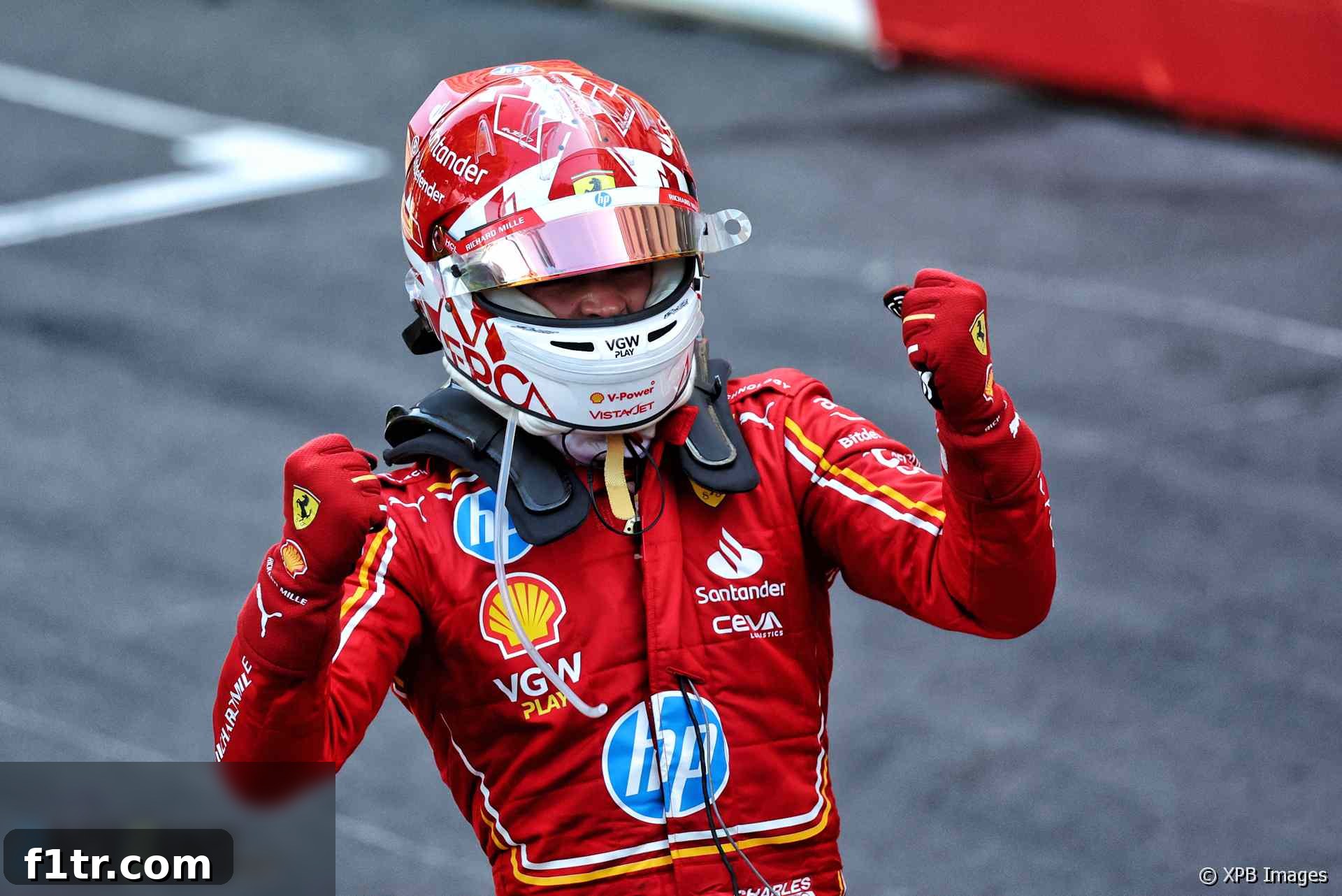
In the high-stakes world of Formula 1, every season presents a unique challenge, and for Charles Leclerc, the past year was a true test of his burgeoning talent against the sport’s most formidable contenders. Often measured against the very pinnacle of Formula 1 excellence, Leclerc once again demonstrated his exceptional skill and unwavering determination. While his teammate, Carlos Sainz Jnr, proved to be a consistently strong rival, with little separating the two Ferrari drivers on many occasions, Leclerc ultimately emerged ahead in the points standings, a testament to his consistent performance.
The collective strength of Ferrari’s driver pairing was, in fact, a crucial factor in their near-success in the Constructors’ Championship. Despite not always possessing the outright quickest car over a single flying lap, the Scuderia’s combined driver talent pushed them remarkably close to the top. Leclerc, in particular, deserves significant credit for navigating a season filled with challenges, not least of which was a teammate who provided far tougher competition than many other top drivers faced within their own teams.
Leclerc’s season began with a series of hurdles that would test any driver’s resolve. Brake problems hampered his performance in the opening race in Bahrain, a frustrating start to what promised to be a pivotal year. He quickly bounced back, delivering a commendable podium finish in Jeddah, a race where Sainz, unfortunately, missed out. However, the momentum was short-lived, as his teammate managed to snatch victory from him in Australia, showcasing Sainz’s own capabilities and intensifying the intra-team battle. At Suzuka, a poor qualifying effort saw Leclerc recovering admirably through the field, only to eventually trail Sainz in fourth after receiving team orders to let his teammate by, a decision that underscored the tight competitive dynamic within the team.
Yet, like any true champion, Leclerc soon found his rhythm. The following races saw him consistently extract the maximum performance from his Ferrari. Fourth place in China was arguably the best the car was capable of that day, demonstrating his ability to secure solid points even when outright victory was out of reach. Miami brought a strong third place in the main race, complemented by a second-place finish in the sprint, indicating his growing confidence and mastery of the SF-24. He followed this with another third-place finish at Imola, further cementing his return to form. These consistent results set the stage for one of the most significant moments of his season: a magnificent and emotionally charged victory from pole position at his home race in Monaco. This win was not just a triumph on the track but a cathartic release, a dream fulfilled for the local hero, ignuding joy among the tifosi and validating his relentless efforts.
Charles Leclerc
| Best | Worst | |
|---|---|---|
| GP start | 1 (x3) | 19 |
| GP finish | 1 (x3) | 14 |
| Points | 356 | |
However, the mid-season brought a period of significant difficulty for Ferrari, as a flawed upgrade package temporarily derailed their progress. During this challenging phase, it sometimes appeared as though Leclerc was over-compensating for the car’s shortcomings, pushing perhaps a little too hard. He was fortunate to escape a stiffer penalty for a somewhat clumsy incident with Lando Norris during practice at Catalunya, a moment that highlighted the fine line between aggression and error. Austria proved to be another trying event, marred by various setbacks that prevented him from showcasing his true pace. A risky gamble on an early switch to intermediate tyres at Silverstone also failed to pay off, illustrating the frustrations and difficult decisions faced during a challenging period for the team.
Once Ferrari managed to diagnose and rectify the issues with their car, Leclerc swiftly regained his impressive stride, delivering a series of exceptional performances in the latter half of the season. At Spa, he surprised many by snatching pole position, a remarkable feat given the competitive landscape, ultimately converting it into a well-deserved third-place finish behind clearly quicker cars. He replicated this strong result at Zandvoort, once again demonstrating his ability to maximize the car’s potential even when not holding the outright fastest machinery. The true highlight, however, came at Monza, the spiritual home of Ferrari. In a strategic masterclass, Leclerc stunned the rival McLarens, seizing a thrilling victory with an audacious and perfectly executed single-stop strategy. This triumph sent the passionate tifosi into raptures, cementing his place as a fan favourite and a strategic genius.
The battles continued fiercely, with Oscar Piastri exacting a measure of revenge at Baku, managing to mug Leclerc for the lead after their pit stops, a testament to the intense competition among the sport’s young stars. Despite this, the ever-resilient Ferrari driver still found himself on the podium once more, showcasing his remarkable consistency. Leclerc secured his final victory of the year in Austin, reveling in a rare day when the SF-24 proved to be the dominant chassis on track, allowing him to demonstrate his full potential without compromise.
As the season drew to a close, Leclerc maintained his strong form, consistently delivering impressive results even on weekends where qualifying hadn’t gone entirely to plan. He staged a superb recovery drive from ninth to fifth in Singapore, a notoriously difficult circuit for overtaking. He repeated this feat, taking fifth place once again, in the challenging rain-affected conditions at Interlagos, proving his adaptability and racecraft in adverse circumstances. These performances highlighted his ability to fight through the field and salvage significant points, regardless of starting position.
Throughout the season, Carlos Sainz continued to be a formidable opponent, often giving Leclerc genuine headaches. In Mexico, Sainz was undeniably the quicker of the two Ferrari drivers, showcasing his raw speed. Leclerc also found himself beaten by his teammate in a close-fought battle in the dazzling streets of Las Vegas. Nevertheless, Leclerc concluded the season with two more stellar podium appearances: a strong second place in Qatar, and an utterly sensational third in Abu Dhabi, achieved after a virtuoso drive from a lowly 19th position on the grid. This final performance was a fitting demonstration of his talent and fighting spirit, encapsulating the highs and lows of his remarkable season.
While these exceptional performances weren’t quite enough to deliver the coveted Constructors’ title for Ferrari, nor for Leclerc to overhaul Lando Norris in the drivers’ standings and equal his personal best championship result, there was an undeniable sense of progress. Looking back, this season unquestionably stands as Charles Leclerc’s most comprehensive and consistent performance to date. It was a year that saw him grow not just as a driver but as a leader, demonstrating incredible resilience, strategic acumen, and raw speed. His journey continues, and the experience gained from navigating such a demanding season will undoubtedly serve him well as he continues his quest for Formula 1 glory, pushing the boundaries against the sport’s most legendary figures.
RaceFans’ driver rankings are meticulously compiled, drawing partly from the individual scores awarded to drivers for their performances in each round, alongside other crucial factors that contribute to a comprehensive assessment of their season-long efforts.
Formula 1 Insights
- Should F1 change tracks or racing guidelines to tackle dangers in 2026 rules?
- Controversies, Norris, Newey and more: Five new motorsport books reviewed
- One of F1’s greatest races happened 15 years ago today. Or did it?
- “Overtaking is overtaking”: Domenicali denies F1’s yo-yo racing is “artificial”
- The crashes F1 is trying to prevent may be rare – but the danger is obvious
Browse all Formula 1 articles