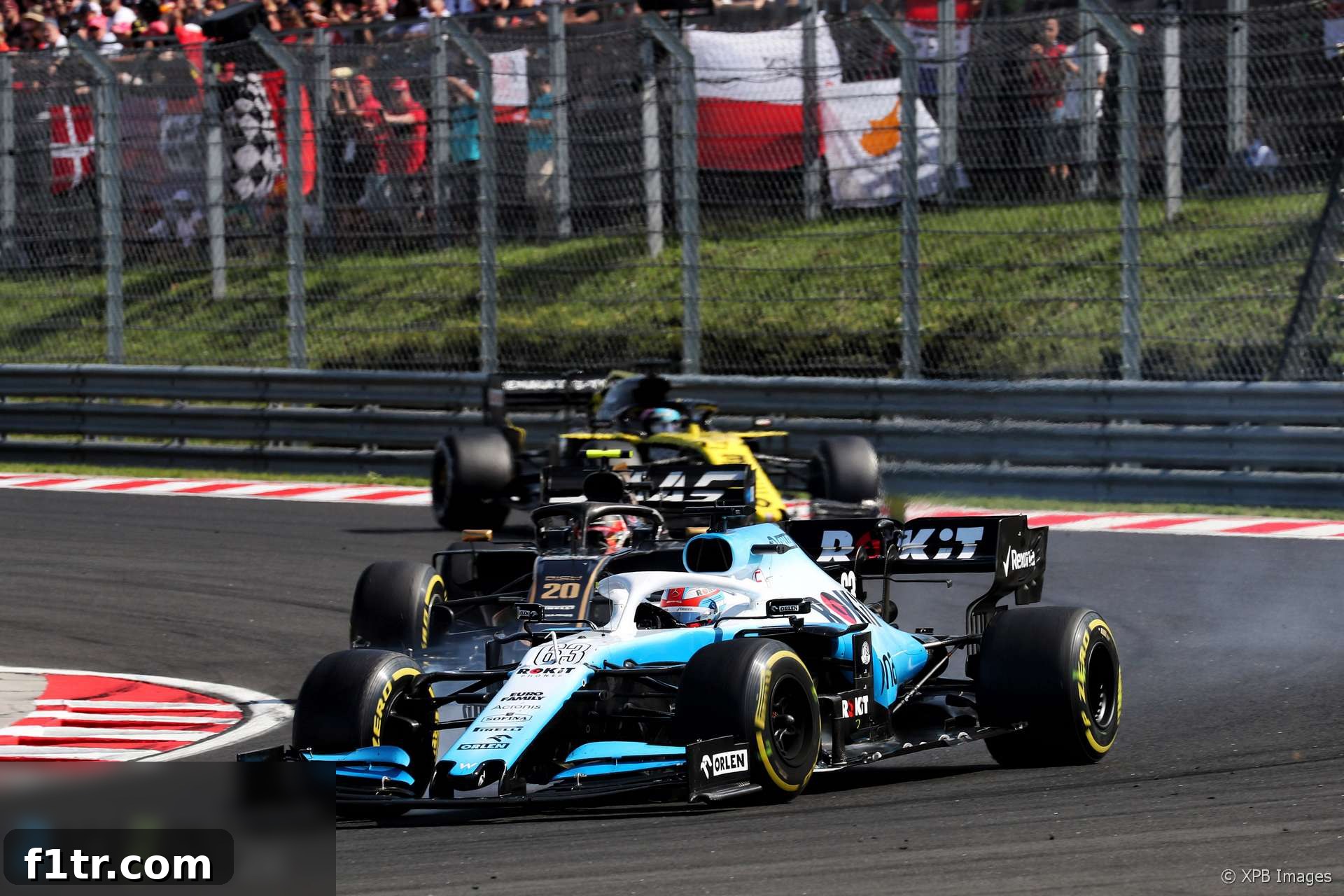
In the challenging landscape of the 2019 Formula 1 season, George Russell embarked on his highly anticipated rookie campaign with Williams Racing. Burdened with the FW42, a car that was, on average, nearly two percent slower per lap than any other car on the grid, Russell’s opportunity to unequivocally showcase his prodigious talent was always destined to be constrained. Despite these significant limitations, his debut year offered compelling glimpses into the potential of a future F1 star, marked by a remarkable dominance over his more experienced teammate and several instances of punching well above the car’s weight.
The statistical battle against his teammate, Robert Kubica, provided the clearest metric of Russell’s inherent speed and adaptability. Across the demanding qualifying sessions of the 2019 calendar, Russell delivered a flawless performance, securing a resounding 19-0 victory over Kubica. This perfect Saturday record, discounting only the rare instances where his teammate did not set a qualifying time, unequivocally demonstrated Russell’s raw pace and his exceptional ability to extract the maximum from the notoriously difficult FW42 in a single flying lap. His consistent superiority on Saturdays was a testament to his precision and burgeoning confidence.
Advert | Become a Supporter & go ad-free
Beyond the single-lap heroics, Russell almost invariably brought his car home ahead of Kubica on race day. This consistent performance across the full race distance further underscored his comprehensive advantage, reflecting not just pace but also race craft, strategic awareness, and tire management – crucial attributes for any aspiring F1 driver. While a definitive points tally might suggest an even playing field, the on-track reality was a stark portrayal of Russell’s superior command of the Williams machinery throughout his inaugural season.
A poignant moment that perfectly encapsulates the story of Russell’s 2019 season unfolded at the German Grand Prix. In a chaotic, rain-affected race that saw numerous retirements and strategic gambles, Russell was agonizingly close to scoring Williams’ sole championship point of the year. The opportunity arose during a crucial phase where several drivers, notably Daniil Kvyat and Lance Stroll, gambled successfully on switching to slick tires at the right moment, catapulting them up the field. Russell was keen to follow suit, sensing the potential. However, Williams hesitated, missing the optimal window. Adding to the misfortune, in the final stages of the race, an unforced error from Russell allowed Kubica to snatch the solitary point, a cruel twist of fate for the young Briton who had demonstrated the greater potential for such a result all weekend. This incident highlighted both the team’s strategic struggles and the fine margins of F1 racing, where even a momentary lapse can prove immensely costly.
Despite this setback, Russell’s clear superiority over his teammate was a season-long theme, drawing comparisons to the significant performance gap between Max Verstappen and Pierre Gasly at Red Bull during the same period. Russell’s exceptional driving was often evident in races where he pushed the FW42 to its absolute limit, sometimes nearly putting Kubica a lap down, as was demonstrably evident at the Red Bull Ring. Furthermore, his skill shone through at the Hungaroring, where he came incredibly close to securing Williams’ only Q2 appearance of the entire season, a testament to his ability to find pace where others struggled to imagine it existed.
Perhaps the most compelling evidence of Russell’s burgeoning talent was his ability to occasionally drag the FW42 home ahead of cars that were, on paper, significantly faster. This feat was not a rare occurrence but a consistent display of his racecraft and opportunistic driving. Six times throughout the season, a Haas competitor finished behind Russell, a statistic Kubica managed only once. The Haas VF-19, while also not a front-runner, was generally considered a more capable package than the Williams. Even more impressive were his battles against the Alfa Romeo drivers: Russell beat Kimi Raikkonen and Antonio Giovinazzi four times each. In stark contrast, Kubica’s combined record against the Alfa Romeo pair was half as good, and he only managed to finish ahead of the seasoned Raikkonen on a single occasion. These results, against cars from more competitive midfield teams, underscored Russell’s ability to maximize any given situation and exploit the smallest opportunities presented during a race.
As the season progressed, the inherent limitations of the Williams FW42 meant that opportunities for truly eye-catching results became scarcer. While Russell consistently out-qualified Kubica, his race starts sometimes saw him more circumspect, occasionally losing positions to his teammate in the opening laps. However, a hallmark of his resilience and superior pace was his almost invariable ability to regain the advantage later in the race, demonstrating excellent tire management and sustained performance throughout Grand Prix distances. This knack for recovery often saw him re-establish his lead over Kubica and maintain it until the chequered flag.
George Russell – 2019 Season Overview |
|
|---|---|
| Beat team mate in qualifying | 19/19 |
| Beat team mate in race | 16/18 |
| Races finished | 19/21 |
| Laps spent ahead of team mate | 906/1151 |
| Qualifying margin (vs. Kubica) | -0.62s |
| Championship Points | 0 |
The 2019 season was not without its share of drama and challenges for Russell. At Spa, he skillfully capitalized on Kimi Raikkonen’s first-lap collision, navigating the chaos to eventually beat the Alfa Romeo, a strong result for the struggling Williams. A week later at Monza, he came incredibly close to achieving a similar feat, almost beating a similarly disadvantaged Sebastian Vettel, showcasing his ability to hold his own against multi-world champions. Singapore saw a rare tangle with Romain Grosjean, which regrettably led to a retirement. Another car failure in Russia tragically ended his race prematurely, sending him into a barrier. Despite these setbacks, Russell’s fighting spirit was never in doubt. At Suzuka, he battled valiantly to the finish line, contending with wildly fluctuating brake performance that he openly described as “borderline dangerous,” yet he pushed on, demonstrating immense resolve under adverse conditions.
One of his most notable race performances came in the chaotic conditions of the Brazilian Grand Prix, where he seized the opportunity presented by multiple incidents and safety car periods to snatch 12th place. This result stood as the team’s third-best finish of the year, a testament to his ability to remain calm and exploit opportunities in unpredictable scenarios. The season finale in Abu Dhabi, however, returned to the familiar slog at the rear of the field, with the Williams unable to challenge for higher positions. Yet, even in these challenging circumstances, Russell continued to maximize the performance of his car.
Accurately assessing George Russell’s ultimate potential compared to his rivals in 2019 remains a complex task, largely due to the profound quality deficit of the equipment at his disposal. The FW42 was not only inherently slow but its performance was often exacerbated by its inability to race effectively with other cars, and its drivers were frequently constrained by the necessity to meticulously preserve the team’s limited stock of spare parts. This meant that Russell was often not just driving a slow car, but one that demanded conservative handling to ensure its survival, further hampering his ability to push for more adventurous overtakes or sustained battles.
What can be said with absolute certainty, however, is that George Russell’s rookie season firmly established him as a talent of immense promise, a driver whose innate ability and refined racecraft deserve to be showcased in a far more competitive machine. His 2019 performance, characterized by relentless consistency, dominant qualifying displays, and an uncanny ability to outperform his car, solidified his reputation as a future star of Formula 1. The hope remains that in subsequent seasons, Williams, or another team, will furnish him with the machinery necessary to fully unleash his capabilities and compete for the positions his talent truly merits. His debut year, against overwhelming odds, served as a powerful declaration of his potential to ascend to the pinnacle of motorsport.
Advert | Become a RaceFans supporter andgo ad-free
Share Your Verdict on George Russell’s 2019 Season
What are your thoughts on George Russell’s debut year in Formula 1? How do you rate his performance relative to his teammate and the challenging Williams FW42? Which drivers, if any, do you believe he outperformed, and where do you think he could have improved? We invite you to share your detailed insights and opinions in the comments section below.
Vote for Your 2019 F1 Driver of the Year
Participate in our annual poll and cast your vote for the standout driver of the 2019 F1 season:
- Vote for your 2019 F1 Driver of the Year
Advert | Become a RaceFans supporter andgo ad-free
Explore More: 2019 F1 Season Review
- ‘I should have done a better job. There’s things that I know I can do better’
- ‘I am definitely not a rookie anymore – but I’m still getting better’
- ‘I didn’t believe in myself much. But after Australia and Bahrain and I gained a lot of confidence’
- ‘It was my best season for sure so far in terms of pure results and speed’
- ‘There’s been plenty of good performances – but there’s also other years I’ve performed at my best’
Browse all 2019 F1 season review articles