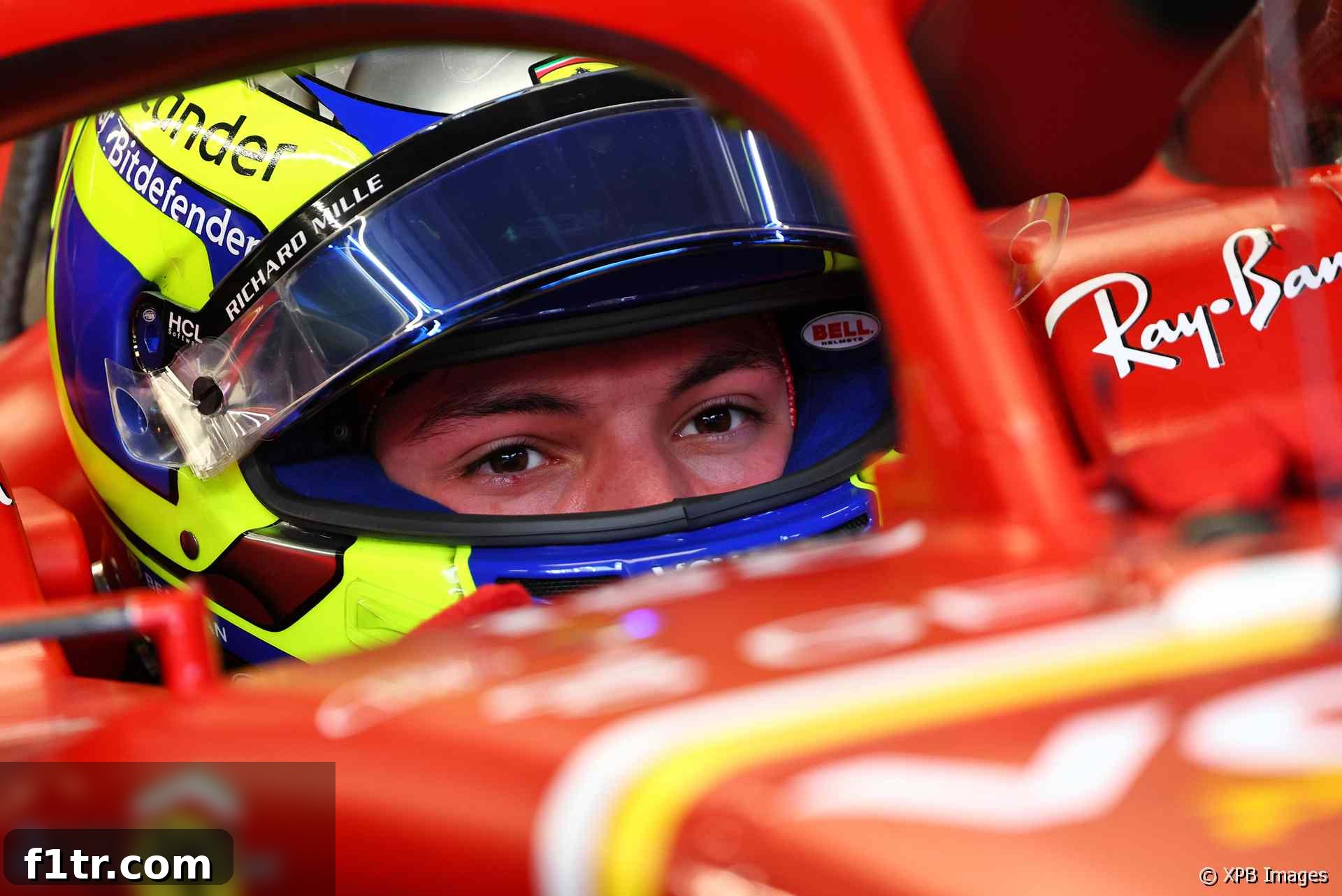
Oliver Bearman’s Unexpected Leap: A Ferrari F1 Debut Against All Odds
The world of Formula 1 is renowned for its high-octane drama, but few moments encapsulate its unpredictable nature quite like a last-minute driver substitution. At the heart of one such extraordinary turn of events was Oliver Bearman, a promising young talent thrust into the unforgiving spotlight of a Ferrari Formula 1 debut at the Saudi Arabian Grand Prix. The call came with breathtaking urgency, giving him less than three hours’ notice before he was to strap into the most iconic car in motorsport for the final practice session, a moment that would etch itself into his burgeoning career and the annals of F1 history.
Carlos Sainz’s Sudden Illness Paves the Way
Bearman’s unprecedented opportunity arose from unfortunate circumstances concerning Ferrari’s seasoned driver, Carlos Sainz Jnr. The Spanish driver was suddenly sidelined after being diagnosed with appendicitis, necessitating immediate surgery. The severity of his condition rapidly escalated; Sainz himself later conveyed that he felt “very weak” during the initial practice sessions on Thursday, a clear indication that something was amiss. His physical state deteriorated significantly overnight, leaving Ferrari with no choice but to seek a replacement.
Ferrari team principal Frederic Vasseur shed light on the rapidly unfolding situation. “On Thursday morning he didn’t feel very well,” Vasseur recounted to Sky Sports. “At the beginning, we were thinking [it was a] food issue. And this morning it was even worse. He went to the hospital and it was quite obvious.” The diagnosis of appendicitis confirmed the necessity for Sainz to withdraw from the weekend’s events and undergo surgery, which was successfully completed, marking a swift resolution to a critical health concern.
For Oliver Bearman, the moment of truth arrived abruptly. Ferrari officially informed him that he would be taking over Sainz’s SF-24 car no earlier than 1:30 pm local time. The window between notification and activation was incredibly tight, a mere three hours later, Bearman was already seated in the cockpit, preparing for a challenge unlike any he had faced before. This lightning-fast transition underscored the demands of Formula 1, where every team must have a contingency plan and every reserve driver must be perpetually ready.
Bearman’s Path to the Prancing Horse: A Prodigious Junior Career
While the circumstances of his debut were sudden, Oliver Bearman’s journey to becoming a Ferrari reserve driver was the culmination of years of relentless effort and exceptional talent. Named the team’s official reserve driver in January of this year, Bearman had already been integrated into the Scuderia’s operations. This role is not merely honorary; it involves extensive simulator work, team briefings, and, crucially, track time in older F1 machinery to keep skills sharp and understanding of the cars current. He had previously driven a two-year-old Ferrari F1 car, providing invaluable experience behind the wheel of Grand Prix-level machinery.
Frederic Vasseur elaborated on Bearman’s prior experience, stating, “He drove the old car a couple of months ago and he did very well.” Beyond his Ferrari commitments, Bearman had also demonstrated his capabilities in official F1 sessions, participating in two Free Practice 1 (FP1) sessions with Haas in the latter half of 2023 at the Mexican and Abu Dhabi Grand Prix weekends. These sessions, though non-competitive, offer a crucial taste of a full F1 race weekend, allowing young drivers to familiarise themselves with the car, the team’s procedures, and the immense pressure of a Formula 1 environment. Vasseur noted that Bearman “did a good job on these two” outings.
Bearman’s foundation for this rapid ascent was built on a truly outstanding junior career. He burst onto the international single-seater scene with immediate impact, winning both the ADAC Formula 4 and Italian Formula 4 championships in 2021. This dual championship triumph marked him as a rare talent. Progressing to the FIA Formula 3 Championship, he consistently performed, securing multiple podiums. His move to Formula 2, often considered the final stepping stone to F1, saw him continue to shine, demonstrating race-winning pace and strategic acumen. Just the day before his F1 debut, he had brilliantly secured pole position in the F2 feature race in Jeddah, a performance Vasseur highlighted as excellent preparation for the intense demands he was about to face.
The Unforgiving Challenge of a Jeddah Debut
Stepping into an F1 car at any circuit is a monumental task, but making a debut at the Jeddah Corniche Circuit amplifies the challenge exponentially. Known as the “fastest street circuit in the world,” Jeddah is an incredibly high-speed, demanding, and unforgiving track, characterized by its long straights, sweeping corners, and incredibly close proximity to the walls. It offers very little margin for error, even for experienced Formula 1 drivers, and is notorious for its steep learning curve.
For a debutant like Bearman, with virtually no preparation time, navigating this labyrinthine circuit during the crucial final practice session was a baptism by fire. FP3 is typically when drivers fine-tune their setups for qualifying and the race, push the limits of the car, and gain critical confidence. Bearman had to perform these complex tasks while simultaneously learning a new car, adapting to a new team structure, and familiarizing himself with a track he hadn’t driven in an F1 car. The mental and physical demands were immense, requiring extraordinary focus, adaptability, and raw talent.
Ferrari’s Approach: Support Without Pressure
Despite the high-stakes nature of a Ferrari debut and the car’s recent performance – Carlos Sainz having just secured a podium finish in Bahrain the week prior – Frederic Vasseur made it unequivocally clear that the team was not placing any undue pressure on Bearman for this short-notice appearance. This stance reflects a pragmatic and supportive approach, acknowledging the extraordinary circumstances and prioritizing the young driver’s learning experience over immediate, unrealistic performance targets.
“In the junior series he did very, very well,” Vasseur reiterated, highlighting Bearman’s consistent excellence. “He was always in top two, top three, he won in F4, he won in F3. He’s doing a very good job.” The Ferrari principal’s words underscored the team’s belief in Bearman’s inherent talent, yet also acknowledged the significant leap from junior categories to the pinnacle of motorsport. “There is always a difference between doing a very good job in the junior series and to do a good job in F1,” Vasseur noted. This distinction is crucial; F1 demands not only pace but also extreme consistency, strategic thinking, and flawless execution under immense pressure.
Vasseur’s concluding remarks on the matter provided clear direction: “We don’t have to draw any conclusion now, we have to let him have time to do the job and I won’t put any pressure on him this weekend.” This philosophy allowed Bearman the crucial mental space to focus on the task at hand: learning, adapting, and safely completing his sessions, rather than being burdened by the expectation of instant, spectacular results. It was a testament to Ferrari’s understanding of driver development and the unique challenges of such a sudden call-up.
The Significance and Future Implications of a Ferrari Debut
Oliver Bearman’s unexpected Ferrari debut is more than just a remarkable story; it’s a significant moment for his career and a powerful illustration of the F1 talent pipeline. For any young driver, making their debut in Formula 1 is a dream come true, but doing so with Scuderia Ferrari, the sport’s most legendary team, is an unparalleled honour. This sudden opportunity served as an extraordinary audition on the world stage, potentially fast-tracking his path to a full-time F1 seat in the near future.
The experience gained from driving an F1 car in a competitive session, even if only practice and qualifying, against the world’s best, is invaluable. It provides a deeper understanding of the car’s intricate systems, the team’s operational procedures, and the immense physical and mental demands of a Grand Prix weekend. Furthermore, Bearman’s ability to seamlessly integrate into the team and perform under such high-pressure, short-notice conditions speaks volumes about his composure, professionalism, and natural talent.
This debut could very well be a pivotal moment for Bearman, opening doors and solidifying his position as one of the most exciting young prospects in motorsport. While Ferrari rightly managed expectations for his immediate performance, every lap driven, every piece of feedback provided, and every moment under the global spotlight contributed to building his experience and reputation. His performance in Jeddah, regardless of the ultimate result, would serve as a crucial data point for future F1 team assessments and negotiations, potentially accelerating his journey from a promising F2 driver to a full-fledged Formula 1 star.
2024 Saudi Arabian Grand Prix
- Bearman’s 2024 Jeddah debut performance makes him ‘feel like an absolute idiot’
- Vowles being patient with Sargeant but expects to see “progress”
- “So I’ve got nothing to worry about?” – The best unheard team radio from Jeddah
- “Shock” of poor start to season showed need for change at Alpine – Famin
- “My tyres are dying”: Stroll’s short-lived struggle until he hit the wall
Browse all 2024 Saudi Arabian Grand Prix articles