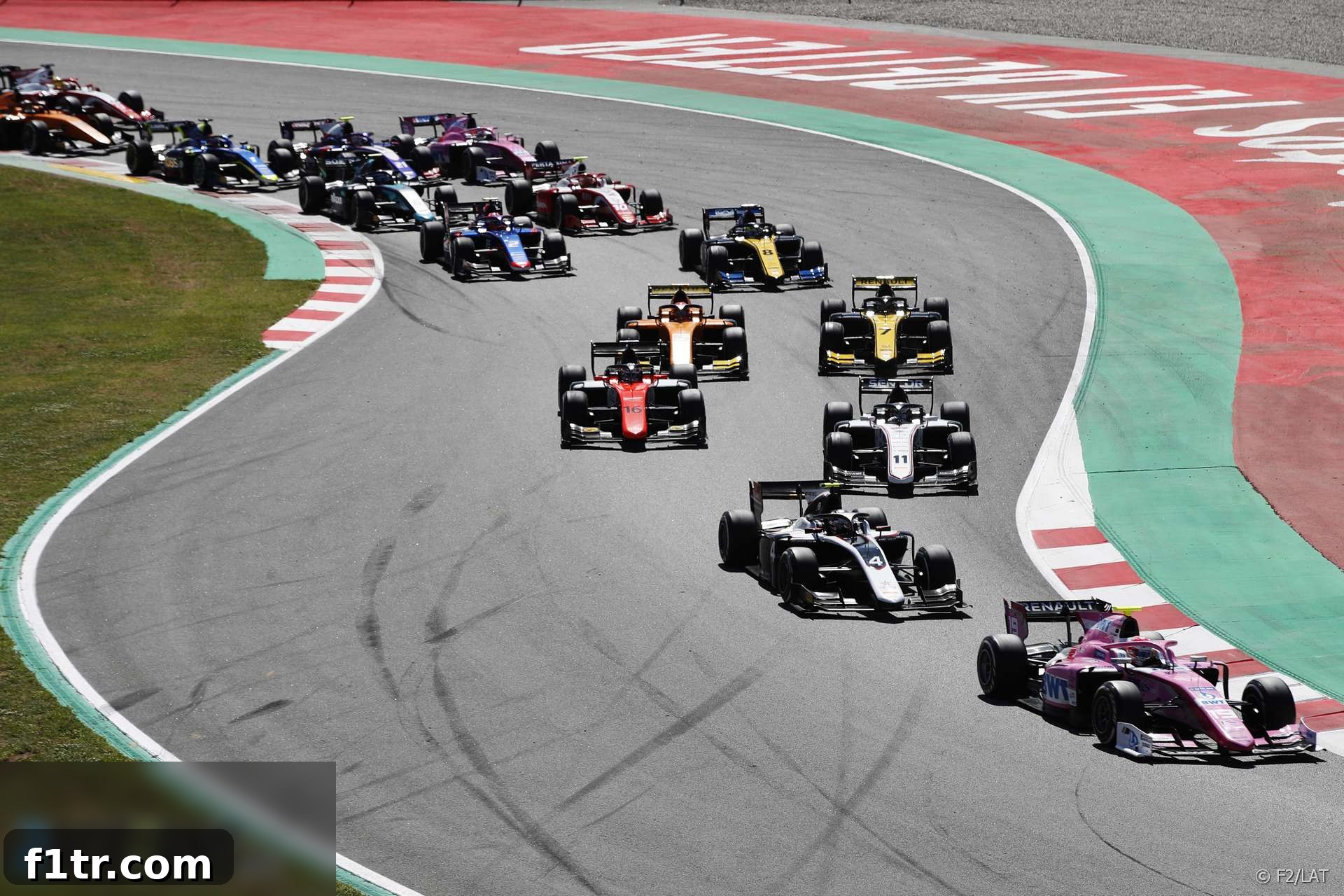
The vibrant world of Formula 2 racing delivered another captivating spectacle at the iconic Circuit de Catalunya in Barcelona. In a thrilling sprint race packed with drama and strategic brilliance, Nyck de Vries secured his maiden victory of the 2019 season. The ART Grand Prix driver demonstrated exceptional poise and race craft, meticulously navigating a highly competitive field before executing a decisive overtake on Anthoine Hubert to claim the top step of the podium. This significant triumph not only marked a personal milestone for de Vries but also ignited the championship battle further, showcasing the intense competition inherent in Formula 2, often regarded as the ultimate proving ground for aspiring Formula 1 talent.
De Vries’ Strategic Masterclass: From Mid-Pack to Victory
The Circuit de Catalunya, a venue renowned for its challenging mix of high-speed and technical sections, promised an unpredictable sprint race. As the starting lights extinguished, the initial moments were crucial. Front-row occupants Callum Ilott and Jordan King both experienced less-than-ideal starts, struggling to get off the line effectively. This momentary hesitation created a golden opportunity for the chasing pack, and it was Anthoine Hubert, driving for Arden, who capitalized brilliantly. With a superb getaway from further down the grid, Hubert surged forward, seizing the lead and immediately setting about defending his hard-won position.
However, the early stages of the race were dramatically interrupted by a severe incident. On the very first lap, Nobuharu Matsushita’s Carlin-run car suffered a catastrophic failure, culminating in a spectacular and alarming fire. As flames engulfed the rear of his machine, the quick-thinking driver bravely leapt from the cockpit to safety. The immediate deployment of the Safety Car was paramount, neutralizing the race and allowing marshals to swiftly extinguish the blaze and clear the track. This incident served as a stark reminder of the inherent dangers in motorsport but also demonstrated the rapid response capabilities of the safety teams.
The Safety Car period, while necessary for safety, invariably reshuffles the strategic landscape of a race. Upon the Safety Car’s return to the pits and the resumption of green flag racing, the restart proved to be somewhat sluggish for the leader. Anthoine Hubert, despite his initial strong showing, found himself under intense pressure, particularly from the relentlessly pursuing Nyck de Vries. De Vries, known for his cool head and ability to manage race situations, patiently stalked Hubert. Over the subsequent laps, the ART driver meticulously closed the gap, and then, utilizing the Drag Reduction System (DRS) to its full potential down one of Catalunya’s crucial straights, he executed a clean and decisive overtake. Claiming the lead, de Vries quickly began to establish a comfortable buffer, showcasing a formidable blend of speed and strategic timing.
Luca Ghiotto’s Unstoppable Charge Through the Field
While Nyck de Vries solidified his position at the front, a truly sensational drive was unfolding further down the grid. Luca Ghiotto, behind the wheel of his Uni-Virtuosi car, embarked on an extraordinary charge through the field that left spectators in awe. Demonstrating exceptional car control, audacious overtaking maneuvers, and relentless pace, Ghiotto methodically picked off rival after rival. His progression was a masterclass in both raw speed and the ability to identify and exploit every available opportunity on the demanding Barcelona circuit.
Ghiotto’s ascent saw him dispatch several high-profile drivers with remarkable precision. He first expertly made his way past Jack Aitken, showcasing superior speed and confidence. He then outmaneuvered Jordan King, demonstrating composure under pressure in wheel-to-wheel combat. Crucially, he also overtook his own team mate, Guan Yu Zhou, in a clean yet decisive move that highlighted his unyielding determination to climb the order. However, his most memorable and impressive overtake came late in the race when he snatched second place from Callum Ilott. This audacious move, executed with immense bravery around the outside of the challenging Turn One, was a testament to his skill and cemented his status as arguably the most impressive performer of the sprint race.
Championship Battle Intensifies: Latifi Extends Lead
Beyond the immediate battle for victory, the sprint race at Circuit de Catalunya also held significant ramifications for the overall Formula 2 championship standings. Nicholas Latifi, the winner of the preceding Feature Race, had a particularly valuable morning. Despite not securing a podium finish in the sprint, his consistent performance and ability to collect crucial points allowed him to extend his lead over key rival Jack Aitken. Latifi’s strategic approach to both races in Barcelona underscored his championship aspirations and his capacity to deliver under pressure, ensuring he remained a strong contender at the top of the leaderboard.
Anthoine Hubert, after an inspired start that saw him lead for a substantial portion of the race, eventually succumbed to the relentless pace of other drivers as the race wore on. Guan Yu Zhou also successfully demoted Hubert later in the race, pushing the Arden driver further down the order. Nonetheless, Hubert displayed commendable resilience in the dying laps, managing to hold off the Feature Race winner Nicholas Latifi at the finish line by a mere half-second. This defensive effort secured valuable championship points that could prove vital as the fiercely contested season progresses. His early pace, despite the eventual slip, unequivocally demonstrated his strong potential.
Aitken’s Frustration and Schumacher’s Penalty Drama
For Jack Aitken, the Campos driver, the Barcelona sprint race proved to be a source of profound frustration and misfortune. His race began with an intense and captivating battle against Guan Yu Zhou, only for the momentum to be abruptly interrupted by the Safety Car deployment. When racing resumed, Aitken found himself losing a crucial position to the charging Luca Ghiotto, who was simply in a class of his own. Further compounding his woes, during a close-quarters duel with Jordan King, Aitken was edged wide at the notoriously challenging Turn One. Respecting the sporting regulation regarding safely rejoining the track, he correctly did not rejoin until Turn Three, a decision that unfortunately cost him another valuable position to Nicholas Latifi, adding to his challenging afternoon.
The closing stages of the race brought another dramatic incident involving Aitken, this time with the highly anticipated Mick Schumacher. The young German driver, pushing relentlessly, launched an aggressive attack on Aitken at the first corner. The pair made contact, resulting in Schumacher taking to the run-off area. However, Schumacher was subsequently deemed to have rejoined the track too soon, gaining an unfair advantage over Aitken. Race stewards promptly reviewed the incident, concluding that a transgression had occurred, and consequently handed Schumacher a five-place grid penalty for the next race. Crucially, this penalty also had an immediate impact on the sprint race classification, effectively restoring Jack Aitken to eighth position, allowing him to salvage a solitary championship point after what had been a challenging and largely unrewarding race up to that point.
The Circuit de Catalunya: A True Test for Formula 2
The Circuit de Catalunya, a familiar and demanding venue for all drivers, consistently provides a stern examination of both car performance and driver skill. Its unique blend of high-speed corners, technical chicanes, and the iconic long main straight makes it a comprehensive proving ground for Formula 2 machinery. The strategically placed DRS zones played a critical role in facilitating overtakes throughout the race, as vividly demonstrated by Nyck de Vries’ decisive move for the lead. Furthermore, tyre degradation is always a significant factor in Barcelona, demanding meticulous management from the drivers and astute strategic foresight from their respective teams.
The Formula 2 sprint race format itself, with its shorter duration and the intriguing element of a reversed grid from the preceding Feature Race, is specifically designed to promote aggressive driving and often leads to highly unpredictable outcomes. This particular race was certainly no exception, delivering a captivating cocktail of early drama, spectacular overtakes, and late-race penalties that kept motorsport enthusiasts glued to their screens. The intensely competitive nature of Formula 2, serving as a crucial feeder series for Formula 1 and boasting a roster of future stars, ensures that every single race is a fiercely fought contest for supremacy, where every decision and every maneuver can make the difference between triumph and disappointment.
Nyck de Vries’ commanding victory at Barcelona was a powerful statement of intent, unequivocally showcasing his championship credentials and underlining his potential. Luca Ghiotto’s incredible drive from the back of the grid demonstrated his raw talent, aggressive racing style, and unwavering determination. Meanwhile, the overall championship battle continues to simmer with intensity, with every single point proving to be absolutely vital in the ultimate quest for the title. The 2019 Formula 2 season promised to be one of the most exciting in recent memory, and the Barcelona sprint race certainly lived up to that expectation, offering a compelling glimpse into the immense talent pool that consistently feeds the pinnacle of motorsport.
More on Formula Two
- Formula 2 to debut in Miami and Montreal after Iran war cancellations
- Ex-McLaren junior Dunne’s move to Alpine finally confirmed
- Schumacher says his IndyCar feels like ‘an F2 car, just with better tyres’
- The Formula 2 team with an older driver line-up than almost half the F1 grid
- FIA to award more F1 superlicence points to IndyCar drivers from 2026
Browse all Formula 2 articles