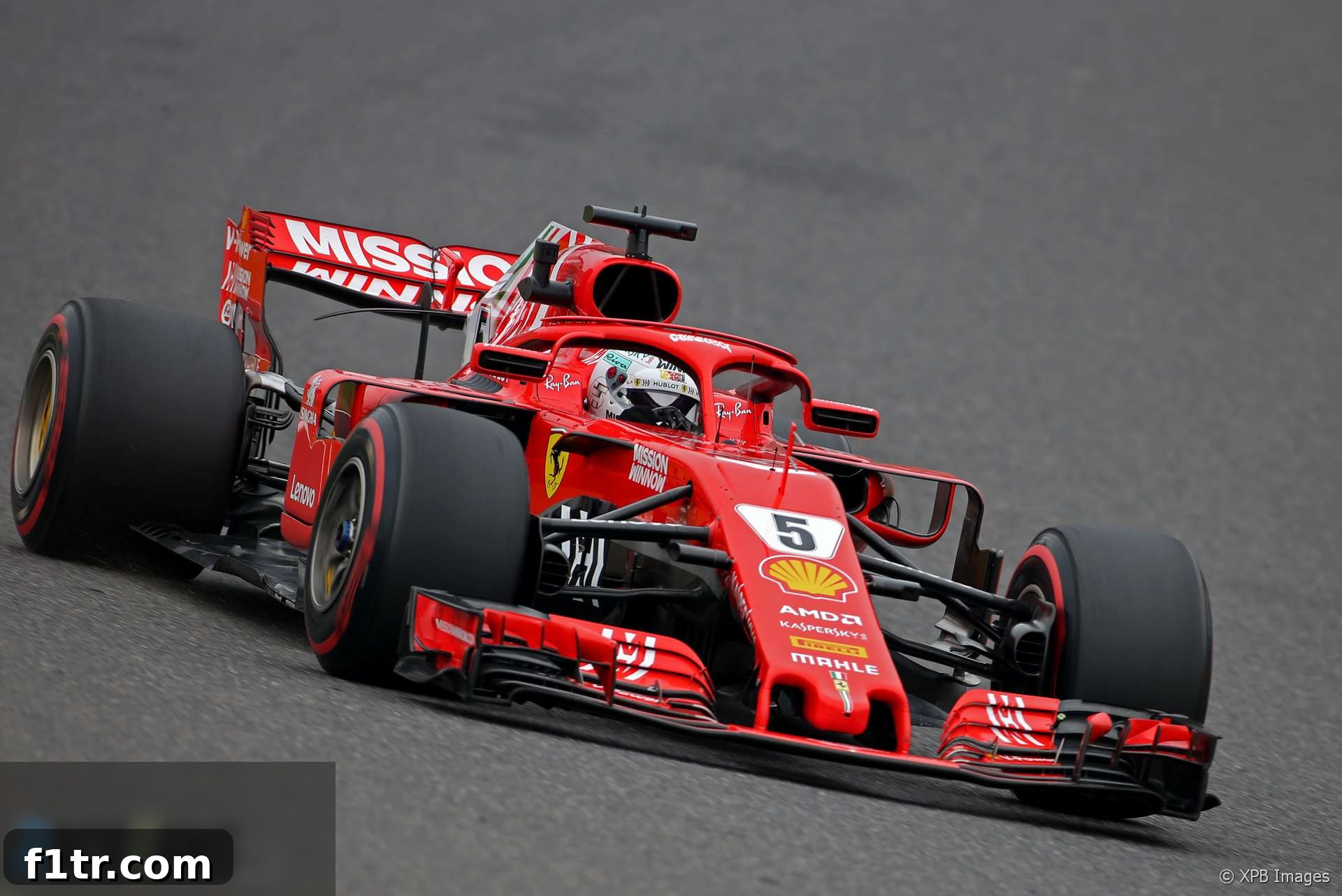
In a dramatic and rain-soaked qualifying session that had championship implications, Sebastian Vettel and Ferrari found themselves lamenting a missed opportunity, relegated to a disappointing ninth place on the grid. The four-time world champion openly expressed his frustration, believing that both he and his team deserved a significantly better outcome, a sentiment rooted in an incorrect tire strategy call during the volatile conditions.
The crucial Q3 segment began with both Ferrari SF71H cars heading out on intermediate tires, a decision that would quickly prove costly. As the track at Suzuka (implied by typical F1 calendar and track characteristics for “Degner” and “Spoon”) rapidly began to dry, their rivals shrewdly opted for slick tires, seizing a narrow window of optimal grip to set formidable lap times. This strategic misstep left Ferrari scrambling. While Vettel’s teammate, Kimi Raikkonen, demonstrated remarkable adaptability to salvage a respectable fourth position, Vettel himself was less fortunate, his initial efforts hampered by the ill-suited intermediates and then compounded by personal errors.
Vettel’s qualifying woes were multifaceted. On his first flying lap, pushing hard on the intermediates, he ran wide at the challenging exit of Degner corner, losing precious time and carrying less speed. Further compounding his struggles, he then went off track at Spoon corner, an error that effectively compromised his entire initial run. By the time Ferrari realized their tactical error and brought Vettel in for slick tires, the weather had, in a cruel twist of fate, turned against them once more. The rain returned with renewed intensity, swiftly negating any chance for him to improve his lap time and firmly sealing his P9 grid slot.
Reflecting on the session, a visibly deflated Vettel commented, “Obviously it’s not the position we deserved to be in. I think we have a better speed than ninth, but we start there and we’ll see how it goes.” His words conveyed a strong sense of injustice, highlighting the gap between the car’s potential pace and its actual grid position. He detailed the sequence of events that undermined his qualifying, explaining, “I think the first run was sort of OK. Obviously I had a mistake in Spoon so lost most of the time there.” The subsequent, more critical setback, was entirely out of his hands: “But obviously the second run we didn’t make it out time the because the rain came so we were too late.” This candid assessment underscored the crucial role that precise timing and strategic foresight play in the unpredictable world of Formula 1 qualifying, especially when Mother Nature decides to intervene.
Advert | Become a RaceFans supporter andgo ad-free
Vettel’s Team Radio from Qualifying: A Communication Breakdown in Real-Time
The frustration and urgency of the situation were vividly captured through Sebastian Vettel’s team radio exchanges during Q3. Immediately upon joining the track on intermediate tires, it became clear to Vettel that the team’s initial assessment of the track conditions was incorrect:
| Vettel: | I think it’s too dry. |
| To Vettel: | Copy. |
| Vettel: | Yeah it’s quite dry, come in straight away. |
| To Vettel: | Understood. |
| Vettel: | Eight and nine also very dry. |
| To Vettel: | Copy. Try all gears. |
| Vettel: | Yeah all the way dry. |
| To Vettel: | OK we go with slicks. So pit stop for quali tyres. Kimi’s 10 seconds in front. Five seconds. Tyre switch on dry and manual pull away. |
| To Vettel: | Hamilton starting timed lap now, eight seconds behind, behind him is Bottas, six seconds, and then track is clear. Hamilton behind let him by. Bottas next. Bottas at turn nine. Bottas three seconds behind and behind Bottas is Gasly, 15 seconds, on a timed lap. |
This critical exchange highlights the instantaneous feedback required from drivers in rapidly evolving conditions. Vettel’s clear warnings about the drying track should have prompted a quicker response, allowing him to capitalize on the dry window. The delay in changing to slick tires proved pivotal, as rivals like Lewis Hamilton and Valtteri Bottas were already out on their timed laps, exploiting the rapidly improving conditions before the rain returned.
The subsequent turn of events, with the rain intensifying, sealed Vettel’s fate and led to further urgent communication with the pit wall:
| Vettel: | Heavy rain, heavy rain. |
| To Vettel: | Copy that. |
| Vettel: | Let me know if this is getting worse. |
| To Vettel: | Turn one will be wetter when you come there. Hamilton timed laps seven seconds behind. Hamilton is aborting. |
| To Vettel: | Want to box for inter or is too late? |
| Vettel: | Too late. |
| To Vettel: | OK. Careful turn one. |
| Vettel: | No chance. |
| To Vettel: | Copy. Heavy rain now in the pit lane, careful. |
| Vettel: | OK, mistake in 13, not our timing today. |
| To Vettel: | Copy that, understood. Try to make it up tomorrow. |
The final radio exchanges underscore the absolute critical nature of timing in such conditions. Once the heavy rain returned, any hope of improving his lap was gone. Vettel’s resigned “Too late” and “No chance” perfectly encapsulated the despair of a driver whose qualifying was undone by external factors and a critical strategic miscalculation. The team’s acknowledgement, “not our timing today,” served as a somber admission of the error.
This incident vividly demonstrates the razor-thin margins that separate success from failure in Formula 1, particularly in capricious weather conditions. Ferrari’s initial gamble on intermediate tires, likely a conservative choice given the prior rain, backfired spectacularly as the track dried at an unforeseen pace. The delay in bringing Vettel in for slick tires meant he missed the crucial window when the track was at its fastest, allowing rivals to set unbeatable times. By the time he was on slicks, the returning rain made further improvements impossible. This strategic blunder not only left Vettel starting from an unfavorable ninth position but also added significant pressure in a season where every point, and every grid position, was paramount in the championship battle. The challenge ahead for Vettel would be immense, requiring a masterful drive through the field to salvage points and reignite his title aspirations, proving that even from P9, the spirit of a champion remains undaunted.
Advert | Become a RaceFans supporter andgo ad-free
2018 F1 Season Highlights and Related Insights
- F1 feared “death knell” for Drive to Survive after Ferrari and Mercedes snub
- McLaren staff told us we were “totally crazy” to take Honda engines in 2018 – Tost
- ‘It doesn’t matter if we start last’: How Red Bull’s junior team aided Honda’s leap forward
- Honda’s jet division helped F1 engineers solve power unit problem
- McLaren Racing losses rise after Honda split
Browse all 2018 F1 season articles