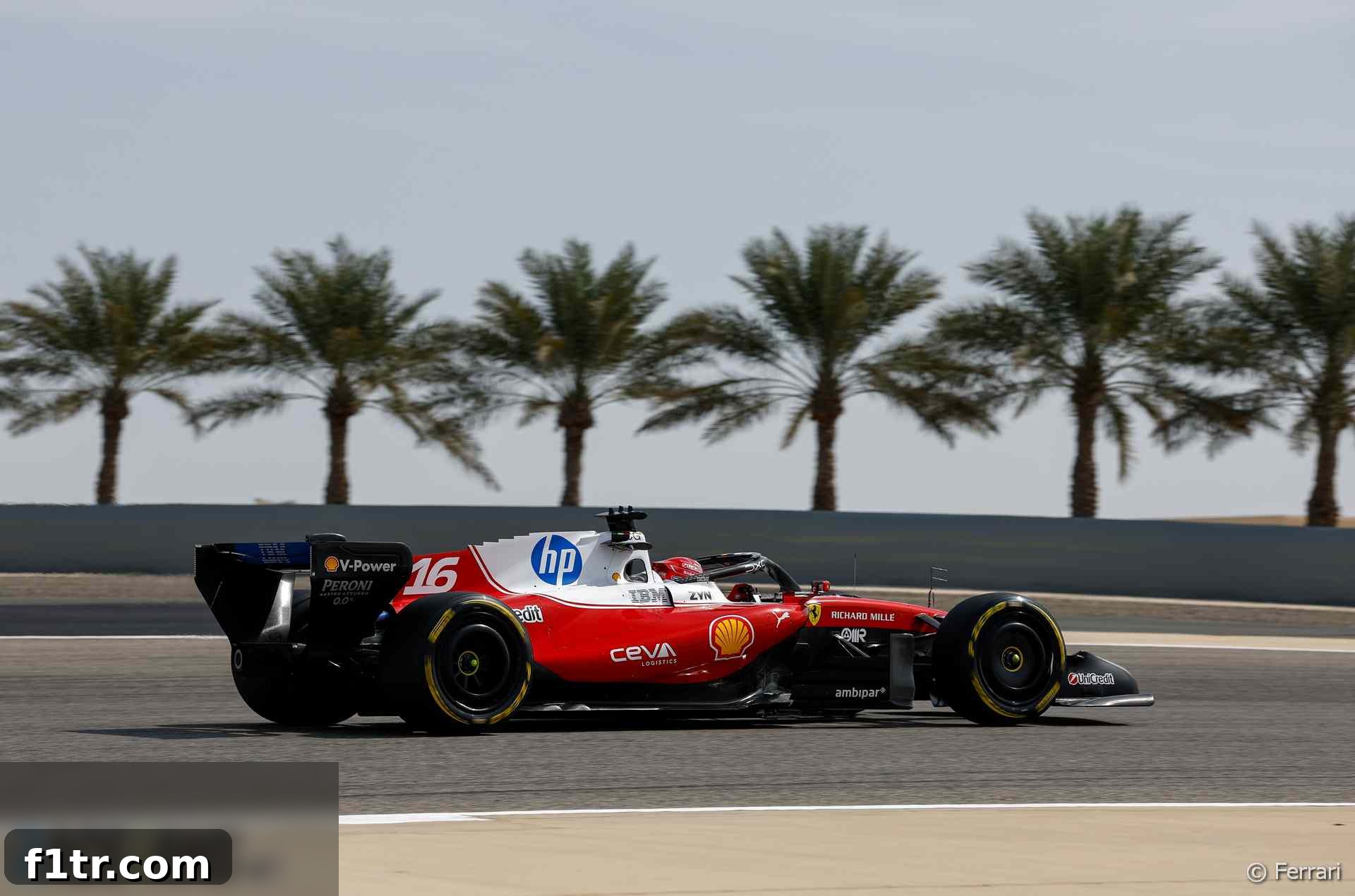
The highly anticipated Formula 1 pre-season testing kicked off its decisive phase in Bahrain, offering the first real glimpse into the competitive landscape of the upcoming 2024 season. Day one, particularly the morning session, saw Charles Leclerc firmly place Ferrari at the top of the time sheets, a position he maintained comfortably until the lunch break. This strong showing immediately ignited excitement among Tifosi and analysts alike, suggesting a potentially more competitive Ferrari this year.
Advert | Become a Supporter & go ad-free
Leclerc, behind the wheel of Ferrari’s latest challenger, the SF-26, posted a blistering lap time of 1’33.739. This impressive benchmark was not only the fastest of the session but also surpassed any lap time recorded by the Scuderia during the initial test sessions at the Bahrain International Circuit just last week. The SF-26, a car generating significant interest, was observed sporting a novel and somewhat unusual winglet positioned strategically in front of its exhaust. This aerodynamic detail hints at Ferrari’s relentless pursuit of performance and innovation, as teams meticulously fine-tune their designs in these crucial pre-season days. The focus for Ferrari during this testing phase appears to be not just raw speed, but also understanding the car’s nuanced behavior across different conditions and tyre compounds, laying a solid foundation for the demanding season ahead.
Pirelli’s Extensive Tyre Range and Prototype Performance
Pirelli, the official tyre supplier for Formula 1, has brought an expanded selection of compounds for these final three days of testing. This includes all five of its standard dry weather compounds, offering teams a comprehensive range of options to evaluate. Additionally, a new prototype tyre was made available, allowing teams to gather crucial data on potential future developments. Leclerc’s chart-topping time was achieved on this prototype tyre, a significant detail that underscores both Ferrari’s confidence in their package and their strategic approach to data gathering.
Equally impressive was Lando Norris, who secured the second-fastest time for McLaren. His lap of 1’34.052, also set on the prototype tyre, represented McLaren’s best performance in testing thus far. This strong showing from Norris indicates that McLaren’s MCL40 could be a potent contender in the hands of their skilled drivers. The team has shown promising signs of recovery and development in recent seasons, and these early test results will bolster hopes for a continued upward trajectory. The consistent performance of both Ferrari and McLaren on the prototype tyres suggests that these teams are not only pushing the boundaries of their car’s performance but also actively contributing to Pirelli’s development feedback loop.
Emerging Talent and Midfield Contenders
Andrea Kimi Antonelli, a highly-touted young driver, continued to turn heads in his Mercedes, securing the third-fastest time. Just a tenth of a second shy of Norris’s pace, and a commanding one-and-a-half seconds ahead of the car behind him, Antonelli’s performance was nothing short of exceptional. Having been the pace-setter in parts of last week’s testing, his consistent speed underscores his immense talent and Mercedes’ capability to produce a strong machine even in the hands of a junior driver. This performance undoubtedly adds another layer of intrigue to the Mercedes camp, with implications for their driver lineup in the coming years.
The midfield battle is shaping up to be fiercely competitive. Mercedes customer teams Williams and Alpine demonstrated encouraging pace, with Alexander Albon and Pierre Gasly claiming the fourth and fifth fastest times respectively. Albon’s performance in the Williams FW48 continues to highlight his ability to extract maximum performance from his machinery, while Gasly’s run in the Alpine A526 suggests the French outfit is making progress in their development. These strong showings from the midfield underscore the depth of talent and engineering prowess across the grid, promising thrilling races once the season officially begins.
Red Bull’s Early Setback and Team Progress
While many teams enjoyed a smooth start, Red Bull faced an early hurdle. Rookie driver Isack Hadjar, driving for the team, completed a mere 13 laps over the initial four hours of testing. A significant portion of his session was spent in the garage as the team diligently worked to identify and resolve a pressure problem within its Red Bull-Ford power unit. Such technical glitches, while not uncommon in early testing, are always a concern, especially for a team with championship aspirations. The limited running meant valuable data collection was lost, potentially impacting their overall test program for the day. However, it’s also during these moments that teams test the robustness of their operations and their ability to quickly diagnose and fix issues, a crucial skill for a long F1 season.
Overall, a significant number of teams have already shown improved pace compared to last week’s initial test sessions. In total, five teams managed to set quicker times, indicating a general progression in understanding and optimizing their new cars. This list notably includes Aston Martin, with Fernando Alonso’s 1’36.536 bringing them within three seconds of the session’s fastest time. Besides Ferrari and McLaren, Williams and Racing Bulls (formerly AlphaTauri) also recorded their quickest lap times of the pre-season testing so far. However, Racing Bulls found themselves further down the order, with Arvid Lindblad registering the 10th quickest time, ahead of Sergio Perez’s Cadillac, highlighting the varying stages of development and testing programs across the grid. The continuous improvement in lap times across multiple teams signifies a promising and potentially close F1 2024 season.
Midday Times: Pre-season test three, day one – A Snapshot of Early Pace
The table below provides a detailed breakdown of the morning session’s performance, offering a clearer picture of who stood out during this critical initial phase of testing. It reflects not just raw speed, but also the number of laps completed, giving insights into reliability and data gathering efforts.
| Pos. | Car number | Driver | Team | Model | Best time | Gap | Laps |
|---|---|---|---|---|---|---|---|
| 1 | 16 | Charles Leclerc | Ferrari | SF-26 | 1’33.739 | 70 | |
| 2 | 1 | Lando Norris | McLaren | MCL40 | 1’34.052 | 0.313 | 54 |
| 3 | 12 | Andrea Kimi Antonelli | Mercedes | W17 | 1’34.158 | 0.419 | 69 |
| 4 | 23 | Alexander Albon | Williams | FW48 | 1’35.690 | 1.951 | 55 |
| 5 | 10 | Pierre Gasly | Alpine | A526 | 1’35.898 | 2.159 | 61 |
| 6 | 6 | Isack Hadjar | Red Bull | RB22 | 1’36.188 | 2.449 | 13 |
| 7 | 31 | Esteban Ocon | Haas | VF-26 | 1’36.418 | 2.679 | 65 |
| 8 | 14 | Fernando Alonso | Aston Martin | AMR26 | 1’36.536 | 2.797 | 28 |
| 9 | 27 | Nico Hulkenberg | Audi | R26 | 1’36.741 | 3.002 | 49 |
| 10 | 41 | Arvid Lindblad | Racing Bulls | 03 | 1’36.769 | 3.030 | 75 |
| 11 | 11 | Sergio Perez | Cadillac | 1’38.191 | 4.452 | 24 |
Advert | Become a RaceFans supporter andgo ad-free
The Significance of Pre-Season Testing for the 2024 F1 Season
Pre-season testing is a crucial, albeit often deceptive, period for Formula 1 teams. While lap times offer a tantalizing glimpse of potential pace, they rarely tell the whole story. Teams employ diverse testing programs, ranging from high-fuel long runs focusing on reliability and race simulations to low-fuel qualifying-style laps designed to push the car to its absolute limit. The true objective for most teams is not necessarily to be the fastest, but to thoroughly understand their new machinery, validate aerodynamic concepts, and iron out any reliability kinks before the first race. Data collection regarding tyre degradation, engine performance across different mappings, and driver feedback on car balance are paramount. The Bahrain International Circuit, with its demanding layout and abrasive track surface, provides an ideal testing ground, offering conditions that are representative of several venues on the F1 calendar.
Ferrari’s early pace with Leclerc is undeniably a positive sign, suggesting a car with inherent speed. However, their consistency over longer runs and their ability to manage tyre wear will be the ultimate litmus test. McLaren’s strong performance echoes their robust end to the previous season, indicating they could be a consistent front-runner. Mercedes, with Antonelli’s impressive showing, hints at a car that might be more user-friendly and adaptable. Red Bull’s power unit issue, while concerning, is not necessarily indicative of a long-term problem for the reigning champions, who are known for their rapid problem-solving capabilities. These three days of testing in Bahrain are the only opportunity for teams to gather extensive on-track data before the lights go out for the season opener. Every lap, every adjustment, and every piece of data gathered is vital for building a championship challenge. The excitement for the 2024 F1 season is palpable, with these early results fueling speculation and anticipation for what promises to be another thrilling year of motorsport.
Formula 1 Insights
- Controversies, Norris, Newey and more: Five new motorsport books reviewed
- One of F1’s greatest races happened 15 years ago today. Or did it?
- “Overtaking is overtaking”: Domenicali denies F1’s yo-yo racing is “artificial”
- The crashes F1 is trying to prevent may be rare – but the danger is obvious
- F1 returning to India soon after 2027 sounds like wishful thinking
Browse all Formula 1 articles