Welcome to this week’s essential motorsport round-up, meticulously crafted for Formula 1 enthusiasts and racing aficionados alike. We dive deep into the thrilling world of high-speed competition, bringing you insightful commentary, the latest news from social media, compelling links to top racing narratives, significant historical moments, and a celebration of birthdays within the motorsport community. Prepare for an engaging journey through the fastest sport on Earth, presented with clarity and precision.
Rethinking Overtaking: The Evolving Dynamics of Formula 1
In the high-stakes arena of Formula 1, overtaking has always been a cornerstone of fan excitement. However, as the sport evolves with new regulations and technological advancements, the very essence of a successful pass seems to be transforming, leading to spirited discussions among viewers. As articulated by @OwenG, a keen observer of the sport, the nuances of overtaking have become increasingly complex and, at times, harder to decipher in the modern era of F1.
One of the enjoyable aspects of overtakes for me has always been watching a battle develop and looking at how the overtaking car tries different ways and then sets it up. A great example of this is Hamilton v Verstappen in Brazil 2021. Hamilton set that overtake up at turn one and also learned from the previous attempts how to make it actually stick. And I understood what he was doing and why he was doing it.
Now I don’t really understand for sure what is happening in these battles. Mistakes? Setting it up? Or just deployment? Yes it’s fun to watch them battle but the enjoyment isn’t as it was because it’s hard to know what is skill and what isn’t.
@OwenG
This insightful observation from @OwenG highlights a critical shift in how Formula 1 racing is perceived. The classic cat-and-mouse battles, where drivers meticulously crafted their attacks over multiple corners, learning from each attempt, provided a clear narrative of skill and strategy. The iconic duel between Lewis Hamilton and Max Verstappen at the 2021 Brazilian Grand Prix serves as a prime example. Fans could clearly see Hamilton’s strategic build-up, his probing, and his eventual decisive move, understanding the profound skill involved in its execution.
In contrast, contemporary Formula 1 sometimes presents a more ambiguous picture. With the advent of advanced energy recovery systems (ERS), DRS, and intricate aerodynamic packages designed to promote closer racing, the lines between genuine driver skill, strategic ERS deployment, and competitor mistakes can blur. While the thrill of wheel-to-wheel action remains undeniable, the ability to discern the underlying factors contributing to a successful overtake has become a challenge for many viewers. Is it a masterclass in car placement and throttle control, or simply a well-timed activation of DRS and ERS boost? This question, posed by @OwenG, resonates with a segment of the fanbase yearning for a clearer understanding of the strategic chess match unfolding on track, ensuring that the spectacle of overtaking truly reflects the incredible talent and calculated risk-taking of the world’s elite drivers.
Insights from the Paddock and Beyond: Key Motorsport Stories
Beyond the immediate action on the track, the world of motorsport is constantly buzzing with developments, debates, and declarations from key figures. We’ve gathered some of the most compelling insights and discussions from across the racing spectrum, offering a deeper look into the sport’s present and future.
‘We don’t need Formula 1 to fail for Formula E to be successful’ – Jeff Dodds, Formula E CEO (Business of Sport)
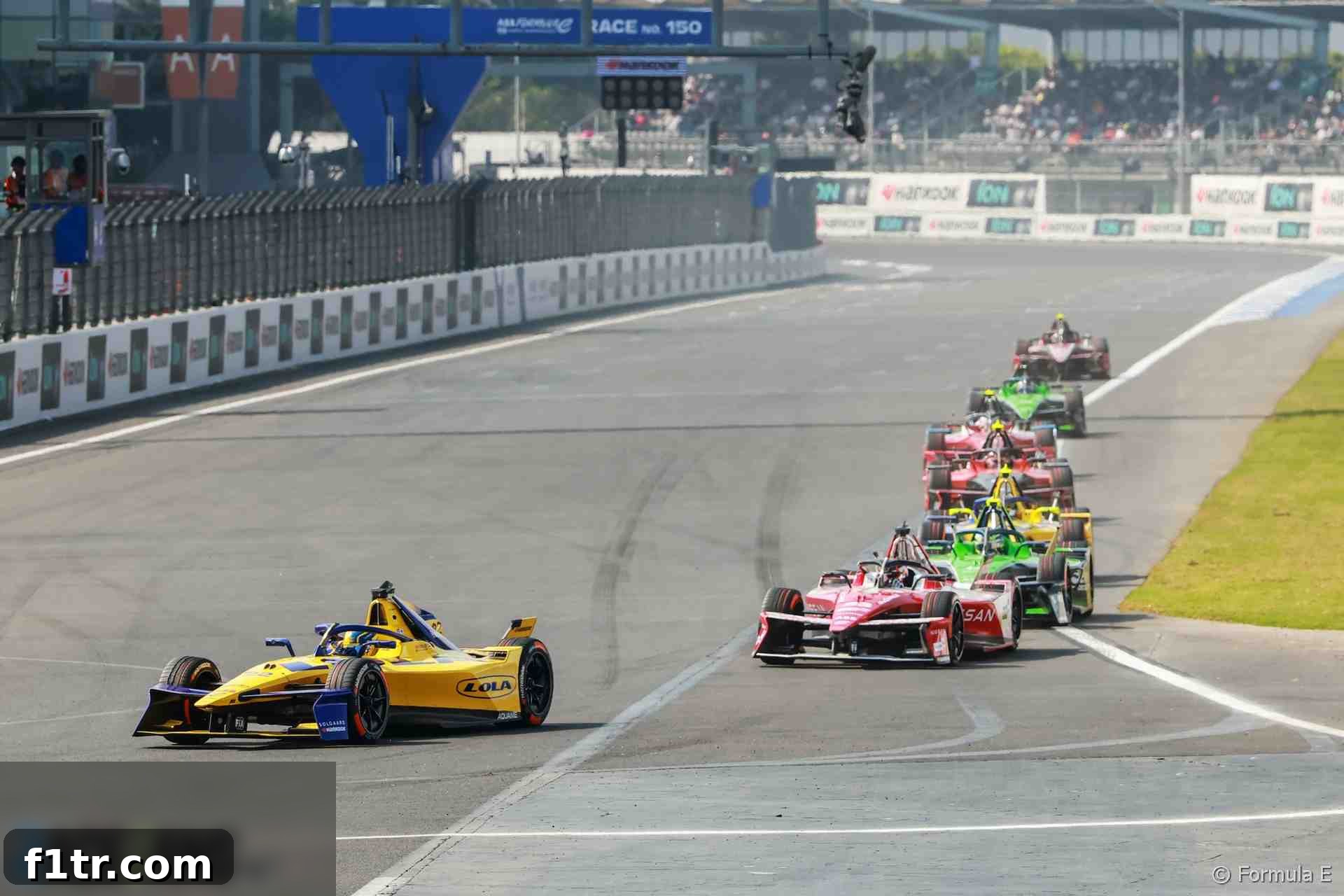
Formula E CEO Jeff Dodds offers a captivating perspective on the co-existence and future trajectory of electric motorsport alongside its traditional combustion engine counterpart. In a candid interview, Dodds articulates a vision where Formula E’s success is not predicated on the downfall of Formula 1, but rather on its own merits as a pioneering, technologically advanced championship. He starkly contrasts the efficiency of F1 engines, which, despite being engineering marvels, convert only around 40% of their energy into propulsion, with Formula E cars boasting an astounding 97% efficiency. This significant disparity isn’t merely an academic point; it underpins Dodds’ bold prediction: “So absolutely our cars, in time, are going to be faster than Formula 1 cars. And that’s not because we’re really clever. It’s because of the physics of the technology that underpins our cars.” This statement underscores the relentless innovation in electric powertrains, where the inherent physics of energy conversion grant electric vehicles a distinct advantage in terms of power delivery and efficiency. Dodds envisions a future, possibly within the next two to six years, where Formula E cars will surpass F1 cars in outright speed, driven by technological evolution rather than a desire to directly compete in every aspect. This long-term vision aims to solidify Formula E’s global fanbase and television audience, carving out its own unique and compelling niche in the motorsport landscape.
Adapting between teams and chasing the perfect balance: How I Race with Sebastián Montoya (Formula 2)
The journey through the junior categories of motorsport is a relentless pursuit of speed, consistency, and adaptability, as eloquently described by Formula 2 driver Sebastián Montoya. His insights into adapting between different teams and striving for the “perfect balance” in car setup reveal the intricate challenges faced by aspiring F1 stars. Montoya details his driving style, emphasizing the nuanced approach required for various corner types: “For a high-speed corner, everything is flat. For a medium speed corner, a little bit of overlap, a little bit of brake and then I just smash the brake for the slow speed corners, turn, smash the power and I’m gone.” This vivid description paints a picture of a driver constantly recalibrating his technique, blending aggression with precision. He also sheds light on the often-misunderstood concept of oversteer, noting, “Surprisingly, I am not someone who likes a lot of oversteer. I think there’s a fine line, like everyone says the car has to be oversteery.” While many drivers prefer a car with a lively rear end that can be rotated aggressively, Montoya’s preference for a more stable machine highlights the personal nature of car setup and how each driver seeks their unique comfort zone to extract maximum performance. His reflections offer a valuable glimpse into the psychological and technical demands placed upon young drivers as they navigate the competitive ladder, seeking to fine-tune both car and craft.
From Werner to Antonelli – Two historic Mercedes victories 125 years apart (Mercedes)
Mercedes-AMG Petronas F1 Team, a powerhouse in modern Formula 1, often reflects on its profound and storied history, a legacy that spans over a century. A recent piece from the team beautifully connects two pivotal victories separated by an astonishing 125 years, illustrating the enduring spirit of competition and innovation that defines the brand. The article spotlights Kimi Antonelli’s recent triumph, which marked the 125th Grand Prix victory for the contemporary Mercedes-Benz F1 team (referring to its modern iteration from Brackley and Brixworth). This milestone, achieved with the distinctive “Silver Arrows” proudly bearing the three-pointed star, carries the immense history and expectation of its Stuttgart origins. What makes this achievement particularly poignant is its timing: it coincided with the 125th anniversary of Mercedes’ very first motorsport victory. That inaugural triumph was claimed by Emil Jellinek, racing under the pseudonym “Mercédès” (after his daughter), at the Nice Race Week in 1899 with a Daimler Phoenix racing car. Connecting these two moments – from the very dawn of motorsport to the cutting edge of Formula 1 – underscores Mercedes’ unparalleled longevity and consistent pursuit of excellence in racing. It’s a testament to a heritage built on innovation, engineering prowess, and a relentless drive for victory, reminding us that success in motorsport is often a continuous narrative across generations.
How we maximised out potential in Japan and why doing so wasn’t straightforward (McLaren)
McLaren’s strategy debrief from recent outings, including their analysis of maximizing potential, offers a fascinating look behind the curtain of modern Formula 1 race management. The team highlights the incredible complexity and dynamic nature of grand prix racing, particularly in the initial laps. They note a “relatively chaotic sequence of laps at the start of races, with drivers still fine-tuning their energy strategies.” This period is crucial, as drivers and their engineers rapidly assess the optimal deployment of kinetic and thermal energy recovery systems (ERS), fuel consumption, and tire management under race conditions. As the race progresses, these phases gradually stabilize into more “normal” periods as teams and drivers refine their understanding of what works best, not just for their own car but also in response to rival strategies. However, true stability is an elusive concept in F1. The state of energy use is constantly changing due to decreasing fuel loads, evolving grip levels as track conditions change, and tire degradation. McLaren specifically mentions “Superclipping starts to happen at different points on track, requiring a response in the driving style.” Superclipping refers to scenarios where the ERS deploys maximum power for an extended period, significantly altering driving lines and overtaking opportunities. These factors, combined with the usual strategic dilemmas of pit stop timing, tire compound choices, and safety car interventions, make race strategy an extraordinarily intricate and constantly adapting challenge. McLaren’s debrief underscores that success in F1 is a blend of pre-race planning, real-time data analysis, and the driver’s ability to execute adaptable strategies under immense pressure.
Super Formula Motegi race one highlights (Super Formula)
For those seeking pure, unadulterated open-wheel racing action, Super Formula consistently delivers. This video captures the thrilling highlights from Race 1 at Motegi, showcasing why Japan’s premier single-seater championship is revered for its intense competition, high speeds, and daring overtakes. With powerful cars and a talented grid of drivers, Super Formula provides a captivating spectacle that stands shoulder-to-shoulder with the world’s best racing series. Witness the close battles, strategic pit stops, and moments of pure racing brilliance that defined the opening encounter at the challenging Motegi circuit.
Super Formula Motegi race two highlights (Super Formula)
The excitement continued into Race 2 at Motegi, and these highlights offer another thrilling glimpse into the high-octane world of Super Formula. After the intensity of the first race, drivers returned to the track with renewed determination, pushing their machines to the limit in pursuit of victory. Expect more breathtaking overtakes, strategic maneuvers, and a showcase of raw speed and precision driving that has become synonymous with this championship. The second race at Motegi often provides an even more dramatic conclusion to a race weekend, with drivers having a better understanding of track conditions and rivals’ strategies.
RaceFans always endeavours to credit original sources. Want to share a relevant motorsport link with us? Send it in via the contact form.
Advert | Become a RaceFans supporter andgo ad-free
- Find more official F1 accounts to follow in the RaceFans F1 social media directory
Community Corner: Happy Birthday!
Wishing a very happy birthday to LAK! We hope you have a fantastic day filled with joy and perhaps a little bit of motorsport excitement. May your year be as thrilling as a last-lap overtake!
On This Day in Motorsport History
Every day holds a special place in the vast annals of motorsport, marking triumphs, births, and pivotal moments that have shaped the sport we love. Let’s look back at some significant events that occurred on this very day:
- A Rising Star Turns 25: Oscar Piastri
Today marks the 25th birthday of Oscar Piastri, a prodigious talent who has rapidly established himself as one of Formula 1’s most exciting young drivers. Born on this day in 2001, Piastri has quickly ascended through the junior ranks, securing championship titles in Formula Renault Eurocup, Formula 3, and Formula 2 in consecutive seasons – an incredibly rare feat. His debut in Formula 1 with McLaren in 2023 saw him immediately impress with his raw speed, maturity, and a remarkable ability to extract performance from the car. Having already secured multiple podium finishes and demonstrating immense potential, Piastri is widely regarded as a future Grand Prix winner and possibly a world champion. His journey continues to captivate fans, and his future in F1 looks exceptionally bright. - Remembering Hermann Lang (Born 1909)
We also remember Hermann Lang, a prominent figure in pre-war Grand Prix racing, born on this day in 1909. Lang was a celebrated Mercedes-Benz factory driver who achieved considerable success in the European Championship, particularly with the dominant “Silver Arrows” of the late 1930s. Post-war, he made a brief return to Formula 1, competing in two Grands Prix in the early fifties. His second F1 outing was for Mercedes’ original Formula 1 team, a testament to his enduring talent. Though his F1 career was short-lived, with a spin-off marking his final appearance, Lang’s legacy as one of Germany’s most skilled drivers of his era remains significant, bridging the golden age of Grand Prix racing with the dawn of the modern F1 championship. - Damon Hill’s Argentinian Pole (30 Years Ago)
Thirty years ago today, in 1994, Damon Hill delivered a masterful performance by putting his Williams FW16 on pole position for the Argentinian Grand Prix at Buenos Aires. This particular season was one of immense emotional weight and intense competition for Hill, as he stepped up to lead the Williams team following tragic events. His pole position in Argentina was a crucial demonstration of his raw speed and determination, showcasing his ability to rise to the challenge. The 1994 season would see Hill engage in a fierce championship battle, cementing his status as a formidable competitor and eventually leading to his own World Championship triumph two years later. His achievement on this day three decades ago remains a memorable highlight in his illustrious career.
Advert | Become a RaceFans supporter andgo ad-free
That concludes our comprehensive motorsport round-up. We hope you enjoyed these insights into the dynamic world of Formula 1, the exciting prospects of Formula E, the challenges faced by rising stars in Formula 2, and a nostalgic look back at motorsport history. Stay tuned for more captivating stories and analyses as the racing season continues to unfold. Your passion drives our coverage!