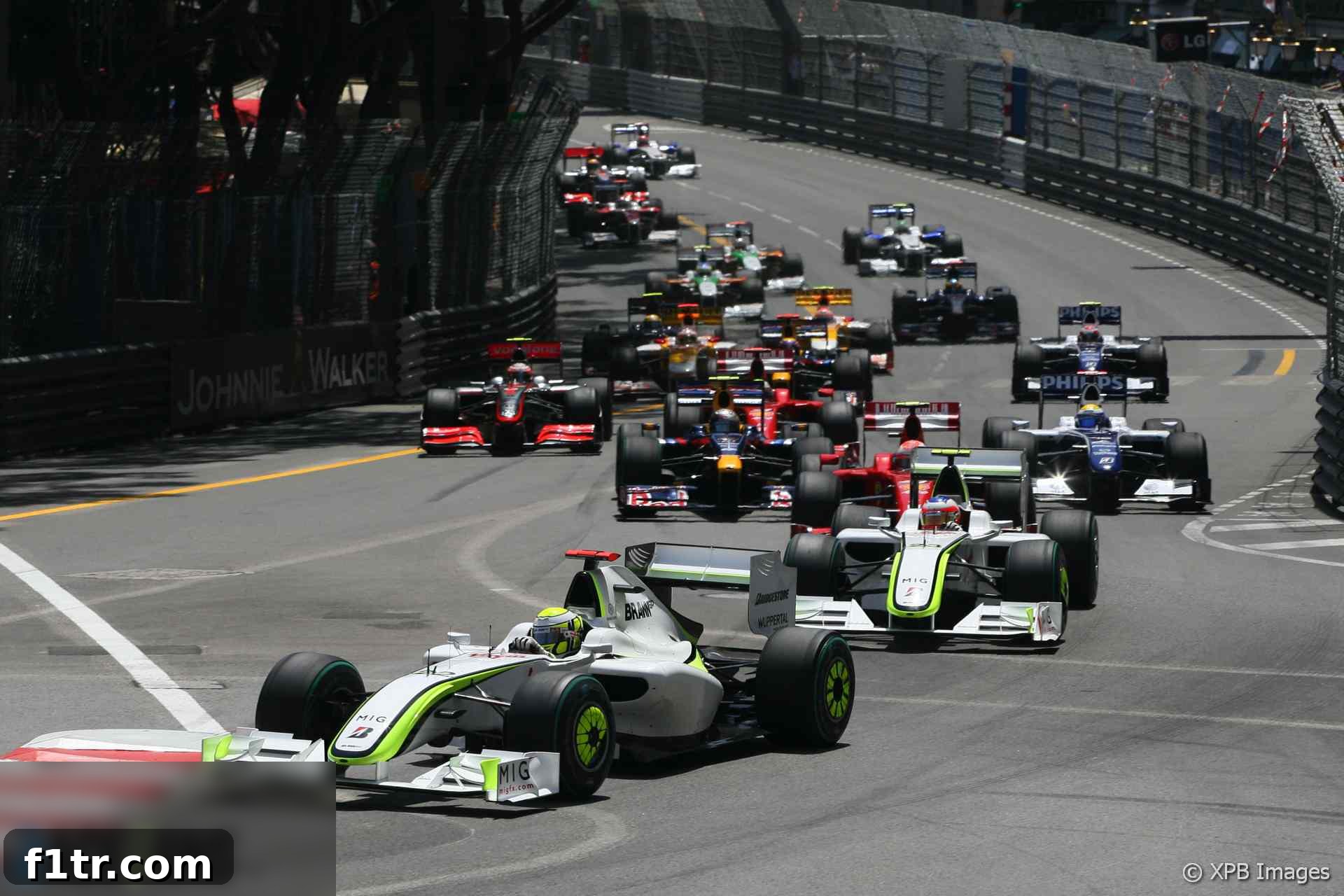
The 2009 Formula 1 season was already proving to be one of the most remarkable in recent memory, dominated by the Cinderella story of Brawn GP and their enigmatic driver, Jenson Button. As the circus arrived at the iconic streets of Monte Carlo for the 67th running of the Monaco Grand Prix, Button was firmly in control of the championship, having clinched four victories from the opening five races. Monaco, a circuit notorious for its unforgiving nature and the ultimate test of driver skill and car precision, presented another crucial challenge in the championship battle. What unfolded on race day, Sunday, May 24th, 2009, might not have been a classic in terms of wheel-to-wheel action throughout the field, but it was an undeniable masterclass from Button, who further cemented his dominance with a commanding fifth win from six starts, leaving his rivals trailing in his wake.
Mastering the Super-Softs: Early Race Dynamics and Strategic Gambles
The qualifying session had already set the stage for an intriguing battle, with Button securing pole position, closely followed by Kimi Räikkönen and Rubens Barrichello. As the red lights extinguished and the cars surged towards Sainte Devote, any fleeting concerns Button might have harboured about Räikkönen’s notorious quick starts from second vanished instantly. It was Barrichello, starting from third on the grid, who executed a flawless getaway. Leveraging the grippier super-soft tyres, the veteran Brazilian deftly passed Räikkönen, snatching second place before the field had even navigated the first corner. This was the only significant position change among the top ten runners, indicating an unusually orderly start for the famously chaotic Monaco circuit. Both Button and Barrichello had opted for the super-soft compound, a decision that initially paid dividends as they quickly established a comfortable gap over the chasing Ferrari.
However, the super-soft tyres, while offering immediate grip, were known for their delicate nature and rapid degradation on the demanding Monaco asphalt. Sebastian Vettel, starting fourth and also on super-softs, was the first high-profile casualty of their temperamental performance. Within just five laps, Vettel found himself struggling significantly, losing six seconds to Räikkönen and coming under intense pressure from Felipe Massa’s Ferrari. Massa, clearly keen to make progress, attempted a bold move at the Nouvelle Chicane on lap six. Over-braking slightly, he cut the chicane, putting him ahead of Vettel. Demonstrating sportsmanship and a keen awareness of potential penalties, Massa immediately yielded the position back. This momentary hesitation, however, proved costly. The opportunistic Nico Rosberg, piloting his Williams, seized the chance, latching onto Vettel’s gearbox and following him past the recovering Massa, who was momentarily powerless to respond. Rosberg continued his impressive charge, passing Vettel on the run to the chicane just four laps later. Massa quickly followed suit, further demoting the Red Bull driver. As Heikki Kovalainen also found a way past, Vettel’s challenging stint on the super-softs concluded with an early pit stop, signaling trouble for his championship aspirations.
Even at the very front, Barrichello began to experience the adverse effects of the super-soft compound. His rear tyres started to grain, causing a noticeable drop in pace. By lap 12, the once-tight gap to Button had ballooned to 7.5 seconds, and Räikkönen’s Ferrari was looming large in his mirrors. Rosberg, despite his earlier overtakes, found himself 16.5 seconds adrift of the leader, a delay largely attributed to his early race battles behind Vettel, highlighting the intricate dance of tyre management and track position that is so crucial in Monaco.
Incidents and Pit Stop Strategies: Shifting Fortunes at Sainte Devote
The notorious Sainte Devote corner, the scene of so many Monaco dramas over the years, lived up to its reputation in the 2009 race. Sebastian Vettel’s already difficult day took a dramatic turn on lap 16. Carrying just a fraction too much speed into the unforgiving first corner, he lost the rear of his Red Bull and spun directly into the barriers. The impact was significant enough to end his race prematurely, a crushing blow for a driver looking to challenge Button for the championship. This incident at Sainte Devote was, remarkably, the second major crash at that very spot on the day. Earlier, during the opening stages, Sébastien Buemi had misjudged his braking, leading to an unfortunate collision that sent Nelson Piquet Jr. out of the race. The narrow confines of Monaco consistently punished the slightest error, and Vettel’s exit underscored this harsh reality.
The pit lane became a flurry of activity as teams reacted to the evolving race conditions and tyre wear. Kimi Räikkönen was the first of the front-runners to make his initial stop on lap 15, switching from super-softs to the more durable soft compound. Brawn GP, ever alert, immediately reacted by bringing Barrichello in on the very next lap to cover Räikkönen, ensuring the Ferrari remained behind their second car. Button, demonstrating his customary calm and control, made his scheduled stop on lap 17, also making the switch from super-softs to softs. This sequence of stops briefly elevated Nico Rosberg into the lead, a rare moment for the young German, though it was short-lived as he too pitted just one lap later.
Williams had gambled on a distinct strategy for Rosberg, opting for a longer middle stint on the soft tyres to minimise the time he would later need to spend on the fragile super-soft compound. This strategic play aimed to capitalise on potential late-race tyre advantages. However, as the race unfolded, this bold move, unfortunately, didn’t quite pay off as intended for Rosberg. Meanwhile, Barrichello managed to chip away at Button’s lead during their second stint on the soft tyres, shaving off approximately two seconds between laps 23 and 46. Yet, Button’s advantage remained formidable at 14.5 seconds. Crucially, Barrichello also carried less fuel, necessitating an earlier second pit stop, leaving Button comfortably in command and unchallenged at the front.
A Challenging Day for McLaren and Late-Race Tyre Dynamics
For the reigning world champion, Lewis Hamilton, the Monaco Grand Prix was a race to forget. His McLaren’s strategy, built around a short-fuel setup, proved hopelessly ill-suited to the tight and demanding confines of Monte Carlo. The lack of clean air and the difficulty of overtaking meant Hamilton was unable to make the significant progress he needed. He made his final pit stop relatively late on lap 53, a stop that included not just fresh tyres but also a new front wing, indicative of the struggles and minor damage he had accumulated throughout the race. While Hamilton persevered, his teammate Heikki Kovalainen was less fortunate. Kovalainen lost control of his car at the entry to La Piscine, a notorious high-speed section, in a manner reminiscent of Massa’s qualifying crash. Unlike Massa, Kovalainen’s incident ended violently against the barriers, forcing his retirement from the race.
As the race entered its final phase, tyre strategy once again came into sharp focus. Kimi Räikkönen was the first of the leading pack to switch to the super-soft tyres for his final stint, pitting on lap 53. This left him with a challenging 25 laps to complete on the previously problematic compound, a stark contrast to earlier in the race when many drivers struggled to manage even a dozen laps on the same rubber. However, a crucial factor had changed: the track surface had now built up a significant layer of rubber, dramatically increasing grip and making the super-softs perform much more effectively and consistently than earlier. This evolution proved to be bad news for Nico Rosberg. Despite making his final stop 12 laps later than Räikkönen, he was unable to fully capitalise on the improved super-soft performance. Having run strongly in fourth place for much of the race, Rosberg unfortunately faded in the closing laps, ultimately falling to sixth by the chequered flag, a disappointing end to what had been a promising drive.
The attrition rate continued to be a feature of the Monaco Grand Prix. Rosberg’s teammate, Kazuki Nakajima, also failed to see the chequered flag, crashing out at Mirabeau due to understeer. He joined the growing list of retirees, which included the aforementioned Vettel, Buemi, Piquet Jr., and Kovalainen. Adding to BMW Sauber’s miserable day, Robert Kubica also retired in the pits, underscoring the relentless challenge of Monaco.
Button’s Triumphant Finish and Championship Implications
Amidst the chaos and strategic gambles playing out behind them, the Brawn GP pair of Jenson Button and Rubens Barrichello executed a flawless closing stage, securing their third one-two finish of the season with remarkable ease. Button’s performance was nothing short of perfection; he didn’t put a wheel wrong from start to finish, driving with a serene confidence that belied the immense pressure of a Monaco Grand Prix. His only “error” came after the race concluded, when he instinctively parked his car in the pits rather than on the traditional start/finish straight for the podium celebrations, a minor lapse in concentration after such an intense effort.
In a truly remarkable display of fitness and exhilaration, Button then sprinted down the long start/finish straight, seemingly oblivious to the 78 laps and 1 hour 40 minutes of grueling racing he had just endured, to claim his rightful place on the podium. This exceptional longevity was not limited to the driver; his Mercedes V8 engine also delivered an outstanding performance. It was the same power unit Button had used in the preceding two Grands Prix, meaning he had achieved an incredible hat-trick of victories on a single engine, a testament to Mercedes’ engineering prowess and Brawn’s meticulous management.
Rubens Barrichello solidified Brawn’s dominance by finishing second, ahead of the resurgent Ferrari duo, who demonstrated genuine progress with their best result of the season so far. Mark Webber managed to salvage valuable points for Red Bull with a solid fifth place. Nico Rosberg, despite his strategic setback, secured sixth position, narrowly ahead of Fernando Alonso in seventh, while Sébastien Bourdais impressively scored the final point in eighth. Giancarlo Fisichella delivered an excellent drive, climbing from 13th on the grid to finish ninth, showcasing his enduring skill. Timo Glock, starting from the pit lane with a heavy fuel load, expertly managed his race on a single pit stop on lap 57 to claim tenth place. Nick Heidfeld finished 11th after his BMW faltered in the final laps, with Lewis Hamilton 12th, followed by Jarno Trulli and Adrian Sutil. Despite his late crash, Kazuki Nakajima was classified 15th due to completing sufficient race distance.
The 2009 Monaco Grand Prix might have been a predictably one-sided affair at the front, but it marked significant developments further down the grid. Ferrari’s strong showing offered glimmers of hope for a competitive second half of the season. For Sebastian Vettel, however, it was a race of missed opportunities, losing another ten crucial points to Jenson Button in the championship hunt. The young German knew he needed a significant turnaround at the next race in Istanbul in two weeks’ time if he was to have any realistic chance of preventing Jenson Button from claiming the coveted Formula 1 world crown.
Driver of the Day: The Fans’ Verdict
The iconic Monaco Grand Prix always sparks passionate debate amongst Formula 1 enthusiasts, and the 2009 edition was no exception. Fans across social media platforms like Twitter weighed in with their nominations for the ‘Driver of the Day’, reflecting both the dominant performance at the front and other standout efforts throughout the field. The overwhelming sentiment, as expected, leaned heavily towards the man who truly mastered the streets of Monte Carlo:
- rjmoseley: It has to be Button, a superb drive, he didn’t put a foot wrong and led for all but.
- filipefurtado: Button. But both Webber and Bourdais did a great job on the back.
- ducolombi: Webber did a great race, but the driver of the day is Button, who had a perfect weekend.
- Clarekelsio: absolutely kimi! This is definitely a huge breakthrough for Ferrari and Kimi himself. 1st time to get a podium this year.
- MarkF1: It has to be Jenson Button he drove a perfect race.
- shaohanmandy: button.
- smboyce: It has to be Button – so fast and consistent. Rosberg was unlucky with strategy…the team can’t sack him now surely.
- Lou_uk: Jenson. Did exactly what he had to, flawless race, and enough energy left over for a little jog’n’skip to the podium! 🙂
- noelinho: Jenson. No other candidate today. Honorary mention to Buemi for his expert take-out on Piquet – beat him at his own game.
- matthewmaber: why Button of course!
- AlasdairCM1982: Fisichella, as much as it pains me to say it.
- 40_thieves: How about Brundle and Legard for finding enough to talk about during that boring race?
The consensus was clear: Jenson Button’s impeccable performance, from his start to his post-race sprint, resonated deeply with fans, making him the undisputed star of the Monaco weekend. Yet, the nominations also highlighted appreciation for other strong performances, from Ferrari’s return to the podium to impressive drives further down the midfield.
Read more:
- Monaco Grand Prix: Rate the Race
- Championship Standings after Monaco
- Monaco Grand Prix Result