Romain Grosjean’s Iconic Bahrain Crash Helmet: A Symbol of Survival and F1 Safety
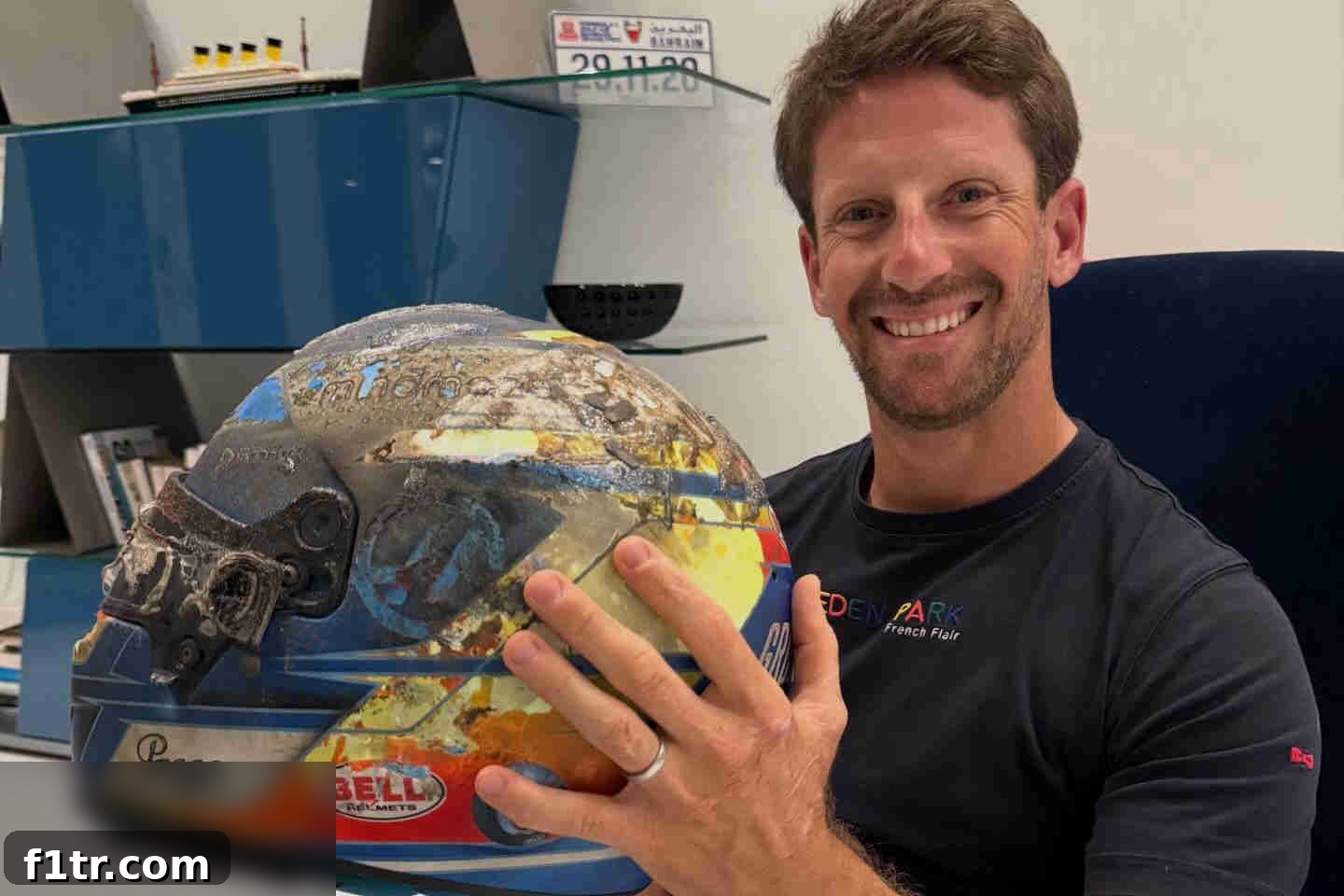
In a poignant moment that resonated across the motorsport world, Romain Grosjean was recently reunited with the very crash helmet that shielded him during his horrifying, fiery accident at the 2020 Bahrain Grand Prix. This reunion, nearly five years after the harrowing incident, brought back vivid memories of one of Formula 1’s most dramatic crashes in recent history, underscoring the vital role of cutting-edge safety technology in saving lives.
The former Formula 1 driver shared an evocative image of his charred Bell helmet on social media, a stark reminder of the inferno it endured. The helmet, though visibly damaged by the intense heat, stands as an indisputable testament to its protective capabilities and the miraculous nature of Grosjean’s escape.
The Fateful Day: Bahrain Grand Prix 2020
The 2020 Bahrain Grand Prix, held on November 29th, started like any other race weekend, but within seconds of the lights going out, it turned into a nightmare scenario. On the very first lap, as the cars jostled for position, Grosjean’s Haas F1 machine made contact with rival Daniil Kvyat’s AlphaTauri. This innocuous-looking tangle sent Grosjean’s car spearing head-first into the unforgiving Armco barrier at an estimated speed of 137 mph (220 km/h) with a force measured at 67G.
A Horrifying Collision and Miraculous Escape
The impact was catastrophic. The front of Grosjean’s Haas chassis, a testament to F1’s rigid carbon fibre construction, prised the steel barrier apart. Shockingly, the car itself split into two distinct pieces, with the rear half breaking away and igniting almost instantaneously into a massive fireball. For what felt like an eternity, Grosjean was trapped within the burning wreckage, engulfed in flames, a horrifying spectacle broadcast live to millions worldwide.
What followed was an extraordinary display of human instinct and sheer will to survive. Despite the overwhelming heat and the immense physical trauma, Grosjean managed to extricate himself from the cockpit. The force required to pull himself free was so immense that it even removed one of his racing boots, which had become trapped amidst the mangled pedals and debris. Against all odds, he emerged from the inferno, visibly shaken but able to walk away with the immediate assistance of the quick-thinking medical and marshaling teams.
While his escape was miraculous, the incident left its mark. Grosjean suffered significant burns to his hands, particularly his left hand, which required extensive medical treatment. These injuries unfortunately prevented him from participating in what would have been the final two races of his Formula 1 career that year, forcing him into an early, albeit temporary, retirement from the sport.
The Unseen Heroes: Advanced Safety Technology
Romain Grosjean’s survival was not solely due to luck. It was a powerful demonstration of decades of relentless innovation in motorsport safety. The combination of FIA regulations, state-of-the-art materials, and meticulous design played an indispensable role in mitigating what could have been a far more tragic outcome.
The Role of the Bell Helmet and Alpinestars Race Suit
At the forefront of this protection were his personal safety items: the Bell helmet and his Alpinestars race suit. The helmet, a marvel of engineering, is constructed from advanced composites like carbon fiber, designed to withstand extreme impacts and temperatures. Its multi-layered structure and energy-absorbing foam liner were crucial in dissipating the tremendous forces exerted during the 67G impact. Furthermore, the visor and shell provided a vital barrier against the intense heat and flames for the 28 seconds Grosjean was exposed to the fire.
Equally critical was the Alpinestars fire-retardant race suit. Made from highly specialized materials like Nomex, these suits are designed to protect drivers from thermal hazards for a significant duration, allowing precious seconds for escape or rescue. The gloves and balaclava, also made from fire-resistant fabrics, further contributed to protecting his skin from severe burns, limiting the damage primarily to his hands.
Evolution of Formula 1 Safety Standards
The Bahrain crash also highlighted the efficacy of broader F1 safety advancements. The ‘Halo’ device, introduced in 2018, while not directly impacting the barrier breach, undoubtedly played a role in preventing the barrier from striking Grosjean’s head as the car penetrated the Armco. The survival cell (monocoque), designed to be virtually indestructible, largely maintained its integrity despite the car splitting, creating a safe space for the driver. Other systems, like the HANS (Head and Neck Support) device, seat belts, and quick-release steering wheels, all contributed to his overall protection and ability to egress rapidly.
The swift response of the FIA medical car team, led by Dr. Ian Roberts and Alan van der Merwe, was also paramount. Their immediate presence and courage in running towards the burning wreck were critical in assisting Grosjean and ensuring his rapid medical attention, a testament to the comprehensive safety protocols in place.
An Emotional Reunion: Facing the Past with Family
The reunion with the helmet was not just a physical act but an deeply emotional one for Grosjean. “Five years after November 29th 2020, I got reunited with my race helmet,” said Grosjean in a heartfelt post on social media. This encounter was particularly significant as it was prompted by his three children, aged twelve, ten, and eight, who expressed a desire to see the artifact of their father’s incredible escape.
Reflections on Gratitude and Life’s Preciousness
Grosjean admitted to his initial apprehension about facing the relic. “I didn’t know if I was ready to see it but my kids really wanted to understand how I was so well protected in the fire and what happened that night,” he explained. The experience allowed him to share a profound lesson with his children about resilience, the power of protection, and the fragility of life. This moment served as a powerful reminder for him, and for many who followed his story, of the immense gratitude he feels for the safety gear and the people who designed it.
“I’ll forever be grateful to Bell and Alpinestars for protecting me so well in that moment,” he reiterated. Beyond the immediate gratitude, the incident profoundly impacted his perspective on life. “Life goes [on] and we forget, but that reminds me how much we should make the most of our lives every day.” This sentiment, shared by Grosjean, resonates with anyone who has faced a near-death experience, emphasizing the importance of appreciating every single moment.
Beyond the Flames: Grosjean’s Journey Post-F1 Crash
The Bahrain incident marked a dramatic close to Grosjean’s Formula 1 chapter, but it was far from the end of his racing career. His recovery, both physical and psychological, was remarkable, demonstrating his unwavering passion for motorsport.
A Return to the Cockpit and New Horizons in Motorsport
After stepping away from F1, Grosjean embarked on a new adventure in American motorsport, competing in IndyCar for four successful years. His talent and determination quickly shone through, earning him podium finishes and demonstrating that the fire had not extinguished his competitive spirit. He subsequently transitioned to sportscar racing in America, continuing to compete at a high level and adding new dimensions to his illustrious career.
A particularly poignant moment came last year when Grosjean had his first run in an F1 car since the fateful crash. Haas F1, his former team, extended a special invitation, giving him the opportunity to drive their 2023 chassis at the picturesque Mugello circuit in Italy. This test drive was more than just a promotional event; it was a symbolic act of closure and a powerful affirmation of his return to full confidence behind the wheel, allowing him to experience the pinnacle of motorsport without the trauma of his last competitive F1 laps.
The Enduring Legacy of the Bahrain Incident
A Testament to Human Resilience and Motorsport Innovation
Romain Grosjean’s Bahrain crash remains etched in the collective memory of motorsport fans worldwide, not just as a terrifying event, but as a powerful narrative of survival. It serves as a stark reminder of the inherent dangers of racing at the highest level, yet simultaneously highlights the incredible strides made in driver safety. The charred helmet, now a personal artifact, transcends its material form to become a potent symbol: a symbol of human resilience, the remarkable effectiveness of modern safety technology, and the continuous, relentless pursuit of making motorsport safer for all who participate.
His story continues to inspire, reminding us all of the fragility of life and the importance of innovation and vigilance in protecting those who push the boundaries of speed and performance.
Related Formula 1 Insights
- Controversies, Norris, Newey and more: Five new motorsport books reviewed
- One of F1’s greatest races happened 15 years ago today. Or did it?
- “Overtaking is overtaking”: Domenicali denies F1’s yo-yo racing is “artificial”
- The crashes F1 is trying to prevent may be rare – but the danger is obvious
- F1 returning to India soon after 2027 sounds like wishful thinking
Browse all Formula 1 articles