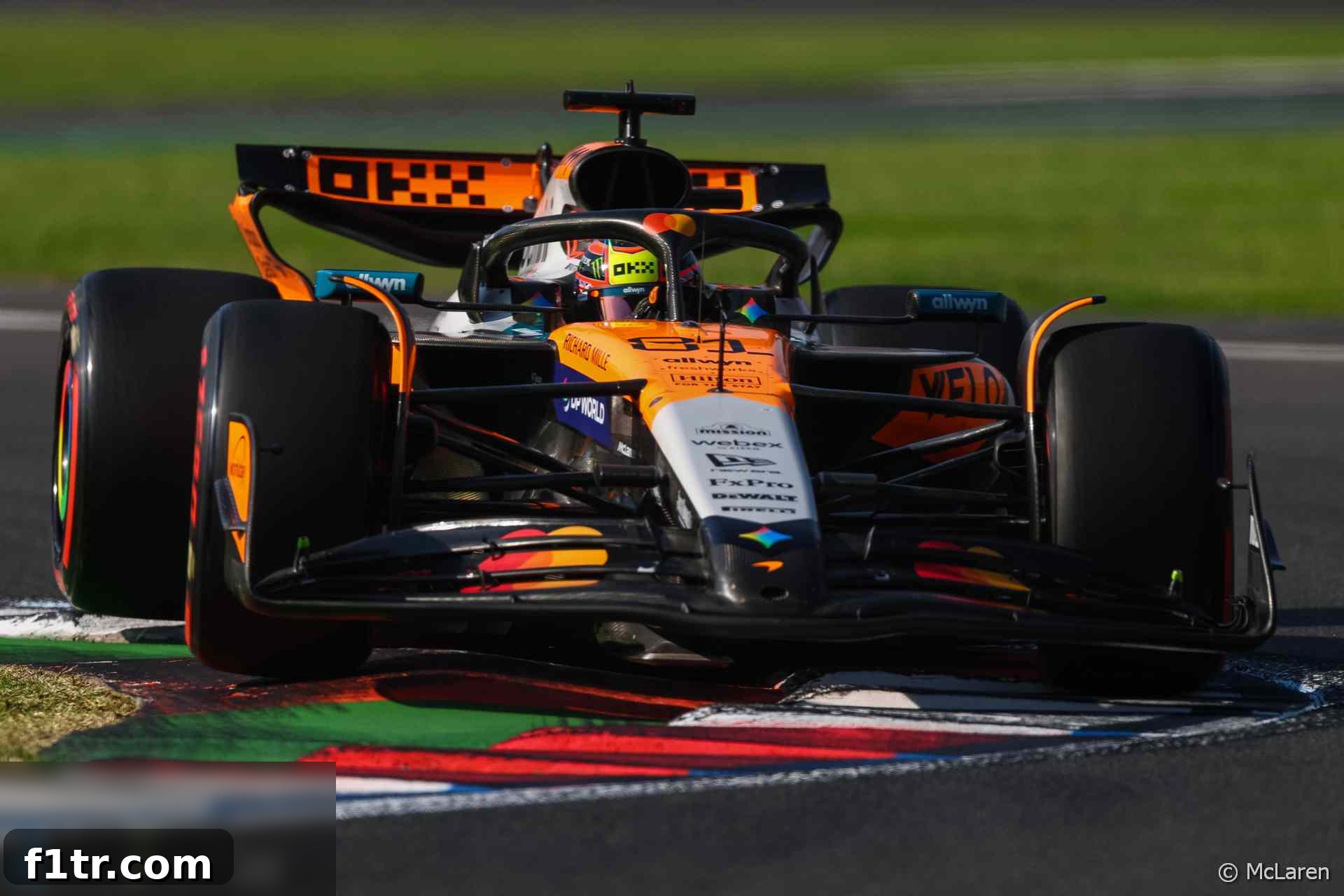
In a qualifying session that saw his McLaren teammate Lando Norris capture a brilliant pole position, Oscar Piastri found himself grappling with a significant and perplexing lack of pace at the Mexican Grand Prix. The young Australian driver candidly admitted there was “no obvious reason” for the substantial deficit, which left him nearly six-tenths of a second slower than Norris on a circuit notorious for its unique challenges.
Oscar Piastri Left Searching for Answers After Tough Mexican GP Qualifying
The high-stakes qualifying for the Mexican Grand Prix proved to be a mixed bag for the McLaren team. While Lando Norris put on a stellar display to secure the top spot on the grid, his teammate Oscar Piastri endured a frustrating afternoon. Piastri qualified eighth, a position that will see him start seventh on the grid once Carlos Sainz Jnr’s penalty is applied, placing him directly behind championship rival Max Verstappen.
A Challenging Path Through Qualifying
Piastri’s struggles were evident early on. He navigated through Q1 and Q2, narrowly avoiding elimination in both segments, a stark contrast to the dominant performance typically expected from the rapidly improving McLaren MCL60. His first run in the decisive Q3 showed a glimmer of promise, bringing him within striking distance of the front-runners and briefly placing him close to Max Verstappen’s time. However, the anticipated improvement on his final lap never materialized, leaving him disappointed and searching for answers.
Post-session, Piastri’s frustration was palpable. “It was tough,” he conceded to the media. “It felt like some of my laps, when it counted, were not bad. But there’s just not the lap time that I’m expecting, obviously. So there’s some things we need to try and understand, but obviously it was a frustrating session.” His comments underscored a significant puzzle for the McLaren camp, as the raw pace simply wasn’t there despite his best efforts and what felt like reasonably executed laps.
Addressing Power Unit Concerns
During the session, Piastri briefly raised concerns over his power unit, an issue that could easily explain a sudden drop in performance. However, he quickly clarified that this was an isolated incident and not a persistent problem. “The PU was fine,” he later confirmed to the official Formula 1 channel. “I think there was just a small under-delivery in one of the corners on the lap, but nothing major that continued.” This reassurance meant the lack of pace couldn’t be attributed to a mechanical fault, deepening the mystery surrounding his performance gap to Norris.
With the power unit ruled out as the primary cause, Piastri reiterated the core issue: “The thing that’s been missing is the lap time. Everything’s felt normal. The car’s never going to feel amazing around here with the high altitude, but everything’s felt pretty normal, just the lap times not being there.” This suggests a subtle but critical disconnect between the driver’s perception of the car’s behavior and its actual speed, particularly challenging at a circuit like Autódromo Hermanos Rodríguez.
The Unique Demands of Mexico City’s High Altitude
The Autódromo Hermanos Rodríguez circuit, located over 2,200 meters (7,200 feet) above sea level, presents an unparalleled challenge on the Formula 1 calendar. The thin air significantly reduces aerodynamic downforce, meaning teams must run maximum wing angles to compensate, yet still achieve the lowest downforce levels of the season. This environment also starves the engines of oxygen, leading to power loss and demanding unique cooling solutions. Drivers often describe the cars feeling “light” and “skittish,” akin to driving on a low-downforce setup despite the maximum wing. This might explain Piastri’s comment that the car never feels “amazing” here, but the lack of lap time relative to his teammate suggests an additional, specific difficulty in adapting to these conditions on this particular weekend.
The intricacies of optimizing car setup for such conditions are immense. Fine-tuning the balance between aerodynamic efficiency and mechanical grip becomes a delicate dance. While the McLaren MCL60 has demonstrated exceptional adaptability and performance on various track types throughout the season, Norris’s ability to extract pole-winning pace while Piastri struggled points towards differences in how each driver managed these unique variables, or perhaps a subtle discrepancy in their respective car setups that manifested significantly in the thin air.
Race Day Prospects from P7
Starting seventh on the grid, directly behind Max Verstappen who lines up fifth, Piastri faces a formidable task. The Mexican Grand Prix is renowned for its chaotic opening laps, thanks to the long run down to Turn 1. This extended drag race offers numerous overtaking opportunities but also carries inherent risks, often leading to incidents. Piastri, known for his aggressive yet controlled racecraft, will be keen to capitalize on any early opportunities.
“I’ll try and have a good start and then see what I can do,” Piastri stated, outlining his immediate objective. “It’s a long run to Turn 1 so there’s opportunities there and I’ll try and take them.” His approach will need to be calculated, balancing aggression with self-preservation to navigate the opening corners cleanly and make progress up the order. A strong first lap could mitigate the disappointment of qualifying and put him in a much better position to score significant points for McLaren.
Furthermore, managing tire degradation and understanding the subtle aerodynamic shifts as fuel burns off will be crucial. The high altitude places extra stress on all components, making strategic pit stops and careful tire management vital for success. Piastri’s ability to adapt his driving style and work with his engineers to find optimal race pace will be key to converting a challenging qualifying into a respectable race result.
McLaren’s Impressive Season and Piastri’s Rising Star
This qualifying performance, while frustrating for Piastri, is an anomaly in what has been an incredibly impressive season for both McLaren and its rookie sensation. McLaren has undergone a remarkable transformation, evolving from early-season struggles to becoming a consistent front-running team, often challenging Red Bull and Ferrari. Lando Norris has been a key figure in this resurgence, consistently delivering podiums and challenging for wins.
Oscar Piastri, in his debut Formula 1 season, has also exceeded expectations. His impressive performances, including podium finishes and strong points hauls, have solidified his reputation as a future star. He has demonstrated remarkable adaptability, speed, and race maturity, making this particular qualifying session in Mexico stand out as an unusual dip. The team will undoubtedly delve deep into the data to understand the root cause of the performance gap, ensuring that Piastri can bounce back stronger in future events.
The contrast between Piastri’s struggles and Norris’s pole position underscores the tight margins and the critical importance of fine-tuning for specific circuit conditions in Formula 1. While the immediate focus is on converting his P7 start into a strong race finish, Piastri’s determination to understand and overcome this challenge highlights the resilience required at the pinnacle of motorsport.
Further Reading on the Mexican Grand Prix
- F1 fans shocked as ferry company screens “adult film” by mistake
- Russell: Lack of penalties over corner-cutting was ‘especially unfair for Lewis’
- Williams aim to give Albon more “consistent” car after consecutive Q1 exits
- Lawson “not at fault” for marshal incident says FIA following criticism from Mexico’s OMDAI
- Stats: Norris takes F1’s biggest win for two years as Ferrari go win-less for 12 months
Browse all Mexican Grand Prix articles