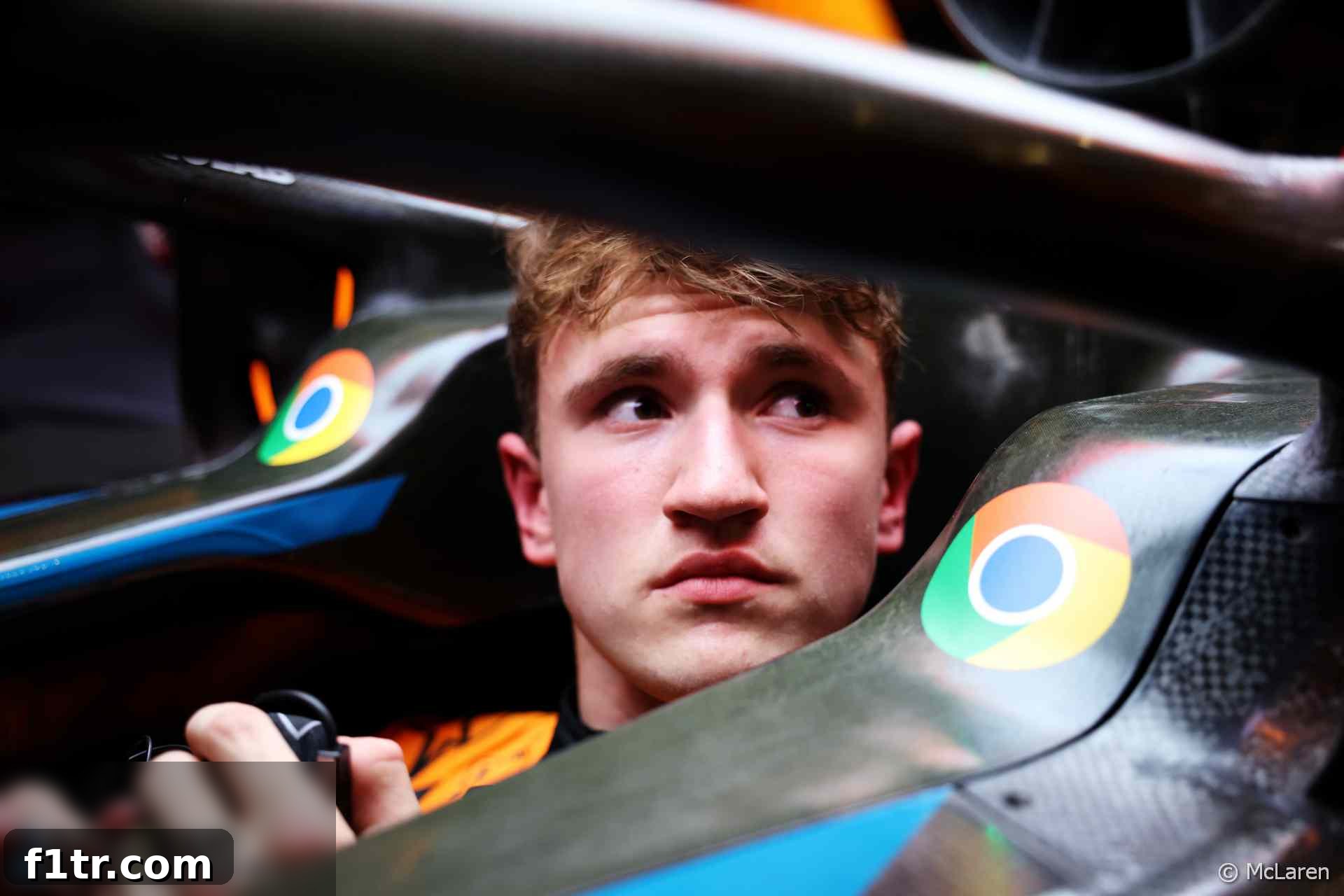
McLaren has officially announced the departure of talented Irish junior driver Alex Dunne from its prestigious Driver Development Programme. This significant development marks a new chapter for both Dunne and the renowned Formula 1 team, as they part ways on what has been described as amicable terms, effective immediately.
Advert | Become a Supporter & go ad-free
The announcement comes after Dunne’s impressive contributions to the programme, which included participating in two Formula 1 free practice sessions this year. These crucial outings provided him with invaluable experience behind the wheel of a contemporary F1 car, a testament to the potential McLaren saw in the young Irishman. His debut at the Red Bull Ring in Austria was particularly noteworthy, where he demonstrated remarkable pace, lapping within a mere tenth of a second of McLaren’s established regular driver, Oscar Piastri. Such a performance on a driver’s first official F1 outing is a strong indicator of raw talent and adaptability, raising expectations for his future career.
Alex Dunne’s Rapid Ascent Through the Motorsport Ranks
Alex Dunne’s journey through the junior motorsport categories has been nothing short of meteoric. His career trajectory has consistently showcased a driver with exceptional natural ability and a keen racing intellect. Prior to joining McLaren’s junior programme in May of last year, Dunne had already made a significant impact on the international scene.
British Formula 4 Champion: A Glimpse of Future Stardom
Dunne’s breakout year came in 2022 when he clinched the British Formula 4 championship, a highly competitive series renowned for nurturing future F1 stars. This championship victory was not just a title; it was a dominant display of skill, consistency, and racecraft. He frequently found himself battling at the front, demonstrating an innate understanding of car control and race strategy that belied his young age. The F4 title served as a crucial stepping stone, validating his talent and putting him on the radar of top-tier junior driver programmes across Formula 1 teams.
Navigating the FIA Formula 3 Challenge
Following his F4 triumph, Dunne progressed to the highly challenging FIA Formula 3 championship. While he finished 14th in his single season in F3, this position doesn’t fully reflect his potential or the fiercely competitive nature of the series. F3 is often a tough proving ground, where drivers compete on the F1 support package, facing intense pressure and battling against a grid full of ambitious talents, many of whom are already affiliated with F1 teams. Dunne’s season in F3 provided him with essential experience in managing complex race weekends, adapting to new circuits, and understanding the nuances of higher-downforce machinery. It was during this period that McLaren recognized his underlying talent and brought him into their fold, aiming to further polish his skills and guide his path towards Formula 1.
Formula 2 Debut: Immediate Impact and Championship Contention
The transition to Formula 2, the final feeder series to Formula 1, saw Dunne make an immediate and powerful statement. His debut season in F2 began with an astonishing victory in the very first feature race he started, held in Bahrain. This was not a lucky win but a performance that highlighted his race management, pace, and ability to perform under pressure. Building on this momentum, he secured a second feature race victory at Imola, a track known for its demanding layout and unforgiving nature. These back-to-back impressive wins briefly propelled him to the lead of the Formula 2 championship standings, a remarkable feat for a rookie in such a competitive series. Although he has since fallen to fifth place, his early season form firmly established him as a significant contender and a driver to watch, demonstrating that his raw speed and racecraft are more than capable of competing at this elite level.
The McLaren Driver Development Programme: A Legacy of Talent Nurturing
McLaren’s Driver Development Programme is one of the most respected and long-standing initiatives in motorsport, dedicated to identifying, nurturing, and guiding the next generation of Formula 1 talent. For decades, McLaren has invested heavily in scouting promising young drivers from around the globe, providing them with comprehensive support, including physical training, mental conditioning, media coaching, and crucial simulator work. The programme aims to equip its recruits with all the tools necessary to thrive in the demanding world of Formula 1, both on and off the track. Alumni of such programmes often go on to achieve great success in various motorsport disciplines, with some even making it to the pinnacle of F1. Alex Dunne’s inclusion in this elite programme was a clear indication of McLaren’s belief in his long-term potential and commitment to his development. The programme’s structure is designed to offer a clear pathway, from junior categories to potential F1 test roles and ultimately, a race seat.
The team’s statement regarding Dunne’s departure reinforced the mutually respectful nature of the split. “It has been a pleasure to work with Alex over the last year and to have been able to contribute to his success and growth as a driver through the McLaren Driver Development programme,” the team announced. “We wish Alex all the best for his career going forward.” This sentiment underscores the professionalism typically observed in such high-stakes environments, where fostering talent often involves a degree of flexibility and understanding of a driver’s evolving career aspirations and opportunities. Releasing a driver from their contract “with immediate effect” is common when both parties agree on a path forward that diverges from the original plan, allowing the driver to pursue new avenues without delay.
Alex Dunne’s Perspective: Gratitude and Future Horizons
Alex Dunne himself addressed the announcement on social media, echoing the sentiment of an amicable separation. “I’ve mutually decided to part ways with the McLaren Driver Development programme,” he confirmed. His message conveyed deep gratitude for the opportunities provided by the Woking-based outfit, particularly the chance to experience Formula 1 machinery firsthand. “I’d like to thank every individual at McLaren that has helped me develop and improve as a driver,” he continued. “To have my first opportunity to drive an F1 car followed by two FP1 sessions is something I’ll always hold very close to my heart, I wish them all the best for the future.”
These two free practice sessions, one at the high-speed Red Bull Ring and another at the iconic Temple of Speed, Monza, were pivotal moments in Dunne’s career. Driving an F1 car during an official session is an experience many aspiring racers can only dream of. For Dunne, these sessions provided invaluable data, both for himself and the team, and allowed him to demonstrate his capabilities on the biggest stage. His impressive pace in Austria, nearly matching Oscar Piastri, undoubtedly raised his stock within the paddock, highlighting his potential to adapt quickly to the extreme demands of Formula 1 cars.
Advert | Become a RaceFans supporter andgo ad-free
The Competitive Landscape: A Glimpse into the Future
The world of junior motorsport is incredibly fluid, with drivers often moving between teams and development programmes as opportunities arise. Dunne’s departure from McLaren has naturally sparked speculation about his next steps. Interestingly, he had previously been linked with a potential move to McLaren’s fierce rivals, Red Bull Racing. Red Bull is well-known for its aggressive and highly successful junior driver programme, which has produced numerous F1 talents, including multiple world champions. Their current F2 roster already includes promising drivers like Arvid Lindblad, Pepe Marti, and Oliver Goethe, indicating a packed pipeline of talent. The possibility of Dunne joining another top-tier development programme highlights his perceived value and the continued belief in his potential to reach Formula 1.
The decision to part ways, even amicably, often signals that a driver or team believes a different path offers a better chance for progression. For a driver like Dunne, whose F2 performance has shown such flashes of brilliance, maintaining momentum and securing the right backing is paramount. The junior categories are a brutal proving ground, where financial backing, team connections, and on-track performance all play critical roles in a driver’s ascent. A change in programme could signify a new alignment with a team that offers a more direct or perceived faster route to F1, or simply a better fit for his specific development needs. While the immediate future remains unconfirmed, Dunne’s impressive resume and current F2 form ensure he will be a highly sought-after talent.
As Alex Dunne embarks on the next phase of his racing career, the motorsport community will undoubtedly watch with keen interest. His early successes in Formula 2, combined with his demonstrated ability in Formula 1 practice sessions, paint the picture of a driver destined for great things. McLaren’s wishes for his future success are genuine, reflecting the shared journey and mutual respect that characterized their time together. The path to Formula 1 is never straightforward, but Alex Dunne has already proven he possesses the speed, skill, and determination to tackle its challenges head-on.
Miss nothing from RaceFans
Get a daily email with all our latest stories – and nothing else. No marketing, no ads. Sign up here:
Formula 1
- Controversies, Norris, Newey and more: Five new motorsport books reviewed
- One of F1’s greatest races happened 15 years ago today. Or did it?
- “Overtaking is overtaking”: Domenicali denies F1’s yo-yo racing is “artificial”
- The crashes F1 is trying to prevent may be rare – but the danger is obvious
- F1 returning to India soon after 2027 sounds like wishful thinking
Browse all Formula 1 articles