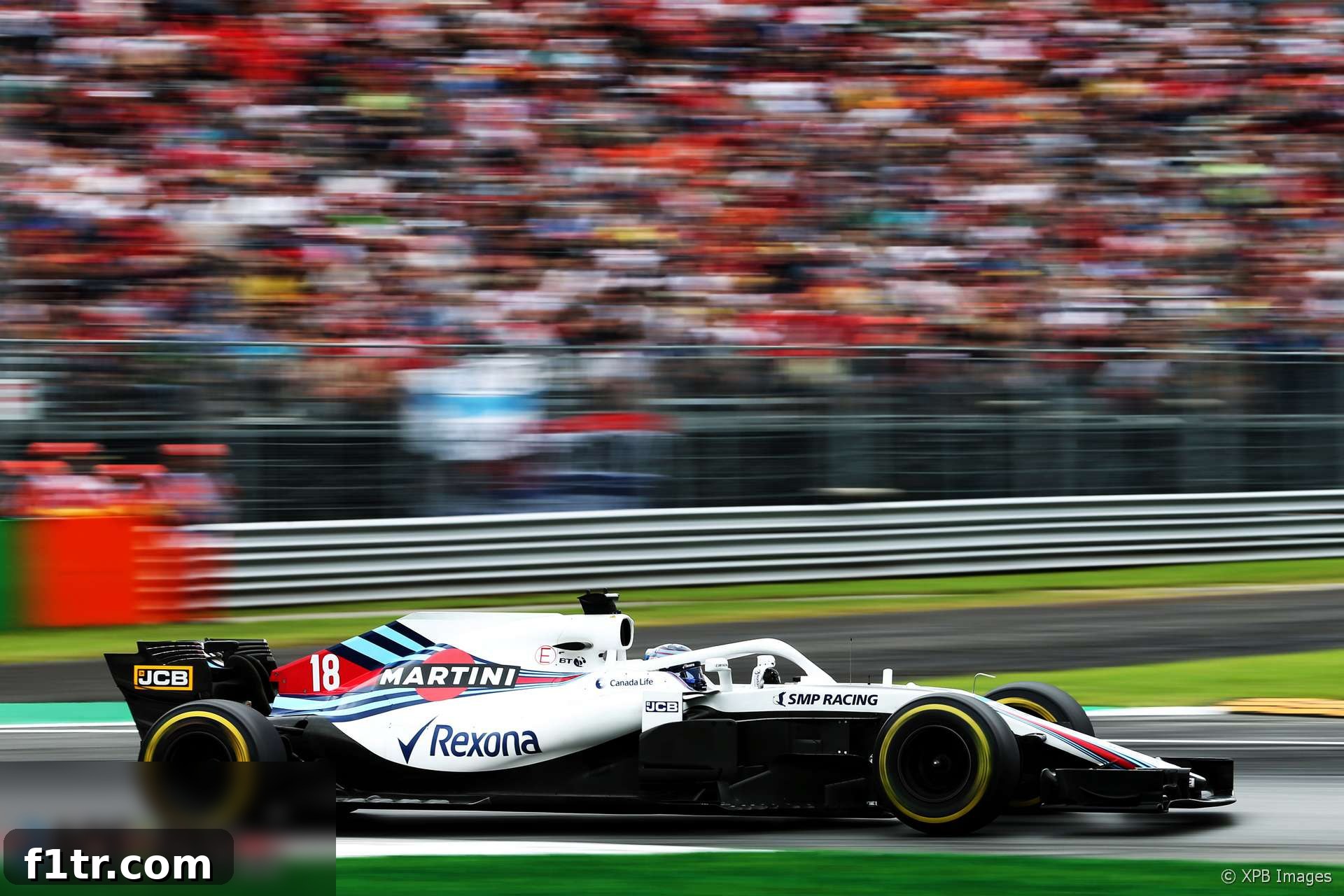
Lance Stroll’s Shock Monza Q3 Appearance: A Glimmer of Hope for Williams
The Italian Grand Prix at Monza, often dubbed the “Temple of Speed,” has a unique way of delivering unexpected moments in Formula 1. For Williams Racing and their young driver, Lance Stroll, the qualifying session for the 2018 race produced one such moment, defying all expectations. Stroll, then just 19 years old, secured a sensational tenth place on the grid, a result that surprised even himself and sent a rare ripple of positivity through the beleaguered Grove-based team.
This achievement was particularly remarkable given Williams’ challenging season. The team had been struggling significantly with car performance throughout the 2018 campaign, making any top-10 appearance a distant dream. Stroll’s advancement to Q3, after securing eighth place in the Q2 session, represented a significant personal triumph and a momentary respite for a team desperately seeking a turning point.
An Unexpected Breakthrough: A Monza Miracle for Stroll
Lance Stroll’s candid reaction immediately after qualifying highlighted the sheer surprise of his performance. “I’m very surprised,” he admitted, a sentiment echoed by many in the paddock. “I wouldn’t have predicted that going into qualifying.” For a team that had only managed to finish in the points once that year – Stroll himself securing a solitary point in Baku – making it into the final qualifying segment was almost unfathomable based on their prior form.
Stroll elaborated on his internal expectations, revealing how modest they had been. “I expected Q2,” he stated. “I thought we did a good job to get into Q2, but Q3 was never in my thoughts looking at all the practice sessions. But the sport’s full of surprises.” This honest assessment underscores the depth of Williams’ struggles and why such a result at Monza felt like a genuine upset. It wasn’t just a good lap; it was a performance that fundamentally reset the perceived limits of what the FW41 chassis was capable of on that particular day.
Monza: A Track of Unique Demands and Potential Opportunities
Monza is unlike any other circuit on the Formula 1 calendar. Characterized by long straights and fast chicanes, it demands an extremely low-downforce setup. This unique aerodynamic requirement often shuffles the competitive order, sometimes allowing cars that struggle with overall downforce to shine. Williams, with its known aerodynamic deficiencies, had pinpointed Monza as a track where their car’s weaknesses might be less exposed, and its Mercedes power unit could be maximized.
The conventional wisdom suggested that Williams, despite its overall struggles, might perform slightly better at circuits where outright top speed was paramount. However, even with this understanding, a Q3 appearance was still a long shot. The FW41, while powered by a strong engine, suffered from a lack of aerodynamic efficiency and inconsistent balance, making it difficult to extract consistent performance. Therefore, Stroll’s ability to capitalize on Monza’s characteristics to this extent was a testament to a combination of driver skill, strategic execution, and a momentary improvement in the car’s handling.
A Symphony of Factors: How Stroll Unlocked Performance
Stroll’s explanation for his breakthrough performance was multifaceted, emphasizing that it wasn’t down to a single element but rather a perfect confluence of circumstances. “It all came together,” he explained. This “coming together” involved several critical components:
The Perfect Lap: Precision and Courage at High Speed
At Monza, a “good lap” is defined by precision through the chicanes, immense bravery under braking, and maintaining momentum through the high-speed corners. Drivers must be absolutely on the limit, trusting the car at speeds exceeding 300 km/h for extended periods. Stroll’s ability to string together a flawless lap under pressure, avoiding errors that can cost tenths, was fundamental to his success. His commitment through corners like the Lesmos and Parabolica would have been crucial, ensuring he carried maximum speed onto the long straights.
The Crucial Tow: Mastering the Slipstream Strategy
The slipstream, or “tow,” is an essential tactical element at Monza qualifying. Drivers strategically follow another car to benefit from reduced air resistance on the long straights, gaining vital speed. Securing a good tow from a faster car can shave significant time off a lap. Stroll acknowledged this, stating, “we got a good tow.” This suggests a well-executed plan by Williams, either through careful timing or an opportunistic find, which allowed Stroll to gain an aerodynamic advantage over his rivals.
Car Improvement: A Moment of Chemistry with the FW41
Perhaps most significantly, Stroll felt a tangible improvement in the car itself. “The car was better today than it has been for a long time,” he remarked. This sensation of the car being “more alive” and the driver being able to truly “work with it and use it” speaks volumes. For a driver, having that “chemistry” with the car means feeling connected to its limits, understanding its responses, and being able to extract every ounce of performance. This could be due to a beneficial setup change that finally clicked with the Monza circuit, specific track conditions that suited the FW41, or a combination of both. Whatever the reason, it allowed Stroll to push the car to a level previously unseen that season.
He continued, “There’s still some limitations and we’re still struggling in a few areas. I think the car was definitely more alive under me today and I could really work with it and use it. It’s always a great feeling as a driver when you’re looking for every little tenth and you can really have that relationship with a car. When you have that chemistry with a car it’s always really pleasant.” This highlights the often-unquantifiable bond between driver and machine that, when present, can yield extraordinary results.
Williams’ Ongoing Struggles: A Glimmer of Hope?
Williams’ 2018 season was widely considered one of their toughest in recent memory. Once a dominant force in Formula 1, the team had been on a steady decline, struggling with both financial resources and technical innovation. A solitary points finish prior to Monza underscored the severity of their performance deficit. While Stroll’s Q3 appearance was a morale boost, it was a rare highlight in a season characterized by difficult weekends and disappointing results.
The question remained whether this performance was a genuine turning point or merely an isolated incident, a flash in the pan enabled by the specific characteristics of the Monza circuit. The team knew their weaknesses were profound, extending beyond just aerodynamic inefficiencies to broader operational challenges. Yet, such a qualifying result provided a much-needed injection of hope and a reminder of the latent talent within the team and its drivers.
Looking Ahead: The Italian Grand Prix Race
Despite the elation of qualifying, Stroll remained realistic about the challenges that lay ahead in the race. Starting tenth meant he would be surrounded by faster cars and experienced drivers, all eager to gain positions. “It’s definitely going to be challenging,” he predicted. His strategy for the race day was clear: “I’ll have to make my car as wide as possible. Try and get a good jump off the line.”
Making the car “as wide as possible” is a common racing driver’s idiom for aggressively defending a position, making it difficult for rivals to overtake. A strong start off the line would be crucial to maintain track position and avoid getting swallowed up by the faster machinery behind him. However, the FW41’s race pace had consistently been weaker than its single-lap performance, often struggling with tire degradation and overall consistency over a full race distance. Scoring another points finish, which would mean holding off more competitive cars for fifty-three laps, would be an even greater feat than his qualifying heroics. It would demand impeccable strategy, flawless pit stops, and unwavering reliability, all elements that had tested Williams throughout the season.
Impact and Future Implications
Lance Stroll’s surprising Q3 performance at Monza offered a significant boost to his confidence and standing within the sport, particularly during a difficult year. It showcased his ability to seize opportunities and extract maximum performance when conditions align. For Williams, it provided a rare moment of celebration and a potent reminder of their potential, even amidst their struggles. While not a definitive turning point for the season, it was a testament to the team’s resilience and the individual talent within its ranks.
This result, albeit temporary, served as a crucial morale booster, demonstrating that despite the overwhelming challenges, moments of brilliance were still possible. For Stroll, a young driver still finding his feet in Formula 1, it reaffirmed his place and his capability to compete at the sharp end, even if only for a single qualifying session. It underscored the unpredictable nature of motorsport and the enduring capacity for human and mechanical synergy to produce unexpected triumphs.
2018 F1 Season Articles
- F1 feared “death knell” for Drive to Survive after Ferrari and Mercedes snub
- McLaren staff told us we were “totally crazy” to take Honda engines in 2018 – Tost
- ‘It doesn’t matter if we start last’: How Red Bull’s junior team aided Honda’s leap forward
- Honda’s jet division helped F1 engineers solve power unit problem
- McLaren Racing losses rise after Honda split
Browse all 2018 F1 season articles