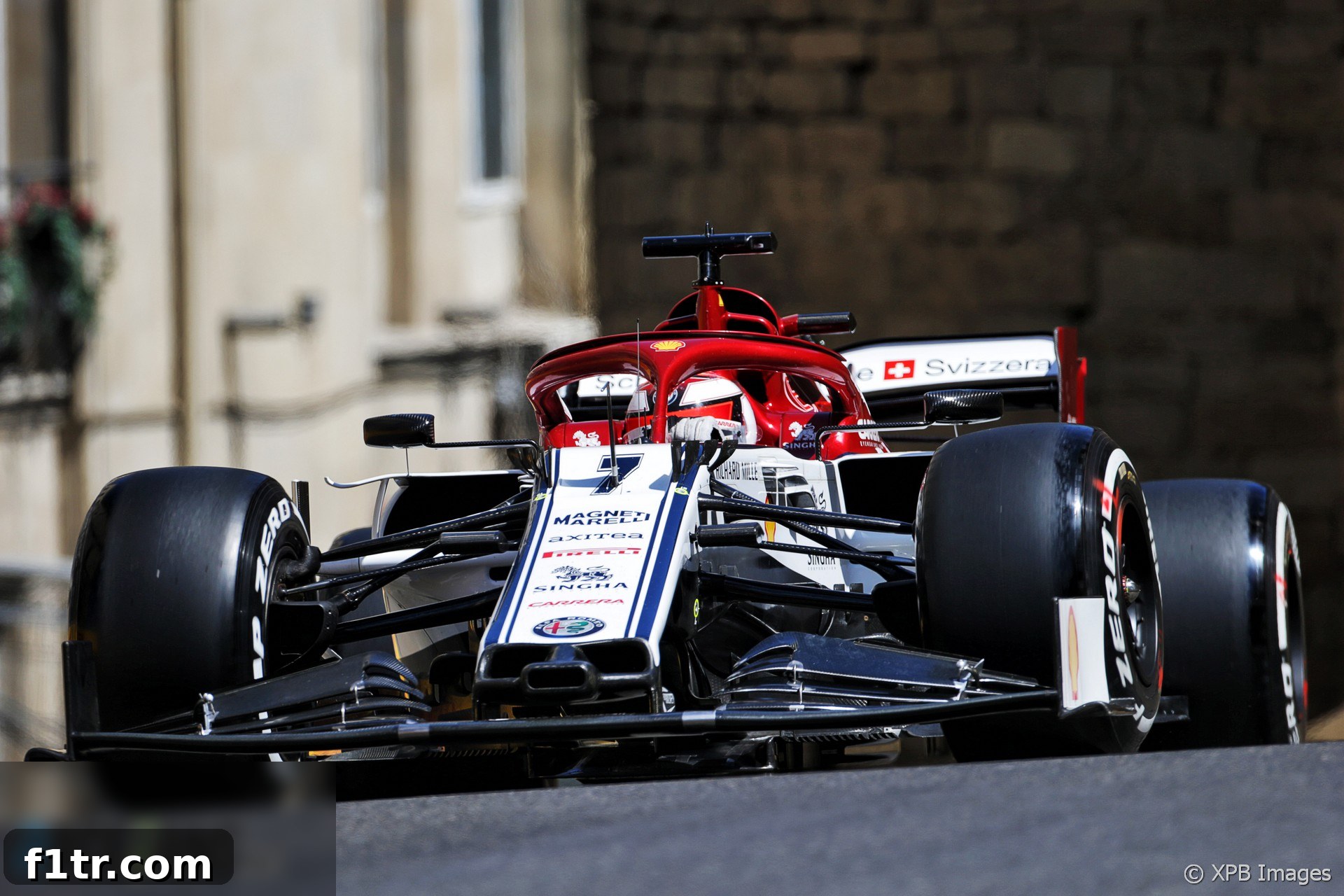
In a dramatic turn of events at the 2019 Azerbaijan Grand Prix, Kimi Raikkonen’s impressive qualifying performance and subsequent starting position faced serious jeopardy following a technical infringement discovered during post-qualifying scrutineering. The veteran Finnish driver, piloting for Alfa Romeo Racing, had secured a commendable eighth place on the grid for Sunday’s race in Baku. However, the meticulous checks conducted by the FIA technical delegates revealed an issue with his car’s front wing, casting a shadow over his promising weekend.
The core of the problem lay in the flexibility of Raikkonen’s front wing. According to the stewards’ findings, the front wing flap on his Alfa Romeo C38 “deflected more than 5mm under a load of 60N”. This finding immediately triggered a review under Formula 1’s stringent technical regulations, which are designed to ensure fair competition and prevent teams from gaining an unfair aerodynamic advantage through flexible components. Such regulations are crucial for maintaining the integrity of the sport and ensuring that all teams operate within a clearly defined set of rules.
Advert | Become a Supporter & Go Ad-Free
Specifically, the infringement related to Article 3.9.8 of the F1 Technical Regulations. This particular article clearly stipulates: “Any part of the trailing edge of any front wing flap may deflect no more than 5mm, when measured along the loading axis, when a 60N point load is applied normal to the flap.” This rule is critical because excessive flexibility in aerodynamic components, particularly the front wing, can allow a car to gain performance by effectively changing its aerodynamic profile at high speeds. While seemingly minor, a few millimeters of deflection can translate into significant gains in downforce or reduced drag, offering an unfair advantage over competitors whose wings remain rigid within the prescribed limits.
The introduction of such strict deflection tests stemmed from a long history in Formula 1 where teams often exploited loopholes to create ‘flexi-wings’ or floors that would bend under aerodynamic load to improve performance. The FIA has progressively tightened these rules and increased the rigor of their checks to eliminate such practices, ensuring that components remain static under specific loads. This constant cat-and-mouse game between innovators pushing the boundaries and regulators enforcing the spirit of the rules is a hallmark of F1’s technical evolution, highlighting the importance of precise measurements and unambiguous regulations.
Upon discovering the breach, the FIA technical delegates refer the matter to the race stewards, who are responsible for investigating incidents and making definitive rulings. The stewards typically summon team representatives and drivers to present their case, providing an opportunity for explanation or defense. In Raikkonen’s situation, the data from the scrutineering test was unequivocal: the front wing’s deflection exceeded the permitted threshold. This left little room for interpretation, pointing towards a clear violation of the technical specifications.
The potential consequences for such a breach are severe. If a car is deemed to be in violation of the technical regulations during qualifying, the usual penalty is exclusion from the qualifying results. This means that Raikkonen would lose his hard-earned eighth-place starting position. More significantly, exclusion from qualifying typically mandates a start from the pit lane for the main race. Starting from the pit lane is one of the most punitive penalties in Formula 1, as it places the driver at the very back of the field, often several seconds behind the pack once the lights go out, effectively compromising their entire race before it even truly begins.
For Alfa Romeo Racing, this presented a significant blow. Raikkonen’s P8 was a strong result for the team, demonstrating competitive pace and offering a promising opportunity to score valuable championship points in Baku, a circuit known for its unpredictable races. Losing this grid position and facing a pit lane start drastically reduces the team’s chances of a points finish, impacting their standing in the constructors’ championship. Teams invest heavily in optimizing every aspect of their cars, and a technical infringement, even if unintentional, can negate weeks or months of development work and track performance.
Update: The stewards concluded their investigation and announced their decision: Kimi Raikkonen was indeed disqualified from the results of qualifying. This ruling solidified his fate for the Azerbaijan Grand Prix, confirming that he would be relegated to a pit lane start. The decision underscored the FIA’s unwavering commitment to upholding the technical regulations, sending a clear message to all teams about the critical importance of compliance. While frustrating for Raikkonen and Alfa Romeo, it reinforces the fairness of competition that underpins Formula 1.
Navigating the Baku City Circuit from the Pit Lane
Starting from the pit lane at the Baku City Circuit presents a formidable challenge. This street circuit is characterized by its incredibly long main straight, tight corners, and a high likelihood of Safety Car periods due to its unforgiving nature. While the long straight offers potential overtaking opportunities, starting from the pits means Raikkonen will lose significant ground to the rest of the field before he even joins the race. He will have to rely on a combination of flawless driving, shrewd strategy calls from his team, and potentially fortunate Safety Car timings to climb through the order.
Drivers who have started from the pit lane in the past have occasionally managed to recover, especially in chaotic races. Baku, with its propensity for incidents and Safety Cars, might offer a glimmer of hope for Raikkonen. However, the sheer talent and competitiveness of the F1 grid mean that every position gained will be hard-fought. His experience and race craft will be put to the ultimate test as he attempts to salvage points from what promised to be a strong weekend.
Ensuring Fair Play: The FIA’s Role in Technical Scrutiny
This incident with Raikkonen’s front wing serves as a potent reminder of the FIA’s diligent role in policing the sport’s technical regulations. Every F1 car undergoes extensive scrutiny throughout a Grand Prix weekend, not just after qualifying but also after practice sessions and the race itself. These checks cover everything from weight and dimensions to fuel flow and aerodynamic components. The objective is singular: to ensure that all competitors adhere strictly to the rules, preventing any team from gaining an unfair advantage through design or operational practices that fall outside the prescribed limits.
The integrity of Formula 1 relies heavily on consistent and fair enforcement of these rules. While teams continuously innovate and push the boundaries of car design, the FIA acts as the guardian of the sport’s technical framework, ensuring a level playing field. Incidents like Raikkonen’s disqualification, though regrettable for the team involved, highlight the unwavering commitment to these principles, ensuring that success is earned purely through skill, strategy, and compliance within the tightly defined regulations.
Don’t Miss Anything New from RaceFans
Stay updated with all the latest news, analyses, and exclusive content from the world of Formula 1. Follow RaceFans across our social media channels for real-time updates and insightful discussions:
- Join the RaceFans community on Facebook
- Follow RaceFans on Twitter for breaking news and live commentary
- Get daily email updates directly from RaceFans
Advert | Become a RaceFans supporter andgo ad-free
Explore More: The 2019 F1 Season in Review
The 2019 Formula 1 season was packed with memorable moments, fierce rivalries, and significant technical developments. Kimi Raikkonen’s incident in Baku was just one of many storylines that unfolded throughout the year. Dive deeper into the events and discussions from that exciting season with our comprehensive archive of articles:
- Esteban Ocon Reflects: “Crying in the Melbourne car park at 2019 grand prix was my career low”
- McLaren Racing’s Financials: Reduced £71 Million Loss Reported in 2019
- Daniil Kvyat on His Hockenheim Podium: “My biggest achievement” of 2019
- FIA’s Response: How New Fuel Flow Meters Targeted Ferrari’s Suspected ‘Aliasing’ Trick
- Behind the Scenes: “He smashed my office door”: 23 Must-See Moments from ‘Drive to Survive’ Season Two
Browse all 2019 F1 season articles for more insights and updates.