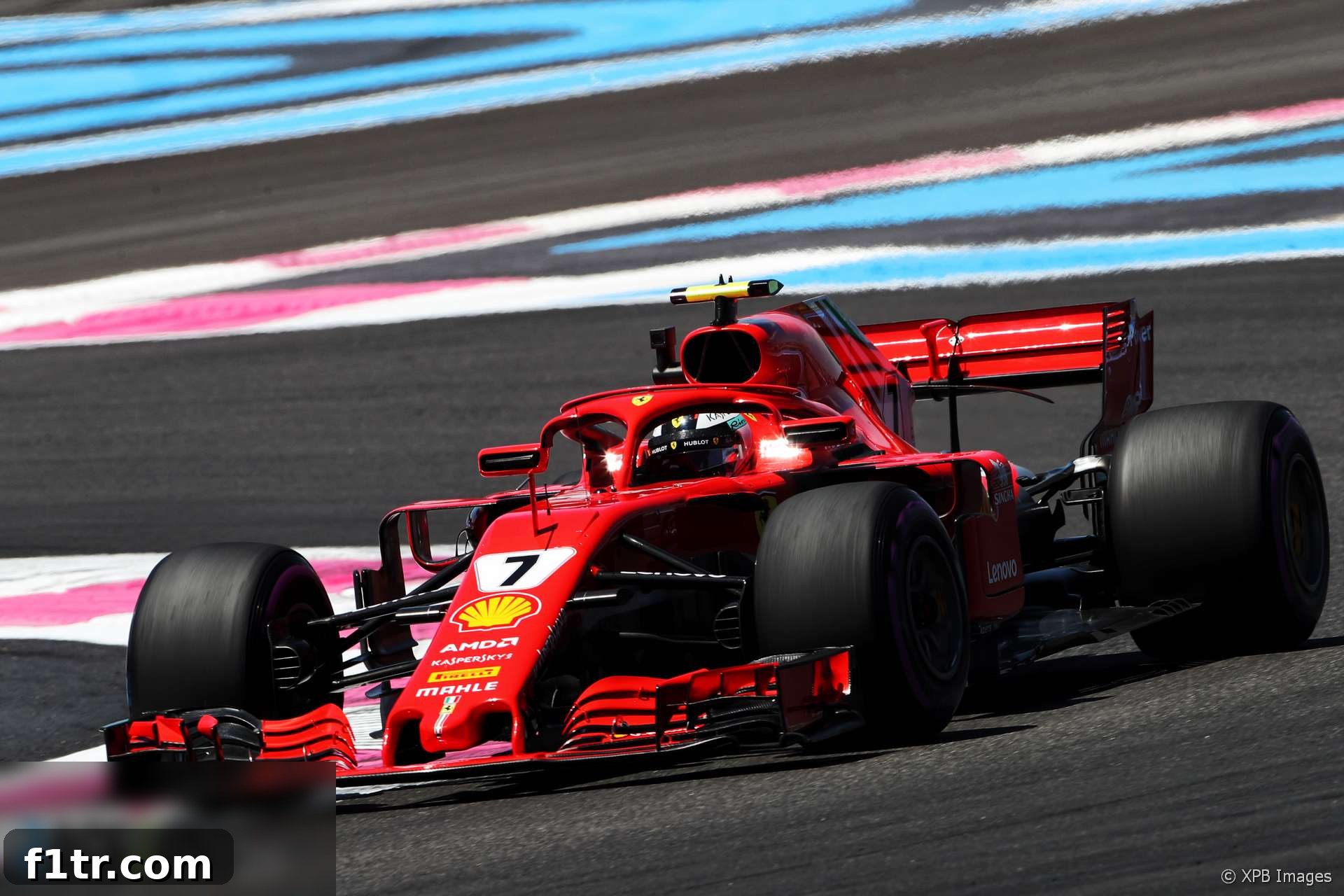
In a decision that sparked considerable debate among Formula 1 enthusiasts and competitors alike, the race stewards opted not to penalise Kimi Raikkonen following an incident during a critical qualifying session. Despite clear evidence that the Finnish driver had impeded Kevin Magnussen by overtaking the Haas F1 Team racer at the outset of his final flying lap, the stewards concluded that Raikkonen’s actions, while impactful, did not warrant a sanction under the prevailing regulations.
The incident unfolded during the intense Q3 phase, where every tenth of a second is crucial for securing a favourable grid position. Both drivers were embarking on their last attempts to set a competitive lap time, a moment fraught with pressure and strategic nuances. Following a thorough review, including discussions with both Kimi Raikkonen and Kevin Magnussen, the stewards issued their findings. They unequivocally stated, “there is no doubt that the ‘push’ lap of car 20 [Magnussen] was thwarted by the proximity of car 7 [Raikkonen] which overtook car 20 just after it had started the lap.” This acknowledgement highlighted the direct negative impact on Magnussen’s crucial lap, a fact further underscored by his frustrated radio message during the session, where he vocally expressed his disbelief at Raikkonen’s maneuver.
The stakes in Q3 are incredibly high, with teams and drivers pushing the absolute limits to gain even a marginal advantage. A clean, uninterrupted lap is paramount, and any interference can significantly derail a driver’s efforts, potentially costing them multiple grid positions. Magnussen’s outburst vividly illustrated the immediate emotional and professional toll such an incident takes. However, the stewards’ ultimate decision hinged not on the outcome of the incident, but on the interpretation of Raikkonen’s intent and whether his driving constituted a breach of specific sporting regulations.
Despite the undeniable disruption to Magnussen’s lap, the stewards ruled that Raikkonen’s driving was consistent with his pattern of behavior on previous laps within the same qualifying session. This formed a cornerstone of their decision-making process. They elaborated, “The stewards noted that the driver of car 20 was unsure of the intentions of the driver of car 7 during the last half of the previous lap, where car 20 was on an ‘out’ lap and car 7 had aborted a push lap. Car 7 did slow towards the end of that lap but when compared to a previous out-lap in Q3, there was a similar pattern of slowing in the same area.” This analysis suggested that Raikkonen’s movements, while ultimately detrimental to Magnussen, were not anomalous for his driving style or qualifying strategy in that specific session. The subtle distinction between causing an impedance and “unnecessarily impeding” became central to their verdict.
The Formula 1 Sporting Regulations are meticulously crafted to ensure fair competition while allowing drivers the necessary freedom to manage their car and tires during qualifying. Specifically, the stewards referenced Article 31.5 of the Formula One Sporting Regulations, which deals with “unnecessarily impeding” another competitor. Their conclusion was that Raikkonen did not ‘unnecessarily impede’ Magnussen. This often means that while an incident may have occurred, the impeding driver’s actions were either unintentional, a result of managing their own car’s performance (e.g., tire temperature, battery charging), or followed a consistent pattern that was not deemed deliberately obstructive. In such high-pressure environments like Q3, drivers are constantly looking for clear track space, and the interpretation of what constitutes ‘unnecessary’ impediment is a fine line stewards must tread.
Furthermore, the stewards also considered Appendix L Chapter IV Article 2e of the International Sporting Code, which addresses driving ‘unnecessarily slowly’. This regulation aims to prevent drivers from deliberately slowing to create gaps, potentially causing dangerous situations or unfairly hindering others. Once again, the stewards found no evidence that Raikkonen had driven ‘unnecessarily slowly’. The pattern of slowing observed on his previous out-lap was deemed similar, suggesting a consistent approach to tire preparation or energy management rather than a deliberate attempt to obstruct Magnussen. This nuanced interpretation highlights the complexity of stewarding decisions, which often require delving into data telemetry and driver explanations to understand intent and context, not just the immediate visual outcome.
Ultimately, despite the clear negative effect the incident had on Kevin Magnussen’s final qualifying lap – a lap that could have significantly altered his starting position – the stewards decided against taking any further action. This outcome underscored the principle that not every incident leading to a disadvantage for one driver automatically warrants a penalty for the other. The specific wording and spirit of the regulations regarding ‘unnecessary’ actions play a crucial role, emphasizing that intent and consistent behavior patterns are carefully weighed alongside the immediate impact. This decision, while controversial to some, reflected the stewards’ adherence to the precise legal framework governing Formula 1, rather than simply penalizing an undesirable outcome.
This incident from the 2018 F1 season serves as a poignant reminder of the fierce competition and razor-thin margins that define Formula 1 qualifying. The 2018 season itself was a period of intense rivalry and evolving dynamics across the grid, with multiple teams vying for supremacy. From the ongoing battle for engine performance, exemplified by Honda’s persistent efforts to improve their power units – a journey often detailed in articles such as “Honda’s jet division helped F1 engineers solve power unit problem” and “‘It doesn’t matter if we start last’: How Red Bull’s junior team aided Honda’s leap forward” – to the strategic decisions made by teams like McLaren regarding engine suppliers, as discussed in “McLaren staff told us we were “totally crazy” to take Honda engines in 2018 – Tost” and “McLaren Racing losses rise after Honda split”, the season was rich with narratives. Even the increasing popularity of the sport, fueled by phenomena like “Drive to Survive,” faced its own challenges, as highlighted by concerns such as “F1 feared “death knell” for Drive to Survive after Ferrari and Mercedes snub”. These broader themes underscore the constant pressure on drivers and teams, making every decision and every on-track interaction, particularly in qualifying, subject to intense scrutiny and profound consequences. The Raikkonen-Magnussen incident was but one snapshot of this relentless pursuit of excellence and the complexities of enforcing fair play at the pinnacle of motorsport.
The stewards’ decision in this case serves as an important precedent, illustrating the intricate balance between penalizing clear infringements and allowing for the natural ebbs and flows of racing strategy within the rules. It reaffirms that while the outcome of an action might be detrimental, the presence of specific intent or a deviation from established patterns of driving must often be proven for a penalty to be applied. For fans and competitors, it highlights the constant challenge of navigating the fine print of the regulations under the intense glare of Formula 1 competition.
2018 F1 season
- F1 feared “death knell” for Drive to Survive after Ferrari and Mercedes snub
- McLaren staff told us we were “totally crazy” to take Honda engines in 2018 – Tost
- ‘It doesn’t matter if we start last’: How Red Bull’s junior team aided Honda’s leap forward
- Honda’s jet division helped F1 engineers solve power unit problem
- McLaren Racing losses rise after Honda split
Browse all 2018 F1 season articles