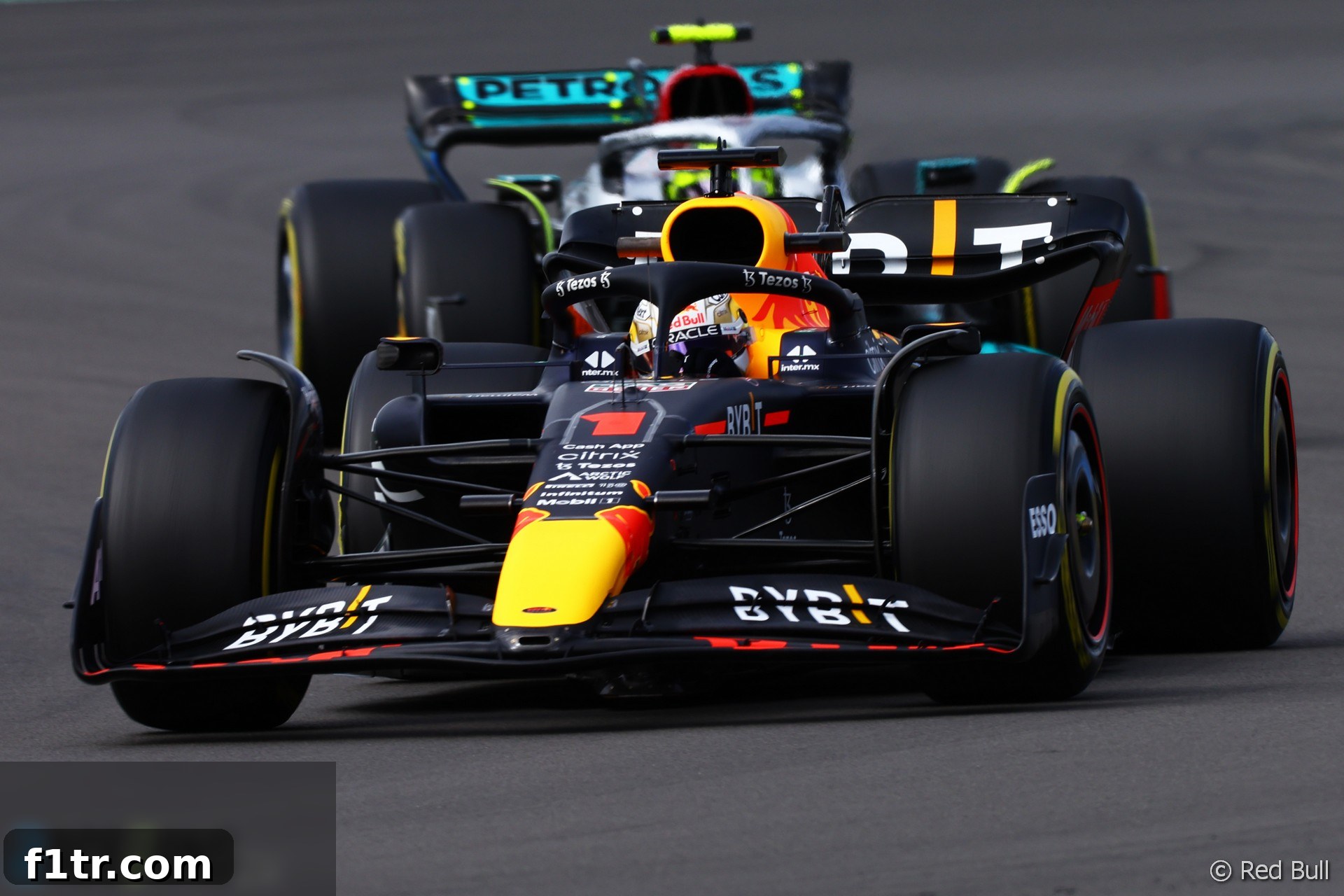
Mercedes-AMG Petronas Formula One Team finds itself at a critical juncture in the 2022 season, meticulously evaluating its revolutionary yet challenging ‘zeropod’ concept against the dominant design philosophy championed by Red Bull Racing. The team’s engineers and strategists are engaged in a deep dive, considering whether to persist with their distinct aerodynamic approach or pivot towards a more conventional, Red Bull-inspired sidepod configuration that has proven incredibly effective under the sport’s new ground effect regulations.
Advert | Become a Supporter & go ad-free
The debate surrounding Mercedes’ W13 and Red Bull’s RB18 has become a focal point of the 2022 Formula 1 season. While Mercedes bravely pushed the boundaries with its minimalist sidepods, aiming for superior airflow management around the crucial underfloor area, Red Bull opted for a more traditional, yet highly refined, concept. The stark performance disparity between the two teams has naturally led to intense scrutiny of their respective design choices. Adding to the pressure, fellow Mercedes power unit customers, Aston Martin and Williams, have recently introduced significant car upgrades that visibly incorporate elements reminiscent of Red Bull’s sidepod design, signaling a potential industry trend towards that concept.
However, Mercedes’ Technical Director, Mike Elliott, offers a nuanced perspective on what truly dictates performance in the current era of Formula 1. He cautions against drawing simplistic conclusions based solely on the visible differences in bodywork, particularly the sidepods. Elliott stresses that the obvious external variations between the upper surfaces of their chassis and the championship leader’s RB18 do not necessarily pinpoint the fundamental reasons for Red Bull’s superior pace and consistency. This insight highlights the profound complexity of modern F1 aerodynamics, where integrated design and invisible airflow play a far greater role than superficial aesthetics.
“People look at the car and they look at the differences and think ‘that’s massive, that’s got to be the big difference that’s there’,” Elliott explained, addressing the common fan and media perception. “I think an aerodynamicist would tell you the really important bits are what’s underneath the floor, the wings and the key aerodynamic structures. While the bodywork contributes to that, it’s not the defining feature.” This statement underscores a critical principle of contemporary Formula 1 car design: the underfloor and its interaction with the surrounding airflow are paramount, especially under the 2022 ground effect regulations. The sidepods, while important, serve more as a means to manage air movement towards and around these critical areas rather than being the primary downforce generators themselves.
Elliott also candidly discussed the unique challenges posed by Mercedes’ bold ‘zeropod’ design. The extremely narrow sidepod concept inherently leads to a wider, more exposed floor structure, which he described as a “big, cantilevered floor.” Managing the structural integrity and aerodynamic performance of such a floor presents significant engineering hurdles. “It’s been well-publicised the difficulty of what we’ve done with the narrow sidepod means you’ve got a big, cantilevered floor. Managing that and managing the stiffness of that is a challenge.” This stiffness is crucial for maintaining a consistent aerodynamic platform, minimizing porpoising, and optimizing the sensitive ground effect – areas where Mercedes has openly admitted to struggling.
The technical director elaborated on the team’s ongoing evaluation process, emphasizing that a thorough and data-driven approach is essential before committing to any significant design changes. “I think we, like probably all of the teams, will evaluate what we’ve got, we’ll look at what others have done and work out what we think are the right ways forward. And I think for us so far the aim has been to generate as much understanding as quickly as we can and then work out what are the right things to do from there.” This comprehensive assessment involves extensive computational fluid dynamics (CFD) simulations, wind tunnel testing, and on-track data analysis, comparing their W13’s performance characteristics against theoretical models and competitor benchmarks. It’s a continuous learning curve for all teams, especially with the radical overhaul of the technical regulations.
Despite being well into the 2022 Formula 1 season, Elliott admits that the optimal approach to the new regulations remains an open question. The sheer complexity and novelty of the ground effect philosophy mean that teams are still uncovering fundamental truths about car performance. “Have we got the right concept? It’s almost impossible to say because you only sort of play your cars, you never play everybody else’s cars.” This statement highlights the inherent difficulty in a competitive environment where direct comparison data is limited. Each team develops its car in isolation, making it challenging to definitively prove the superiority of one concept over another without side-by-side, real-world data across a range of conditions. Elliott further acknowledged that there’s always more to learn, particularly concerning the mechanical aspects of the car, which significantly influence how aerodynamic forces are translated into grip and stability.
Advert | Become a RaceFans supporter andgo ad-free
Mercedes’ philosophy, even in the face of adversity, remains one of relentless self-improvement and adaptability. “But I think we need to just keep chipping away at it. We’re pretty honest with ourselves, we’ve not started on the front foot and we just need to look at where our weakness is, look at how we improve and just keep bringing those upgrades as fast as we can and within the cost cap as well.” This commitment to incremental gains, alongside a brutal honesty about their current performance, defines their strategy. The cost cap, introduced to level the playing field, adds another layer of complexity, demanding efficiency and shrewd decision-making in upgrade development and deployment.
Crucially, Elliott confirmed that Mercedes will not allow pride to hinder their pursuit of performance. The team is prepared to adopt elements from rival designs, including Red Bull’s, if their analysis concludes it’s the best path forward for the W13’s development. “The bodywork bit, the bit that’s visibly different, is probably not the key differentiator, it’s the detail in the floor design. We’ve evaluated some concepts in that direction.” This confirms that their internal assessments delve far deeper than just external shapes, focusing on the intricate aerodynamic interactions, particularly those under the car.
“I’m not going to say which way we’re going to go but we’ll look at that. I think we’d be silly not to have a level of humility that you think you’ve potentially got it wrong and you go and look at what everybody else has done. And that’s not just the Red Bull concept, that’s looking at all the concepts up and down the grid and saying what looks interesting and why.” This statement perfectly encapsulates the competitive spirit of Formula 1: a perpetual cycle of innovation, learning, and adaptation. Mercedes isn’t just fixated on Red Bull; they are meticulously analyzing every design philosophy on the grid, extracting valuable insights from each competitor to inform their own development trajectory. This holistic approach ensures they leave no stone unturned in their quest to return to the front.
The decision to shift concepts is not taken lightly within a top-tier F1 team. Elliott emphasized that such a significant move would only occur if Mercedes possessed a complete understanding of how a different concept performs and, crucially, if it offered a demonstrable advantage over their current design. This rigorous process is paramount to avoid expensive and time-consuming missteps. “[What you] try to do is understand what you think is happening in the flow field, work out what you want to do with the flow field and then develop the bodywork shapes from there.” This involves reverse engineering, where engineers hypothesize the intended function of a competitor’s design based on its visual characteristics and then use simulation tools to validate or refute these hypotheses. They aim to understand the ‘why’ behind the ‘what’.
“So we’ll go and look and say ‘what do we think the Red Bull bodywork does and why does it do that?’ And the same for all the other cars up and down the grid, and see what we can learn from that. We’ll see what we can apply and then maybe you’ll see changes this year, maybe you’ll see changes next year or maybe we’ll stick with where we are. They’re the questions we’re trying to answer.” The timeline for potential changes remains fluid, reflecting the complexity of F1 development cycles. Significant concept shifts often require substantial design, manufacturing, and testing periods, making mid-season overhauls challenging. Whether Mercedes introduces major revisions to their ‘zeropod’ concept this year, adapts their car more significantly for the 2023 season, or chooses to refine their existing philosophy, hinges entirely on the insights gained from their ongoing, intensive evaluation. The journey to reclaim championship glory is paved with hard decisions and continuous innovation for the Silver Arrows.
Advert | Become a RaceFans supporter andgo ad-free
2022 British Grand Prix Insights and Beyond
The 2022 British Grand Prix offered a microcosm of the season’s challenges and learning curves, particularly for Mercedes, as they continued to unlock the potential of the W13. Such events provide crucial data points for teams to refine their understanding of the complex aerodynamic and mechanical interactions under the new regulations. Every race weekend is an opportunity to gather more information, test new hypotheses, and inform future development directions, a process integral to Mercedes’ current evaluation of their sidepod strategy.
- How many victory chances did Hamilton have in his first winless F1 season?
- New rule added on drivers abandoning cars after George Russell’s Silverstone retirement
- Hamilton told Leclerc ‘I didn’t want to clip you and send you off’ after Copse scrap
- Carlos Sainz: Ferrari accepted I was right not to follow “10 car lengths” instruction
- Guanyu Zhou says Silverstone crash force exceeded roll hoop impact test
Browse all 2022 British Grand Prix articles