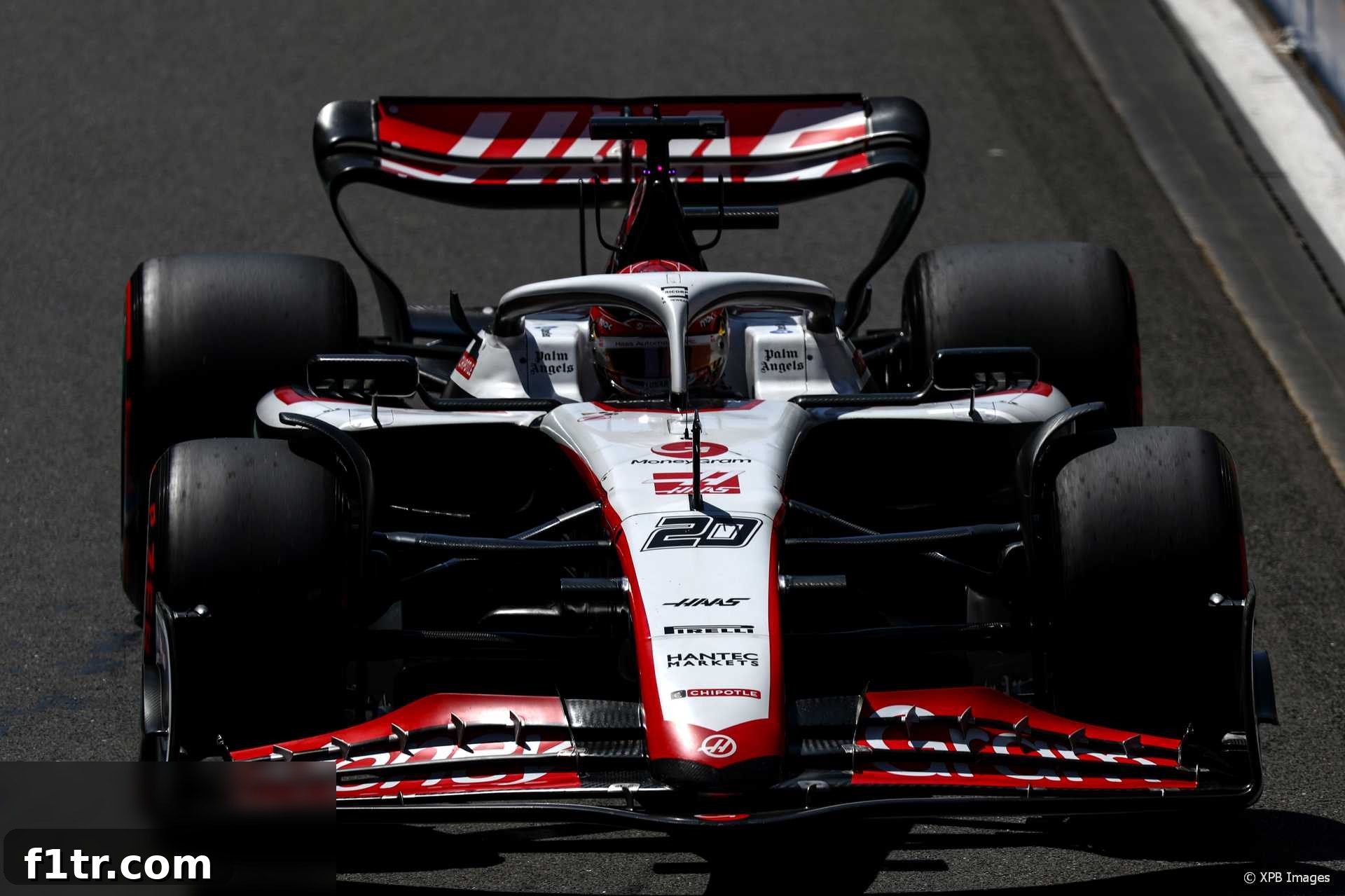
Kevin Magnussen, a seasoned competitor in the high-octane world of Formula 1, has faced a challenging period, failing to finish higher than 15th in his last nine Grand Prix appearances. This string of results highlights a broader struggle with the Haas VF-23, a car that has proven generally uncompetitive in race trim throughout the season.
Advert | Become a Supporter & go ad-free
While his Haas teammate, Nico Hulkenberg, has frequently demonstrated the ability to extract strong qualifying performances from the VF-23, Magnussen has openly admitted his difficulty in mastering the car over a single, decisive lap. This disparity in one-lap pace has become a focal point of his season, prompting introspection and a deep dive into the nuances of his driving style versus the car’s demands.
Decoding Magnussen’s Struggle with the Haas VF-23
The rigorous Formula 1 calendar, featuring 12 Grands Prix crammed into five intense months followed by a critical month-long summer break, offered Magnussen both ample track time and a crucial period for reflection. This extended period allowed him to meticulously analyze the disconnect between his approach and the VF-23’s characteristics, fostering a clearer understanding of the root cause of his qualifying woes.
“I think I understand what it is,” Magnussen shared with media, including RaceFans, during the Monza weekend. “I can see what it is I need to do, but it’s such fine details. It’s very, very difficult to do.” His statement underscores the intricate nature of F1 racing, where even minute adjustments in technique or car setup can yield significant performance differences.
Heading into the recent race weekends, Magnussen expressed a cautious optimism, noting subtle signs of improvement. “I think actually – nothing to show for it, but – I have a feeling that if you look at the practice times and stuff, I think in the last two events, it’s been better. Maybe even three, from Hungary.” This indicates a gradual progression in his understanding and adaptation, even if not yet fully reflected in headline-grabbing results.
The Physics of Cornering: ‘V’ vs. ‘U’ Driving Styles
To articulate his challenge, Magnussen delved into the commonly used ‘V’ and ‘U’ analogies that drivers employ to describe cornering techniques. These styles dictate how a driver manages braking, turn-in, and throttle application, significantly impacting the car’s behavior and the forces exerted on its tires.
- ‘V’ Style Cornering: This aggressive approach involves maximum braking in a straight line, followed by a sharp, late turn-in. The driver then quickly straightens the steering wheel to open up the corner exit, allowing for an early and full application of throttle in a straight line. The car spends minimal time rotating under lateral load, emphasizing straight-line acceleration and braking. This style is often favored when a car has strong straight-line speed and braking performance but may struggle with mid-corner stability or tire temperature management under combined loads.
- ‘U’ Style Cornering: In contrast, the ‘U’ style is characterized by a more gradual, arcing approach to the corner. The driver initiates turning while still braking, carrying speed into the apex and maintaining a longer period of rotation through the corner. This requires a delicate balance between longitudinal (braking/acceleration) and lateral (cornering) forces, with the driver smoothly transitioning from brake to throttle while the car is still turning. This style often suits cars with strong mechanical grip, balanced aerodynamics, and tires that can withstand prolonged combined-G loads.
These two distinct methodologies have profound implications for the G-forces experienced by the car and its crucial Pirelli tires. Turning under braking means that lateral forces are applied perpendicular to the car’s direction of travel, in addition to the vertical downforce pushing the tire into the track (generating traction) and the longitudinal forces from braking or acceleration. Managing these multi-directional forces simultaneously is a delicate art, directly impacting tire temperature, wear, and ultimate grip.
Advert | Become a RaceFans supporter andgo ad-free
Magnussen firmly believes that mastering this intricate interaction is paramount to unlocking the VF-23’s potential. He elaborated, “You can’t really combine Gs much with these cars. I think also a big part of it is the tyres. They don’t allow you to combine G so you can’t do a lot of rotation and braking at the same time. You kind of have to ‘V’ the corners more.” His natural inclination, he admits, is to be more of a ‘U’ driver, a style that clearly clashes with the current car-tyre dynamic.
The Dane suspects that the inherent performance differences between the cars on the grid also play a significant role. He quipped that if he were “in the Red Bull I think I could do it easily,” highlighting that a more forgiving or inherently stable car might mask these driving style conflicts. However, adapting within the confines of the Haas VF-23, which appears less tolerant of combined loads, is proving to be a substantial hurdle.
The Challenge of Reprogramming Driver Instincts
Changing deeply ingrained driving habits, honed over decades of racing, is not a simple task for an elite athlete. “It has to be automatic,” Magnussen explained, drawing an apt comparison to a golf swing. “It’s like a golf swing, at the end of day. Trying to change the angle of your wrist just a couple of degrees, at like at this exact point in the swing, [very quickly] it’s gone. You’ve done it.” This analogy perfectly illustrates how a fraction of a second in a corner requires automatic, intuitive responses that are deeply embedded in a driver’s central nervous system.
“It’s very hard to adjust these things. It takes 10,000 hours and then you’ve done it. It is really something so in our central nervous system, it’s in there, being done very automatically.” This emphasizes the profound challenge of altering what has become muscle memory for a top-tier racing driver. The mental and physical effort required to consciously override these automatic responses, especially at speeds exceeding 200 mph, is immense.
Conscious of the pitfalls of ‘over-thinking’ the problem, Magnussen is exploring alternative solutions. “Often it’s best not to try too hard to change those things, but actually find ways around it,” he noted. This involves working closely with his engineers to adapt the car’s setup to better complement his natural tendencies, rather than forcing a complete overhaul of his driving style. “I’ve changed some things in the car, some simple things, that I feel like helped a lot. So that my driving style starts to work a little bit better. Stuff that that can kind of allow me to drive more in a ‘V’ style in an easier way.” This pragmatic approach suggests a focus on optimizing the available tools to bridge the gap between driver and machine.
Magnussen firmly believes that his adaptability is not a weakness. “I think I’m a driver who can drive many different cars,” he asserted, referencing his experience in sports cars, Indy cars, and various F1 machines. “It’s always been easy for me to adapt. So I think this car, it’s unstable in just the worst part of the corner.” This points to a specific characteristic of the VF-23 – particularly its instability at the critical mid-corner phase – as the core issue, rather than a general lack of versatility on his part.
Advert | Become a RaceFans supporter andgo ad-free
Qualifying vs. Race Pace: A Tale of Two Performances
Despite his qualifying struggles, where Hulkenberg has out-qualified him in 11 of 14 Grands Prix this year, Magnussen has consistently demonstrated stronger race pace, converting his Sunday performances into points more often than his teammate. This discrepancy is a common theme in Formula 1 and can be attributed to several factors.
“That one-lap qualifying where sometimes he seems to drive around the issue, or the problems of the car, it’s good to have someone with that much experience when you’re trying to develop a car,” Magnussen acknowledged, referring to Hulkenberg’s ability to extract peak performance in qualifying. He highlighted the immense value of an experienced teammate in guiding car development, especially when the team faces specific technical challenges. “And when you have an issue and you need a new direction, then it’s good to have all this experience in the team.”
The difference between qualifying and race performance often lies in tire management, fuel load, and the level of aggression required. In qualifying, drivers push the car to its absolute limit for a single lap, often ignoring tire degradation for that brief window of maximum performance. In a race, managing tire wear and fuel consumption over many laps becomes paramount, which can sometimes play into the hands of drivers who are naturally smoother or whose cars are kinder to the tires. Magnussen’s ability to score points suggests his race craft and tire management are still strong, even if the absolute one-lap pace is elusive.
“In terms of the pace, it’s not like I have this problem like I just can’t drive this car, as on Sunday it’s always fine. It’s just that one lap that sometimes I struggle to get it out of,” he reiterated. “I have had good qualifying [sessions] this year, I qualified P4 in Miami, so it’s not like I can’t do it ever. But he seems to somehow be able to drive around the issue a bit more often. But I think I’m turning it around.” This sentiment reflects a determined spirit and a belief that, with continued effort and subtle adjustments, he can overcome this specific challenge and consistently unlock the VF-23’s potential on a Saturday as well as a Sunday.
Bringing the F1 news from the source
RaceFans is dedicated to delivering its readers direct insights and breaking news straight from the heart of Formula 1. This commitment to original journalism is made possible, in part, by the invaluable support of our RaceFans Supporters.
By contributing as little as £1 per month or £12 per year (or the equivalent in your local currency), you actively help us cover the essential costs involved in producing independent, high-quality Formula 1 coverage: from extensive travel to circuits, meticulous writing and analysis, content creation, website hosting, direct communication with paddock insiders, and ongoing platform development.
For over a decade, our readers have been our proudest supporters. If you value our unbiased, in-depth reporting and passion for Formula 1, please consider becoming a RaceFans Supporter today. As a token of our appreciation, all Supporters enjoy the added benefit of browsing our entire site completely ad-free. Discover more and sign up via the links below:
- Become a RaceFans Supporter
- RaceFans Supporter FAQ
2023 Italian Grand Prix Articles
- Despite close battles at Monza, F1 drivers want more powerful DRS
- Monza “frustrating” for Alonso but Aston Martin expect better form in coming races
- F1 changed rules to stop Mercedes in 2021 but we won’t ‘cry foul’ now – Wolff
- McLaren will bring ‘follow-up to Austria upgrade’ before focusing on 2024 car
- Magnussen explains why his driving style rarely works with the Haas VF-23
Browse all 2023 Italian Grand Prix articles