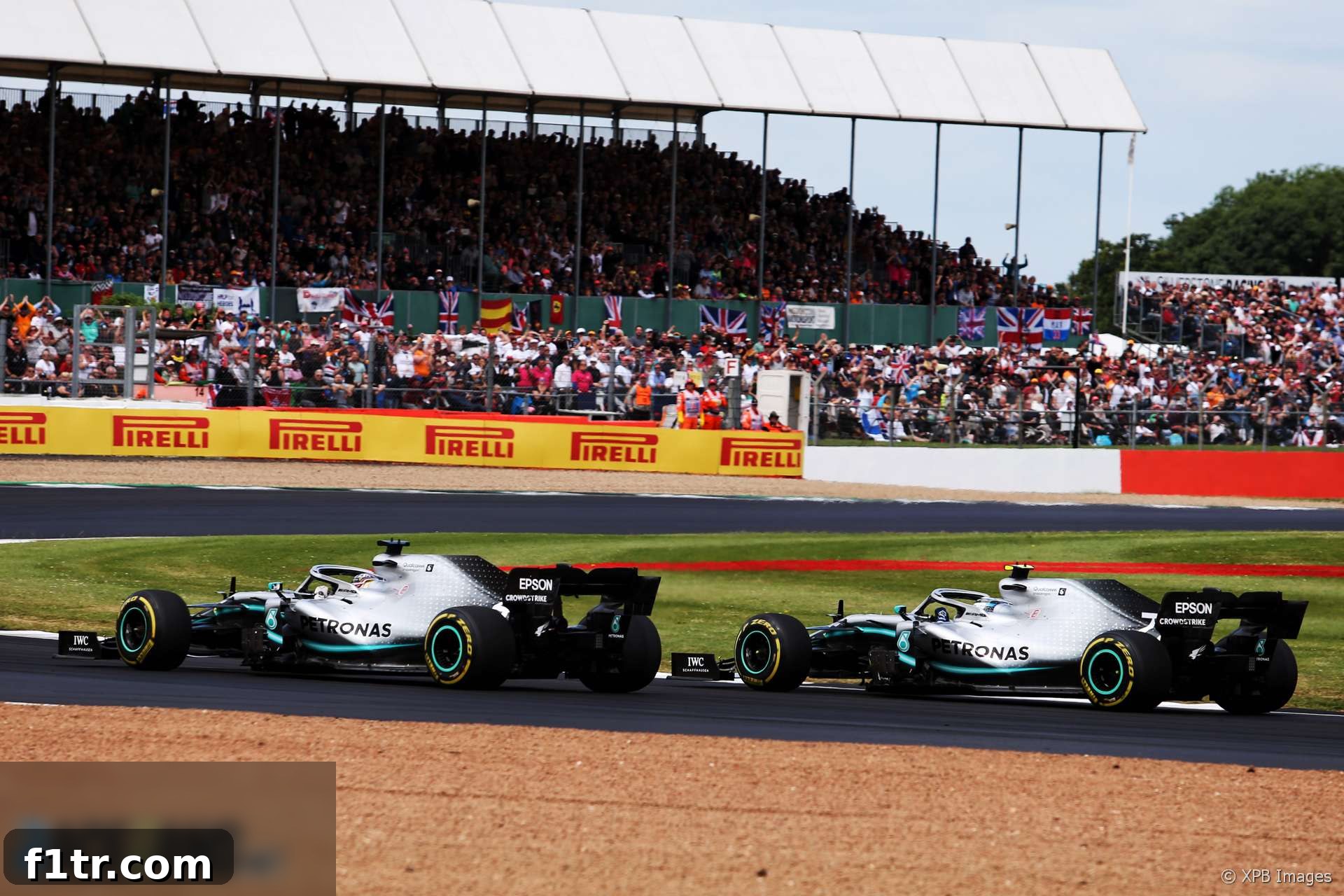
Mercedes-AMG Petronas Team Principal, Toto Wolff, has offered a compelling and nuanced perspective on the intensifying aggression observed in Formula 1 racing, expressing satisfaction with increasingly robust inter-team battles while advocating for restraint between his own drivers, Lewis Hamilton and Valtteri Bottas.
The debate surrounding aggressive driving tactics has been a consistent feature of recent Formula 1 seasons, prompting varied reactions from teams, drivers, and the sport’s governing bodies. Wolff’s comments arrive amidst a backdrop of thrilling wheel-to-wheel encounters that have captivated audiences, particularly those involving some of the sport’s most fiercely competitive talents. While FIA Race Director Michael Masi has maintained that stewards at the Silverstone British Grand Prix did not adopt a more lenient approach to policing race incidents compared to previous rounds, Wolff clearly appreciated the spectacle of hard racing witnessed last weekend, specifically citing the fierce duel between Ferrari’s Charles Leclerc and Red Bull’s Max Verstappen.
The Fine Line: Hard Racing vs. Borderline Dirty
Wolff elaborated on his views, highlighting a perceived shift in the interpretation of racing incidents. “You can clearly see that the Leclerc-Verstappen incident of Austria being interpreted exactly in the way it was in Austria,” Wolff stated, referring to a pivotal moment that set a precedent for what constitutes acceptable on-track aggression. This interpretation, he believes, allows for more assertive maneuvers, such as pushing a rival wide upon corner exit, a tactic frequently seen in other motorsport categories. “Hard racing is permitted. You can push somebody out whilst exiting a corner. I think this is how it is allowed in most of the other formulas,” he noted, underlining a desire for F1 to embrace a more cutthroat, yet still regulated, style of competition.
The Mercedes chief’s enthusiasm, however, comes with a crucial caveat: such intensity should ideally be reserved for battles between competing teams. “It needs to be between teams: team against team. This is what we all and the fans want to see, but it is hard racing. It is something we need, I think,” Wolff asserted. This distinction underscores a fundamental tension within Formula 1: the need to provide thrilling entertainment for fans while simultaneously protecting a team’s championship aspirations and internal harmony. The spectacle of two drivers from different teams fighting tooth and nail for position is undeniably one of F1’s greatest draws, embodying the very essence of competitive motorsport.
The Leclerc-Verstappen Blueprint: A Spectacle for the Fans
The rivalry between Charles Leclerc and Max Verstappen has rapidly become a highlight of recent F1 seasons, often producing some of the most memorable and audacious overtakes. Their spirited exchange at the Austrian Grand Prix, which saw a robust but ultimately unpenalised move by Verstappen to secure the lead, was a clear example of the type of racing Wolff now welcomes. This incident, initially reviewed by stewards but ultimately deemed a racing incident, signaled a potential shift towards a “let them race” philosophy, allowing drivers more latitude in their on-track duels. This approach resonates deeply with fans who crave genuine, unadulterated racing action, often feeling that excessive penalties can detract from the excitement. Wolff’s comments reinforce this sentiment, suggesting that such intense inter-team contests are vital for the sport’s health and appeal, injecting a much-needed dose of unpredictability and drama.
The dynamic between Leclerc and Verstappen, characterized by aggressive late braking, bold overtakes, and fearless wheel-to-wheel combat, represents the pinnacle of modern F1 racing for many. It showcases raw talent, tactical brilliance, and an unwavering will to win, often pushing the boundaries of what is permissible. For Wolff and many purists, these are the moments that define a championship and captivate a global audience, making the sport a truly compelling spectacle. The allowance of “hard racing” in these scenarios encourages drivers to unleash their full competitive potential, leading to more engaging and unpredictable race outcomes.
Hamilton vs. Bottas: Strategic Restraint in Intra-Team Battles
In stark contrast to his endorsement of external rivalries, Wolff expressed particular satisfaction with the measured approach taken by Lewis Hamilton and Valtteri Bottas during their battle for the lead at the start of the British Grand Prix. Despite their fierce competition for victory, their fight remained clean, devoid of the “borderline dirty” tactics seen elsewhere on the grid. “This is exactly why we have debated in the morning,” Wolff revealed, indicating a pre-race discussion within the team regarding appropriate conduct. “I don’t want to see anything of this in an intra-team battle.”
This strict policy for internal competition is rooted in several crucial factors. Firstly, the primary objective of a Formula 1 team is to maximize its points in both the Drivers’ and Constructors’ Championships. An aggressive intra-team battle that results in a collision or significant damage can have catastrophic consequences for these goals, potentially costing the team valuable points and resources. Wolff explicitly trusts his drivers’ judgment and mutual respect: “I have no doubt that these guys know how to race each other. We’ve seen that now on many occasions between Valtteri and Lewis. They respect each other off-track and they respect each other on-track.” This mutual respect fosters an environment where drivers can push each other without jeopardizing the team’s overall performance. While intense intra-team rivalries have historically delivered spectacular racing, such as the infamous Ayrton Senna-Alain Prost dynamic or even the more recent Hamilton-Rosberg clashes, they often come at the cost of team cohesion and sometimes, indeed, championship points. For Mercedes, maintaining a balance between driver ambition and team success is paramount.
Wolff reiterated his appreciation for their clean contest: “And to take it another step is fair enough if you’re racing another team. But I really I thought it was very good racing between the two of them. Certainly very entertaining, nobody could say that there wasn’t hard defending, but it wasn’t dirty. And I think what you’ve seen between some of the other drivers is is borderline dirty.” This statement encapsulates the Mercedes philosophy: competitive excellence within a framework of team discipline. The ability of Hamilton and Bottas to engage in a high-stakes battle without resorting to aggressive or potentially dangerous maneuvers is a testament to their professionalism and their understanding of team priorities. This calculated approach ensures that Mercedes maximizes its potential on the track, avoiding unnecessary risks that could derail their championship aspirations.
Stewarding Consistency: A Perennial F1 Debate
The context of Wolff’s comments also touches upon the broader and often contentious issue of stewarding consistency in Formula 1. Michael Masi’s insistence that Silverstone stewards maintained their existing policing standards highlights the ongoing challenge faced by the FIA in drawing clear, universally accepted lines for driver conduct. What one race director or set of stewards might deem a “racing incident,” another might view as deserving of a penalty. This subjective element, while inherent in sports requiring rapid judgment, frequently sparks debate among fans, drivers, and team principals. The shift towards allowing more robust racing, as exemplified by the non-penalty for Verstappen in Austria, has been largely welcomed by those who prioritize spectacle, but it also places immense pressure on stewards to apply these new interpretations consistently across every incident, every race, and every driver. The quest for this elusive consistency remains a central theme in discussions about the future direction and fairness of Formula 1.
The Evolving Spirit of Formula 1: Balancing Spectacle and Integrity
Toto Wolff’s insights offer a valuable window into the ongoing evolution of Formula 1, a sport constantly striving to balance thrilling spectacle with sporting integrity and safety. The desire for “hard racing” reflects a broader trend within motorsport to deliver more engaging content for a rapidly expanding global audience. Yet, this push for aggression must be carefully managed. The boundaries between permissible hard racing and “borderline dirty” tactics are thin and constantly debated, necessitating clear communication and consistent application from the FIA. For team principals like Wolff, the challenge lies in encouraging their drivers to push the limits against competitors while maintaining discipline and harmony within their own ranks, especially when fighting for championship glory. This delicate balancing act defines the strategic and sporting complexities at the heart of modern Formula 1.
Conclusion: A Call for Strategic Aggression
In essence, Toto Wolff’s stance is a call for strategic aggression. He champions the kind of fearless, no-holds-barred combat that energizes fans and showcases the immense talent of F1 drivers, but only when it serves the broader competitive narrative between different teams. Within Mercedes, however, a different set of rules applies, prioritising team success and clean competition. This nuanced perspective reflects the complex realities of modern Formula 1, where entertainment, sporting integrity, and championship aspirations must all coexist. As F1 continues to evolve, the distinction between permissible contact and outright unfair driving will remain a pivotal talking point, with team leaders like Wolff playing a crucial role in shaping the sport’s identity.
2019 F1 Season: Further Insights
Delve deeper into the events and storylines from the 2019 Formula 1 season, a year filled with memorable moments and intense rivalries that continue to shape the sport.
- Crying in the Melbourne car park at 2019 grand prix was my career low – Ocon
- McLaren Racing reports reduced £71 million loss in 2019
- Kvyat: Hockenheim podium last year was “my biggest achievement” so far
- How the FIA’s new encrypted fuel flow meter targets Ferrari’s suspected ‘aliasing’ trick
- “He smashed my office door”: 23 must-see moments from ‘Drive to Survive’ season two
Browse all 2019 F1 season articles