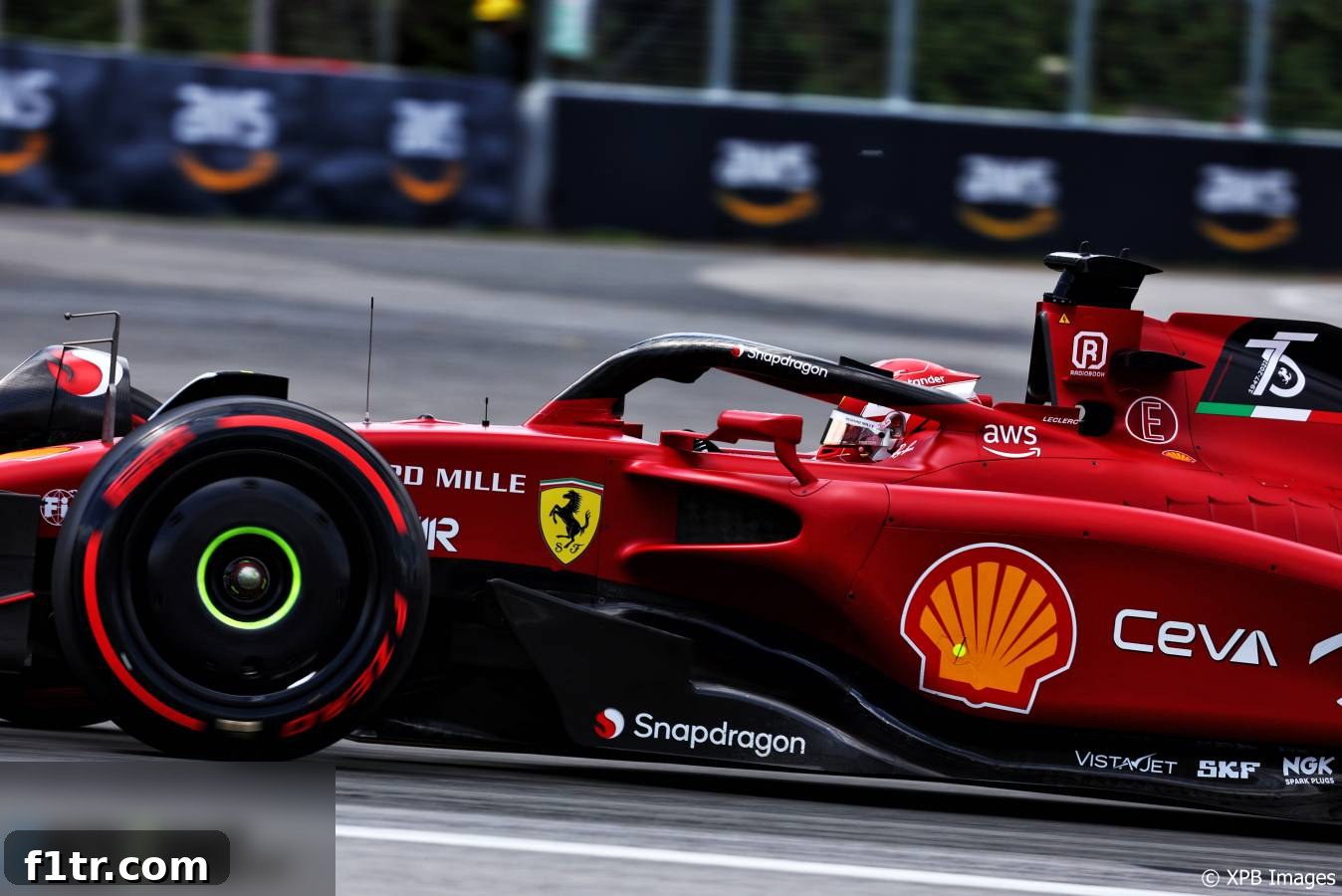
The highly anticipated Canadian Grand Prix is set to ignite this weekend, but not without its share of pre-race drama. Ferrari driver Charles Leclerc, a key contender for the 2022 Formula 1 World Championship, faces a significant setback as he is confirmed to start the race from the very back of the grid. This drastic measure comes after Ferrari opted to fit a comprehensive suite of new power unit components to his car just ahead of the crucial final practice session, triggering a severe grid penalty.
Advert | Become a Supporter & go ad-free
Leclerc’s penalty woes began earlier in the Grand Prix weekend. He was already facing a 10-place grid drop for exceeding his maximum seasonal allocation of Control Electronics (CE). However, the strategic decision made by the Scuderia on Saturday morning to introduce multiple additional new power unit parts has escalated his penalty, effectively relegating him to the rear of the field. This move suggests either ongoing reliability concerns with Ferrari’s power unit or a calculated tactical decision to take a heavy penalty on a circuit where overtaking is traditionally more feasible, thus safeguarding future races.
The raft of new components fitted to Leclerc’s F1-75 includes a new Internal Combustion Engine (ICE), a new Turbocharger (TC), a new Motor Generator Unit-Heat (MGU-H), and a new Motor Generator Unit-Kinetic (MGU-K). By introducing these fourth examples of each component for the season, Leclerc has now surpassed the permissible limits for all four of these critical elements under Formula 1’s stringent power unit regulations. Each time a driver exceeds their allocation of a specific power unit component, they incur grid penalties, which accumulate rapidly, often leading to a back-of-grid start when multiple components are changed simultaneously. Furthermore, Leclerc also received his fifth new exhaust system (EX), though this component change still keeps him within the generous limit of eight for the season, meaning it did not contribute to his grid penalty in this instance.
The decision to take such a significant penalty at the Canadian Grand Prix, a circuit known for its high-speed sections and heavy braking zones, indicates a clear strategic pivot by Ferrari. With Leclerc trailing championship leader Max Verstappen, reliability has been a recurring concern for the Italian team. Rather than risk further DNFs or compromised performance in upcoming races, it appears Ferrari has chosen to bite the bullet in Montreal. While starting from the back is a formidable challenge, the Circuit Gilles Villeneuve’s layout, combined with potentially variable weather conditions, might offer opportunities for a skilled driver like Leclerc to carve his way through the field and salvage crucial championship points.
Understanding Formula 1 Power Unit Components and Penalties
To fully grasp the magnitude of Charles Leclerc’s situation and the strategic complexities faced by Formula 1 teams, it’s essential to understand the intricate power unit regulations. Modern F1 power units are a marvel of engineering, comprising several interconnected components, each with strict seasonal usage limits imposed by the FIA to manage costs and promote reliability. Exceeding these limits results in grid penalties, which can profoundly impact a driver’s weekend:
- Internal Combustion Engine (ICE): The primary engine that converts fuel into power. Drivers are permitted to use a maximum of three ICEs per season.
- Turbocharger (TC): A device that forces more air into the engine, significantly boosting power. Three TCs are allowed per season.
- Motor Generator Unit-Heat (MGU-H): Recovers energy from exhaust gases, converting it into electrical power or directly spinning the turbo. Three MGU-Hs are allowed.
- Motor Generator Unit-Kinetic (MGU-K): Recovers kinetic energy during braking, storing it in the Energy Store. Three MGU-Ks are permitted.
- Energy Store (ES): Essentially the battery pack that stores electrical energy recovered by the MGU-H and MGU-K. Drivers are limited to two ES units per season.
- Control Electronics (CE): Manages the flow and distribution of electrical power within the hybrid system. Two CEs are allowed per season.
- Exhaust System (EX): The exhaust pipes. Drivers can use up to eight exhaust systems per season, making penalties for this component far less common.
The penalty system is cumulative. For the first time a driver uses an additional component beyond the allowed limit, they incur a 10-place grid penalty. For each subsequent additional component used, a 5-place grid penalty is applied. If the total penalty exceeds 15 grid places, the driver is automatically demoted to the very back of the grid. This explains why Leclerc’s accumulation of multiple new components, each exceeding its limit, instantly sends him to the tail end of the starting order.
Other Drivers Facing Penalties and Strategic Component Changes
Yuki Tsunoda, the AlphaTauri driver, is another competitor who will start the Canadian Grand Prix from the back of the grid. Tsunoda was already destined for a rear-of-field start due to prior component changes. His situation was further compounded by AlphaTauri fitting a third Energy Store (ES) and a third set of Control Electronics (CE) to his car ahead of practice. While these changes incur additional theoretical grid penalties, they have no practical effect on his starting position since he was already confirmed to start at the back. This strategy is often employed by teams to introduce fresh components without suffering further practical consequences when a back-of-grid start is already locked in.
Meanwhile, other drivers have made component changes this weekend without incurring any penalties. Carlos Sainz Jnr, Leclerc’s Ferrari teammate, has moved onto his third Internal Combustion Engine (ICE). This is a critical development for Sainz, as it represents his final penalty-free change for this vital component for the remainder of the season. Any further ICE changes for Sainz will result in grid penalties, placing immense pressure on Ferrari’s reliability department. Similarly, Valtteri Bottas of Alfa Romeo has taken his second and final new Energy Store (ES), meaning any subsequent ES changes for him will also trigger grid penalties. These ‘final free changes’ highlight the fine line teams walk throughout the season, balancing performance, reliability, and the ever-present threat of penalties.
Power unit parts used so far
| N° | Car | Engine | Driver | ICE | TC | MGU-H | MGU-K | ES | CE | EX |
|---|---|---|---|---|---|---|---|---|---|---|
| 63 | Mercedes | Mercedes | George Russell | 2 | 2 | 2 | 2 | 1 | 1 | 3 |
| 44 | Mercedes | Mercedes | Lewis Hamilton | 2 | 2 | 2 | 2 | 1 | 1 | 3 |
| 1 | Red Bull | Red Bull | Max Verstappen | 2 | 2 | 2 | 2 | 1 | 1 | 3 |
| 11 | Red Bull | Red Bull | Sergio Perez | 2 | 2 | 2 | 2 | 1 | 1 | 4 |
| 16 | Ferrari | Ferrari | Charles Leclerc | 4 | 4 | 4 | 4 | 1 | 2 | 5 |
| 55 | Ferrari | Ferrari | Carlos Sainz Jnr | 3 | 2 | 2 | 2 | 1 | 2 | 4 |
| 3 | McLaren | Mercedes | Daniel Ricciardo | 2 | 2 | 2 | 2 | 1 | 1 | 2 |
| 4 | McLaren | Mercedes | Lando Norris | 2 | 2 | 2 | 2 | 1 | 1 | 2 |
| 14 | Alpine | Renault | Fernando Alonso | 4 | 4 | 4 | 4 | 3 | 3 | 4 |
| 31 | Alpine | Renault | Esteban Ocon | 3 | 3 | 3 | 3 | 2 | 2 | 3 |
| 10 | AlphaTauri | Red Bull | Pierre Gasly | 3 | 3 | 3 | 3 | 2 | 2 | 5 |
| 22 | AlphaTauri | Red Bull | Yuki Tsunoda | 4 | 4 | 4 | 4 | 3 | 3 | 5 |
| 18 | Aston Martin | Mercedes | Lance Stroll | 2 | 2 | 2 | 2 | 2 | 2 | 2 |
| 5 | Aston Martin | Mercedes | Sebastian Vettel | 2 | 2 | 2 | 3 | 2 | 2 | 2 |
| 23 | Williams | Mercedes | Alexander Albon | 2 | 2 | 2 | 2 | 2 | 2 | 2 |
| 6 | Williams | Mercedes | Nicholas Latifi | 2 | 2 | 2 | 2 | 2 | 2 | 2 |
| 77 | Alfa Romeo | Ferrari | Valtteri Bottas | 3 | 3 | 3 | 2 | 2 | 2 | 4 |
| 24 | Alfa Romeo | Ferrari | Zhou Guanyu | 2 | 2 | 2 | 2 | 1 | 1 | 3 |
| 20 | Haas | Ferrari | Kevin Magnussen | 3 | 3 | 3 | 3 | 2 | 2 | 4 |
| 47 | Haas | Ferrari | Mick Schumacher | 2 | 3 | 2 | 2 | 2 | 2 | 4 |
Analyzing the Power Unit Usage Landscape
The updated table of power unit usage so far in the season provides fascinating insights into team strategies and potential reliability disparities. Unsurprisingly, Charles Leclerc now tops the charts in multiple categories, having used four ICEs, TCs, MGU-Hs, and MGU-Ks. His teammate Carlos Sainz is also on the brink of penalties for his ICE, indicating that Ferrari’s power unit reliability remains a critical area of concern, especially given their championship aspirations. Ferrari-powered customer teams like Haas (Kevin Magnussen on 3 ICEs, TCs, MGU-Hs, MGU-Ks) and Alfa Romeo (Valtteri Bottas on 3 ICEs, TCs, MGU-Hs) are also showing higher usage compared to their Mercedes and Red Bull counterparts, hinting at a wider pattern of stress on the Ferrari power units.
Beyond Ferrari, Alpine’s Fernando Alonso and AlphaTauri’s Yuki Tsunoda are also notable for their high component usage, especially with four ICEs, TCs, MGU-Hs, and MGU-Ks for both. Alonso has even gone through three Energy Stores and Control Electronics, reflecting a challenging start to the season for the experienced Spaniard and the Renault power unit. In contrast, the Mercedes and Red Bull-powered cars of Mercedes, Red Bull Racing, and McLaren appear to be managing their component allocations much more conservatively, with most drivers on their second ICE, TC, MGU-H, and MGU-K units. This conservative usage offers a significant advantage as the season progresses, providing more flexibility to introduce fresh, higher-performance components later in the year without incurring penalties.
The Road Ahead: Leclerc’s Challenge in Montreal
Starting from the back of the grid presents a monumental challenge for Charles Leclerc, especially in a championship battle as tight as the 2022 season. However, the Circuit Gilles Villeneuve is renowned for producing unpredictable races. Its long straights leading into heavy braking zones, particularly the final chicane before the ‘Wall of Champions,’ offer legitimate overtaking opportunities. Furthermore, the Montreal weather can be notoriously capricious, with rain often mixing up the grid and creating chaotic race conditions that could play into Leclerc’s hands. His skill, combined with the raw pace of the Ferrari F1-75, will be put to the ultimate test as he attempts to carve his way through the field and salvage vital points.
The strategic gamble by Ferrari highlights the relentless pressure in Formula 1. While a back-of-grid start is a bitter pill to swallow, ensuring the reliability of their power unit for the remainder of the season, particularly for circuits that are less conducive to overtaking, might be a necessary evil. Leclerc’s recovery drive will undoubtedly be one of the most compelling storylines of the Canadian Grand Prix, as he strives to minimize the damage to his championship hopes and prove Ferrari’s decision to be a shrewd one in the long run. The entire F1 world will be watching to see how the Monegasque driver performs under this immense pressure.
Advert | Become a RaceFans supporter andgo ad-free
Browse all 2022 Canadian Grand Prix articles