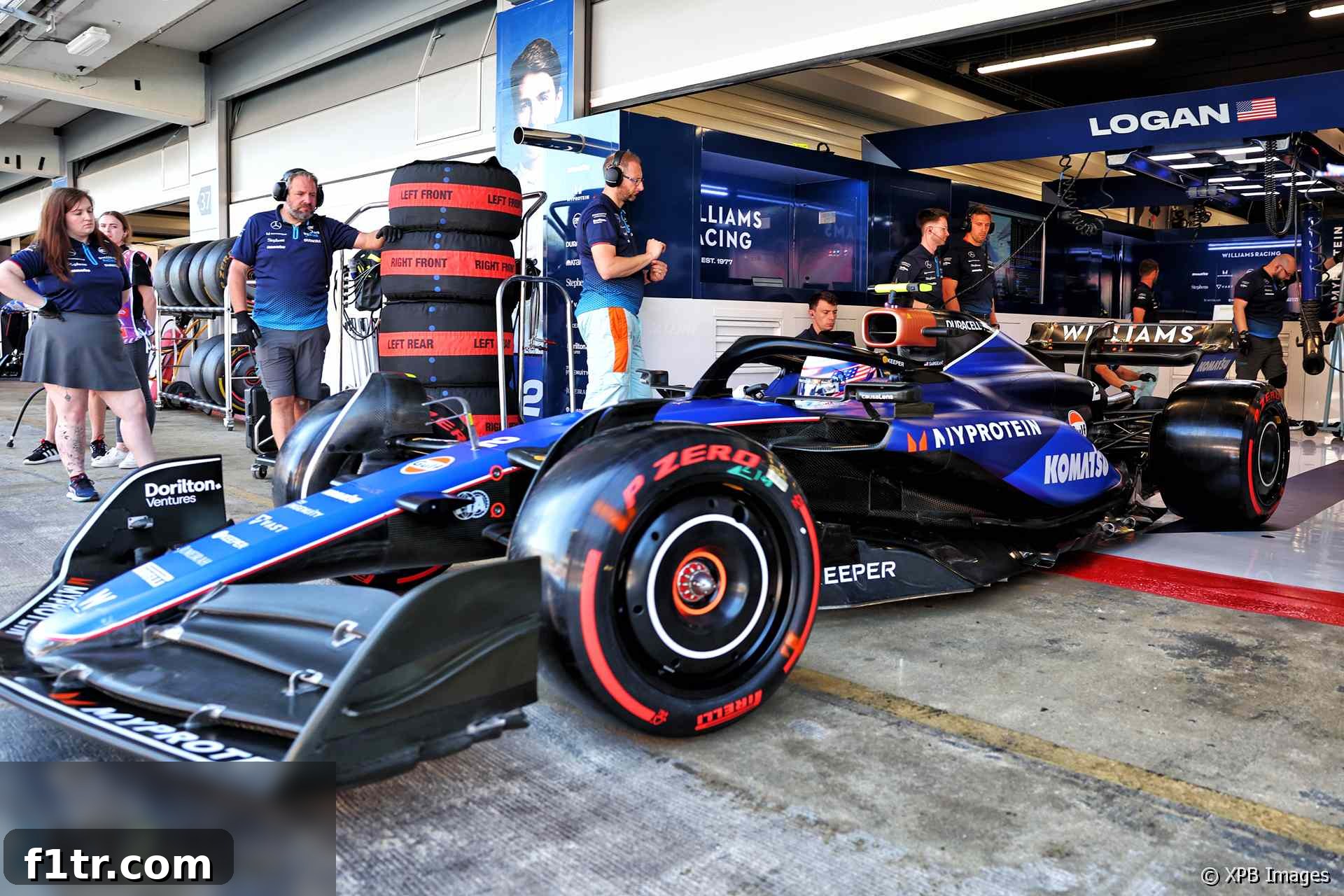
Williams Investigates Persistent Downforce Mystery on Sargeant’s FW46 Following Challenging Spanish GP
Williams Racing faced a perplexing engineering challenge at the recent Spanish Grand Prix, as the team tirelessly worked to understand why Logan Sargeant’s FW46 was consistently underperforming in terms of downforce compared to his teammate, Alexander Albon. The team’s efforts included testing three different floor specifications on Sargeant’s car throughout the Barcelona weekend, yet the issue persisted, leading to a frustrating lack of performance.
Advert | Become a Supporter & go ad-free
[Advertisement]
A Recurring Enigma: Downforce Deficit Plagues Williams
The downforce discrepancy isn’t an entirely new problem for Williams this season. Team Principal James Vowles revealed that Alexander Albon’s car had experienced similar unexplained downforce losses earlier in the championship. This recurring issue highlights a deeper, more elusive challenge for the Grove-based squad as they strive to maximize the potential of their 2024 challenger.
Speaking in a candid video debrief released by the team after the Spanish Grand Prix, Vowles elaborated on the situation: “It’s fair to say that both cars have been suffering with an odd situation where we can measure a small amount of downforce loss. That’s been happening across several events, more typically on Alex’s side than on Logan’s side, Logan here across three different floors.”
The exhaustive testing program for Sargeant in Spain underscored the team’s urgency to get to the bottom of the problem. “We had what we know to be a good state floor on Friday in FP1,” Vowles explained. “That’s where he was due to start. That reported a loss. We had the same when we changed to another floor for FP2 and the same again as we changed to a brand new floor, in fact, for qualifying.”
The meticulous nature of Formula 1 car design means that even slight deviations can have significant impacts. Vowles stressed that the floors themselves were geometrically sound. “The reason why we were changing floors is simply that the floors are geometrically in a good way so when you put a floor in the car, you’re continuously – all teams will do this – adjusting it to get into the optimum position, relative to where it should be from design. But even in that state, we were seeing an amount of reported loss and that wasn’t happening on Alex’s side.” This perplexing consistency across multiple components suggests that the root cause may lie elsewhere than the individual floor units themselves.
Searching for Answers: Measurement Errors or Undiscovered Aerodynamic Factors?
The implications of this downforce deficit are significant. Sargeant, for instance, qualified three-tenths of a second slower than his teammate in Spain, a gap that can prove insurmountable in the hyper-competitive world of F1. Vowles confirmed that the team is now committed to a deeper investigation into the underlying causes of this performance mystery.
“I’m more in a situation that when you’ve changed three different floors, I think it’s fair to say you don’t question the floor, because they were reporting exactly the same amount of loss,” Vowles pondered. “So I think either we’re not measuring this correctly, which is entirely possible, or that we have another element that we’re not understanding on the car in that circumstance.”
Advert | Become a RaceFans supporter andgo ad-free
[Advertisement]
The challenge underscores the extreme precision demanded in modern Formula 1. Teams strive to position critical aerodynamic components, like the floor, within “decimals of a millimeter” to achieve optimal performance. While such minute adjustments are standard, the persistent loss across different floors points to a more fundamental puzzle for Williams engineers to solve.
Lessons from Barcelona: Preparing for Austria and Silverstone
The immediate task for Williams is to gain a definitive understanding of the data. “What we need to make sure is as we go through into Austria and Silverstone, we continue doing tests, as we did here, to understand what is changing that reading, or do we trust readings going forward,” Vowles emphasized. This iterative process of testing, analysis, and validation is crucial for an F1 team looking to improve.
The Spanish Grand Prix proved to be a significant setback for Williams. Both Sargeant and Albon failed to progress beyond Q1, and neither driver finished in the points. This result was a stark contrast to their encouraging performances in recent races, particularly in Monaco and Montreal, where the team showed improved pace and competitive spirit.
“I think it’s fair to say that we had good events in Monaco and Montreal,” Vowles reflected, acknowledging the progress the team had been making. “The car is getting lighter, we’re adding performance to the car, and it’s translating. So it was a smack in the mouth when we went to Barcelona and the car was poor.”
Barcelona’s Unique Demands Expose Hidden Weaknesses
Historically, the Circuit de Barcelona-Catalunya has often been a challenging venue for Williams. However, Vowles expressed particular disappointment given the extensive development work on the FW46 for the current season. He noted that the car’s design changes should have yielded a more competitive showing in Spain this year.
“To a certain extent, looking at what we’ve changed with the car, the car should have been more competitive this year than it was previously. There’s a lot of characteristics that we’ve spent time on redeveloping. Some of the aero characteristics have changed on the fundamentals of the car changed. And yet we weren’t,” Vowles stated. “We were as poor as we have been in previous years. We were lapped by teams that we were faster at the previous two events, in fact the last four or five events.”
Advert | Become a RaceFans supporter andgo ad-free
[Advertisement]
The dramatic drop in relative performance points to a fundamental mismatch or an unaddressed vulnerability. “They haven’t changed their car, so that puts it in the category of we’re getting something either fundamentally wrong in on parent car design in Barcelona, or we haven’t got the car set-up in the correct direction for it, or a number of attributes or being added together,” he added, outlining the various possibilities for the team’s underperformance.
Vowles suggested that the specific characteristics of the Catalunya circuit might have exposed a lingering weakness within the FW46’s design or its setup window. However, he remains optimistic that the team will overcome this challenge and expects better performances in the upcoming races in Austria and Silverstone. This optimism is also bolstered by plans to introduce a significant car upgrade in the near future, which could provide a much-needed boost.
Understanding the “Bogey Race”: A Path to Broader Performance Gains
Refuting the notion of a “bogey race” or a track where a team is simply destined to perform poorly, Vowles emphasized a more analytical approach. “There’s no such thing as a ‘bogey race’. There’s no such thing as ‘you’re just bad at this one track’,” he asserted. “What there is, is that there are elements of a car that need to be in the right place to have fundamentals that work across all 24 tracks, and understanding that and pushing into the discomfort of why are we not quick in Barcelona will actually lead to more performance gains across other tracks.”
Barcelona’s circuit profile is indeed unique, featuring a diverse combination of high-speed, mid-speed, and low-speed sections, with a particular emphasis on mid-speed corners. These characteristics, combined with high track temperatures and significant tire energy demands, create a challenging environment for car setup and aerodynamic efficiency.
“It’s a circuit where you’re very hot on tyres. Typically, as you can see there, it was mid-summer really in Barcelona with track temperatures at the higher end, but it’s not the first time we’ve run at higher temperature. There’s a lot of energy that goes in as well as the result of the high-speed and the mid-speed corners,” Vowles elaborated. The sustained lateral G-forces experienced in Barcelona’s longer corners, as opposed to quick rotation corners, also place different demands on the car’s aerodynamic platform and mechanical grip.
Advert | Become a RaceFans supporter andgo ad-free
[Advertisement]
The Williams team’s objective now is to meticulously deconstruct these various factors. “These may or may not be contributing factors. The point to this is simply to show that we have to go and break all of that down, and understand what has characterised or caused a performance loss in simulation,” Vowles concluded. The crucial step is to replicate the performance loss in their simulation tools, which then allows engineers to adapt the car through both setup changes and fundamental aerodynamic design modifications.
Despite the recent setback, Vowles remains confident that the team can rebound. “I don’t expect that this performance will translate now in Austria or Silverstone. I think you’ll see a return to a more normal condition,” he predicted, signaling hope for a stronger showing in the upcoming European races.
Miss nothing from RaceFans
Get a daily email with all our latest stories – and nothing else. No marketing, no ads. Sign up here:
2024 Spanish Grand Prix Coverage
- Russell ensures Norris has still never kept his lead from pole position
- Williams repeatedly switch floors in search for Sargeant’s missing downforce
- “Why’s he not defending?”: How Russell sank to fourth after stunning start
- What radio calls reveal about Verstappen’s controlled pace and Perez’s struggles
- 2024 Spanish Grand Prix weekend F1 driver ratings
Browse all 2024 Spanish Grand Prix articles