In the fiercely competitive world of Formula 1, where every millisecond and every design choice can mean the difference between victory and defeat, Mercedes-AMG Petronas has consistently stood as a benchmark for engineering excellence. Since the dawn of the V6 hybrid era, their power unit has been lauded as the gold standard, powering the Silver Arrows to an unprecedented string of championships and race wins. This engine, a marvel of modern automotive technology, has delivered superior horsepower and remarkable efficiency, firmly cementing Mercedes’ dominance for much of the past decade. It’s a reputation earned through relentless innovation and an unwavering commitment to performance.
However, even the most formidable machines can possess an Achilles’ heel. While Mercedes’ power unit is undeniably potent, it harbors a subtle technical characteristic that, on rare occasions, can prove to be a significant strategic disadvantage. This particular nuance seldom surfaces as a critical factor in race outcomes or qualifying sessions. Yet, in a dramatic turn of events during qualifying for the Russian Grand Prix, this seemingly minor technical detail became a pivotal element, directly impacting Lewis Hamilton’s strategy and potentially influencing the complexion of the upcoming race. The incident served as a stark reminder that in Formula 1, even the smallest differences can yield the biggest consequences.
The drama for Lewis Hamilton began unfolding in the crucial Q2 segment. On his initial flying lap, Hamilton pushed the limits, only for his lap time to be summarily deleted due to exceeding track limits at Turn 18. This was a costly misstep, immediately placing him under immense pressure. With his first attempt nullified, he was forced to return to the pits for a fresh set of tyres and, more critically, to manage his fuel allocation before making a second attempt. As Team Principal Toto Wolff later clarified, “We couldn’t do another lap because we didn’t have the fuel,” highlighting the tight margins teams operate within during qualifying.
The decision of which tire compound to use for his subsequent Q2 run was paramount. Drivers who successfully advance to Q3 are mandated to start the Grand Prix on the tyres they used to set their fastest time in Q2. Hamilton’s preference was to qualify on the medium compound, a choice that promised greater longevity and strategic flexibility for the race start. The alternative, the soft compound, while offering superior outright grip for a single lap, would degrade much more rapidly, potentially forcing an earlier pit stop and complicating his race strategy. With this strategic imperative in mind, Hamilton ventured back onto the circuit, fitted with a fresh set of medium tires, aiming to secure his place in Q3.
However, fate intervened once more, further complicating Hamilton’s qualifying bid. Just as he was navigating the penultimate corner of his second Q2 lap, Sebastian Vettel suffered a high-speed crash at Turn 4. The incident immediately triggered a red flag, bringing the session to an abrupt halt and leaving Hamilton’s second flying lap unfinished and unrecorded. The clock froze with a mere two minutes and fifteen seconds remaining. Given that a complete lap of the Sochi Autodrom typically takes just over ninety seconds, this theoretically left enough time for some drivers to complete an out-lap and commence a timed lap once the session resumed. Yet, the narrow window of opportunity raised serious doubts as to whether all fourteen remaining cars could manage to do so effectively.
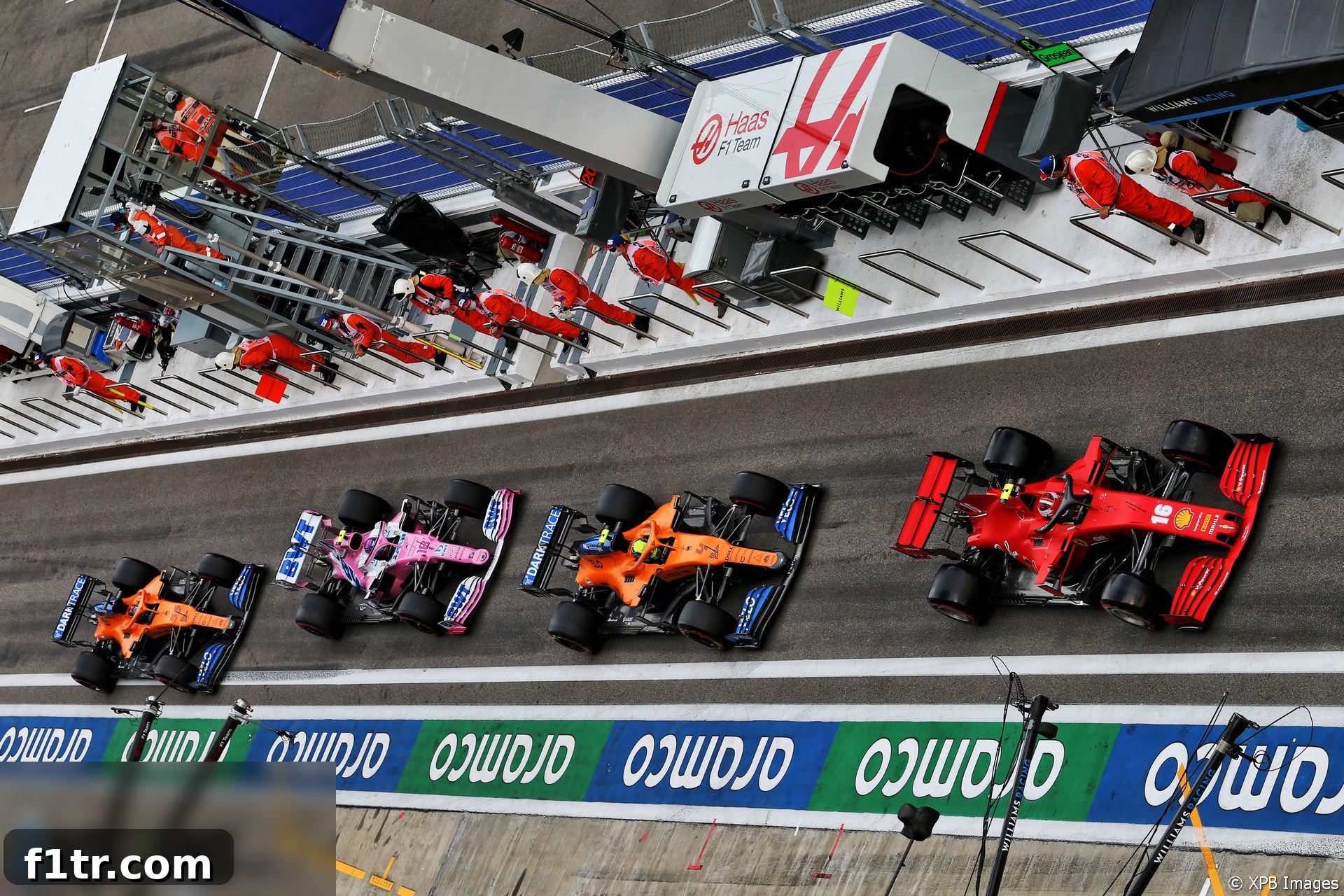
In the frantic moments that followed the red flag, a critical tactical consideration emerged for all teams: track position. To maximize their chances of setting a competitive time within the abbreviated session, drivers needed to be at the absolute front of the queue at the pit lane exit, ready to unleash their cars the instant the green light appeared. However, with multiple drivers sharing this exact objective, the pit lane quickly became a congested bottleneck. The prospect of an extended wait with engines running at idle presented a significant risk of overheating, a problem that could severely compromise engine performance or, worse, lead to a terminal failure before a lap could even be attempted.
This is where the unique technical disparity between the Mercedes power unit and those of its rivals came sharply into focus. For teams equipped with Renault, Honda, or Ferrari engines, navigating such a scenario presents less of a challenge. These power units possess the crucial ability to be switched off while waiting in the pit lane and then seamlessly restarted using the electrical power generated by the MGU-K (Motor Generator Unit – Kinetic). The MGU-K, an integral part of the hybrid system, is designed to recover kinetic energy during braking and convert it into electrical power, which can then be deployed for acceleration or, as in this case, for engine restart. A notable example of this capability was seen when Charles Leclerc was able to restart his Ferrari during the Spanish Grand Prix after his car came to a standstill.
The Mercedes power unit, however, does not share this same MGU-K restart capability. This technical distinction became the linchpin of Mercedes’ strategic dilemma. Toto Wolff confirmed this operational limitation: “We couldn’t really send him out early because you need to switch off the car and then restart it on the MGU-K, which is something we can’t do.” This meant that if Hamilton were to join the queue early, his engine would have to remain running, putting it at risk of overheating during a potentially lengthy wait. The inability to safely shut down and restart the engine in the pit lane profoundly constrained Mercedes’ options, forcing them to adopt a reactive, rather than proactive, approach to the restart.
Had Mercedes possessed the MGU-K restart functionality, they could have strategically positioned Hamilton at the very front of the pit lane queue. This would have afforded him the luxury of dictating the pace of his out-lap, ensuring the medium compound tires reached their optimal operating temperature before commencing his timed lap. Such an approach is critical for extracting maximum performance from the tires. However, constrained by their engine’s limitation, Mercedes recognized that if Hamilton were stuck at the rear of a slow-moving train of cars, his out-lap would be severely compromised, making it impossible to adequately warm the medium tires. This forced them into a difficult decision: they had to abandon the preferred medium compound and instead fit the soft tires for his final Q2 attempt.
As the red flag period drew to a close, a procession of non-Mercedes powered cars converged on the pit exit, eager to secure prime track position. Alexander Albon led the charge, closely followed by Max Verstappen, Pierre Gasly, Daniil Kvyat, Charles Leclerc, and Lando Norris. The solitary Mercedes-powered driver initially in this queue was Lance Stroll, who, like Hamilton, found himself precariously positioned in the ‘drop zone’. Tragically, Stroll’s car had to be pushed away from the queue even before the session resumed, confirming the very risk Mercedes was trying to avoid with Hamilton. “We had an overheating issue with the engine,” Stroll candidly admitted after the session, underscoring the severity of the pit lane idling problem for Mercedes power units.
Armed with this crucial information and acutely aware of the risks, Mercedes made their strategic call for Hamilton. They opted to send him out only shortly before the session was scheduled to restart, and crucially, they fitted him with a set of soft compound tires. Toto Wolff elaborated on this decision: “We felt that if he was at the back of the train and could not do the out-lap that he would need to do, we could be caught out because the medium is simply not there yet. That’s why we put him on the soft.” It was a pragmatic decision, prioritizing qualification for Q3 over optimal race strategy.
The consequence of this forced tire choice is significant. While Hamilton successfully secured pole position, his closest rivals on the grid, Max Verstappen and Valtteri Bottas, will both commence the race on the more durable medium compound tires. Wolff openly acknowledged the strategic handicap: “[This] is clearly compromising him for the strategy tomorrow, but it was the necessary safeguard today to be sure that he would make it into Q3.” Hamilton will face the challenge of managing faster-degrading soft tires at the start of the race, potentially losing track position or being forced into an earlier pit stop than his competitors.
In the broader context of Formula 1, Mercedes’ competitors would, on most race weekends, eagerly exchange the MGU-K restart capability for even a marginal increase in power or fuel efficiency that the Mercedes unit so consistently delivers. However, on this particular occasion at the Russian Grand Prix, this nuanced difference in power unit functionality proved to be critically significant. It laid bare a rare vulnerability within the dominant Mercedes package. The question now looms large: will this technical characteristic, and the subsequent strategic compromise it forced upon Lewis Hamilton, ultimately disadvantage him enough to jeopardize his race performance and potentially alter the outcome of the Grand Prix?
2020 F1 season
- Grosjean to make F1 test return tomorrow for first time since Bahrain horror crash
- Pictures: Wrecked chassis from Grosjean’s Bahrain fireball crash to go on display
- Bottas vs Rosberg: Hamilton’s Mercedes team mates compared after 78 races each
- F1 revenues fell by $877 million in Covid-struck 2020 season
- Hamilton and Mercedes finally announce new deal for 2021 season
Browse all 2020 F1 season articles