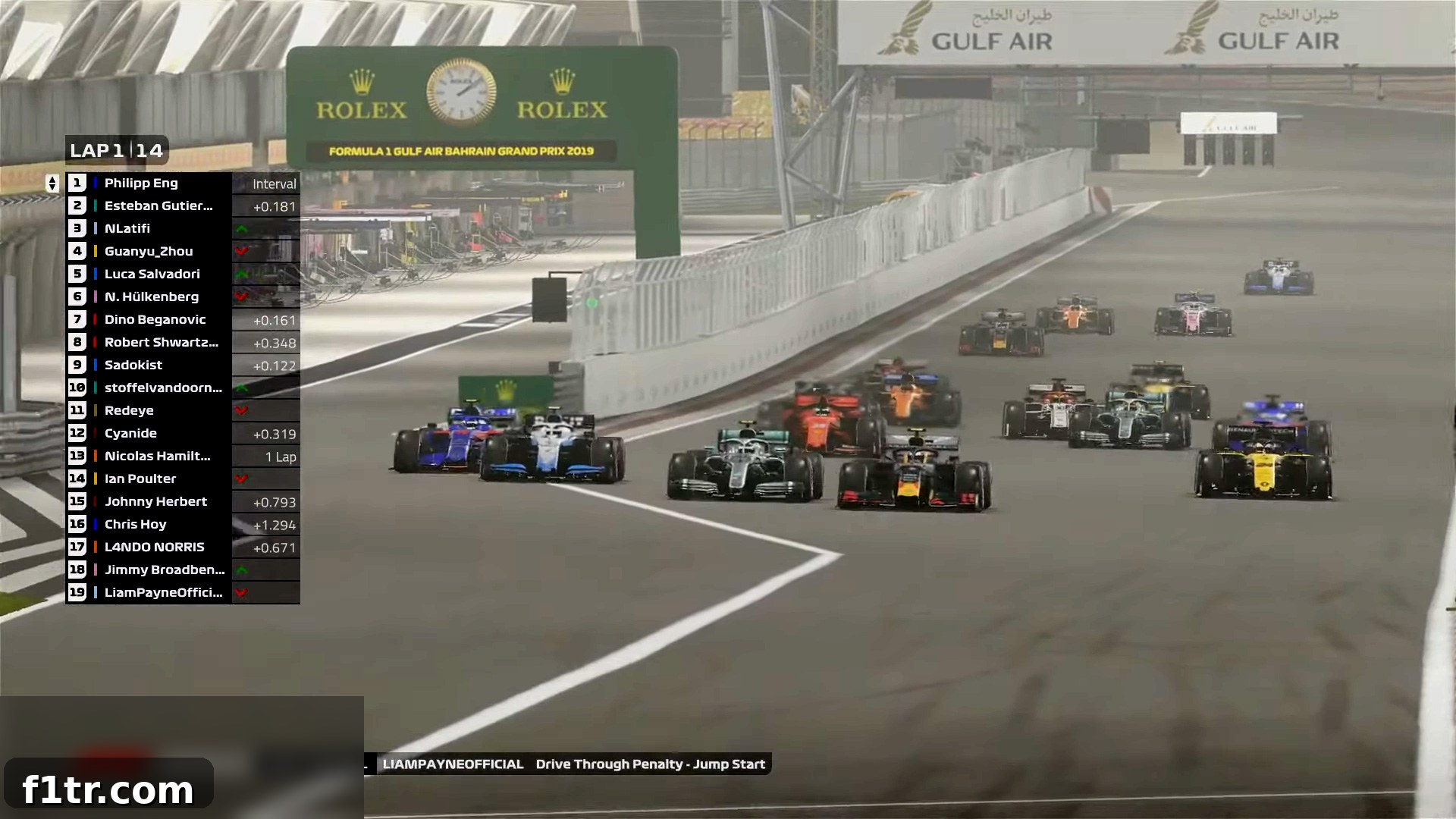
Last Thursday marked a pivotal moment in Formula 1’s history, as news broke of plans to host a ‘virtual’ Bahrain Grand Prix. The announcement immediately sparked a crucial question among fans and pundits alike: how many of the sport’s elite drivers would truly embrace this unprecedented digital challenge?
Advert | Become a Supporter & go ad-free
The subsequent press release, arriving the very next day, left no room for ambiguity: “The first race of the series will see current F1 drivers line up on the grid.” While the sport admirably met this ambitious target, it did so by the narrowest of margins, revealing a fascinating insight into the world of professional motorsport during an unforeseen hiatus.
Among the brave few who graced the virtual grid were Nicholas Latifi, the Williams rookie who, somewhat ironically, now boasts more virtual Grand Prix starts than actual ones. He was joined by McLaren’s charismatic Lando Norris, a known enthusiast of sim racing and an engaging personality within the F1 paddock. Yet, the vast majority of their fellow 2020 F1 competitors were conspicuously absent. This raised an even more pressing query: what factors contributed to their apparent reluctance, and how might this landscape evolve as the virtual series progresses?
The Dawn of Virtual Racing: F1’s Bold Step into Esports
The global pandemic of early 2020 sent shockwaves through the sporting world, bringing seasons to an abrupt halt and leaving millions of fans yearning for live action. Formula 1, an intricate ballet of engineering and human skill, found itself in an unprecedented situation, with its meticulously planned calendar crumbling under the weight of global health concerns. In this vacuum, the idea of a virtual Grand Prix emerged not merely as a novelty, but as an urgent necessity to fill the void, maintain fan engagement, and keep the sport’s pulse beating.
The concept of a virtual race, particularly one involving current F1 drivers, was a bold and ambitious undertaking. It represented a significant pivot for a sport traditionally rooted in physical competition and tangible speed. For Formula 1’s Esports head, Julian Tan, the journey began much earlier, when the Chinese Grand Prix was initially called off in February. However, the subsequent, rapid-fire cancellations of further races – particularly the season-opening Australian Grand Prix – thrust the virtual concept into overdrive. As Tan revealed, the situation demanded they “adapt very, very quickly,” transforming a speculative idea into a tangible event within a matter of days.
This rapid deployment highlighted both the agility of F1’s digital strategy and the inherent challenges of attempting to coalesce top-tier athletes from across the globe into a cohesive online competition. The initial announcement of the Virtual Bahrain Grand Prix, therefore, was met with a mixture of excitement and skepticism, as the F1 community grappled with the implications of seeing their heroes trade real asphalt for digital circuits.
A Mixed Grid: Examining Driver Participation in the Virtual Bahrain GP
The promise was clear: current F1 drivers on the grid. The reality, while technically fulfilling that promise, painted a more nuanced picture. While two active F1 drivers, Nicholas Latifi and Lando Norris, did participate, their presence merely underscored the absence of the other eighteen competitors from the 2020 roster. This left fans with a sense of wonder and a desire to understand the underlying reasons behind the lukewarm response from the wider F1 community.
Nicholas Latifi, still awaiting his actual Grand Prix debut, seized the opportunity with enthusiasm. His participation demonstrated a willingness to engage with fans and gain additional virtual experience, even if it meant doing so in an unconventional format. Lando Norris, on the other hand, arrived with a reputation as an avid sim racer, frequently streaming his gameplay and showcasing a genuine passion for virtual competition. His involvement was almost expected, given his established presence in the online gaming sphere, lending a much-needed touch of credibility and high-profile participation to the event.
However, the grid was predominantly filled by a diverse mix of talent that included five former Grand Prix racers, a selection of junior drivers from various F1 teams’ academies, and notable online influencers and celebrities. While this eclectic lineup certainly provided entertainment and garnered significant viewership, it starkly contrasted with the initial vision of a full grid of contemporary F1 stars. The conspicuous absence of household names, multiple race winners, and championship contenders sparked a deeper inquiry into the practicalities, perceptions, and pressures that might have kept them away from F1’s inaugural official virtual race.
Unpacking the Reluctance: Why Most F1 Drivers Sat Out
Organizing any gathering, even among friends for a casual online game, inevitably comes with its share of logistical hurdles. When attempting to coordinate world-class athletes on an international scale, these challenges are magnified exponentially. Several key factors contributed to the limited participation of current F1 drivers in the Virtual Bahrain Grand Prix.
Firstly, the **logistical hurdles and rapid adaptation** played a significant role. The F1 Virtual Grand Prix idea, though conceived earlier, had to be brought to life with incredible haste following the sudden and widespread cancellations of real-world races. This left event organizers, and by extension, the drivers, with very little lead time. Unlike other Esports events that attract top driving talent, which often benefit from weeks or even months of planning, F1’s venture was conceived and executed within mere days. This condensed timeline made it incredibly difficult to coordinate schedules, ensure technical compatibility, and provide adequate preparation opportunities for the drivers.
Secondly, **equipment and platform specificity** proved to be a major barrier. The Virtual Bahrain Grand Prix was run on the PC edition of F1 2019, a specific simulation platform that not all drivers had access to or were familiar with. Many F1 drivers own sophisticated sim racing rigs for training, but these setups often run on different, more specialized simulators like iRacing or rFactor, rather than the commercially available F1 game. McLaren’s Carlos Sainz Jr., for instance, openly admitted in an online chat with Lando Norris that he couldn’t participate because he lacked the necessary PC setup, highlighting a significant digital divide among the F1 paddock.
Thirdly, the ongoing **isolation factor** due to global travel restrictions further complicated matters. Many drivers were observing periods of self-isolation after returning from the abruptly cancelled Australian Grand Prix. This meant that even those who possessed the right hardware might have been geographically separated from their equipment or faced challenges in setting up complex sim rigs in temporary or restricted environments.
Perhaps the most significant deterrent was **competitive concerns and professional pride**. F1 drivers are fiercely competitive individuals, accustomed to performing at the absolute pinnacle of motorsport. The prospect of participating in a game against experienced sim racers, and potentially appearing uncompetitive, was a genuine concern. Romain Grosjean candidly expressed this on social media, stating, “[I] will hide for now as my level is poor.” Lando Norris himself, despite his sim racing prowess, revealed to Sainz that F1 2019 was a “difficult” game to master, admitting he had been “one second off” the pace of experienced players in another recent event. He elaborated, “There was the real drivers like me, Stoffel [Vandoorne] and [Esteban] Gutierrez. Then you had the professional sim drivers… the top six were pretty much guys who play the game. Everyone who didn’t play the game, I ended up beating.” This illustrates a stark skill gap between professional F1 drivers who play the game casually and dedicated sim racers.
Red Bull Racing’s Max Verstappen, known for his directness, outright admitted this was his primary reason for not joining. “I don’t play that game and I would have to adapt to it,” he told Ziggo Sport. “That would take a few days, and that doesn’t make much sense as I’m busy with other things, other games. I would have to switch too much, and that doesn’t work.” Verstappen accurately predicted that he “would be running around the back, and I don’t enjoy that.” For an elite athlete, the thought of being uncompetitive, even in a virtual environment, can be a powerful disincentive, potentially impacting their professional image and personal enjoyment.
Finally, **prior commitments and personal preference** played a role. F1 drivers, even during a hiatus, maintain rigorous training regimens, engage with sponsors, and spend time with family. For some, dedicating significant time to learn a new game and compete at a high level might not have aligned with their existing priorities or simply wasn’t their preferred way to unwind or engage with the sport during an enforced break.
The Virtual Bahrain Grand Prix: A Spectacle of Strengths and Learning Curves
Despite the challenges in attracting a full roster of current F1 drivers, the Virtual Bahrain Grand Prix was an undeniable spectacle and a crucial learning experience for Formula 1. Unlike many professional esports events, top sim drivers like David Tonizza and Brandon Leigh were notably not invited to participate in this initial F1-sanctioned event. This decision, perhaps aimed at maintaining an “F1 family” feel, inadvertently contributed to the “crash-strewn race” that unfolded, as described by observers.
The event, featuring a mix of active F1 drivers, ex-Grand Prix racers, junior talent, and online personalities, provided significant entertainment value, even if it lacked the polished precision of a dedicated esports championship. The chaotic nature of the race, filled with overtakes, collisions, and unpredictable outcomes, resonated with a segment of the audience looking for pure, unadulterated fun rather than clinical perfection. Max Verstappen’s initial fear of “running around the back” was likely allayed by the somewhat unpredictable and less competitive nature of the actual event, proving that even a casual approach could be engaging for viewers.
From F1’s perspective, the Virtual Grand Prix was a strategic masterstroke in bridging the gap left by the real season’s suspension. It successfully kept the brand visible, generated positive media buzz, and provided an engaging outlet for millions of starved fans. The viewership numbers, often comparable to or even exceeding traditional esports events, demonstrated the immense hunger for F1 content and the power of its brand, even in a virtual format. It also allowed fans to see a different, more relaxed side of their favorite drivers and other personalities within the F1 ecosystem, fostering a sense of community during challenging times.
Paving the Way Forward: The Future of F1 Virtual Grands Prix
The inaugural Virtual Bahrain Grand Prix, while imperfect, offered invaluable lessons for Formula 1 as it navigates the nascent waters of esports. The primary takeaway is the critical need for enhanced planning, clearer communication, and robust support for drivers.
Looking ahead, the next Virtual Grand Prix is scheduled for April 5th, coinciding with when the Vietnam Grand Prix would have taken place. Crucially, organizers intend to replicate the cancelled Australian Grand Prix at Albert Park. This decision to use a track that the drivers would have physically raced on adds a layer of realism and familiarity, potentially making it more appealing for them to participate. With a two-week lead time – significantly more than for Bahrain – drivers now have a better opportunity to acquire the necessary equipment, familiarize themselves with the F1 2019 game, and dedicate time to practice the Albert Park circuit. This increased preparation window is anticipated to encourage a broader spectrum of drivers to take part, leading to a potentially more competitive and star-studded virtual event.
To further encourage broader participation, F1 could implement several strategies. Standardizing equipment, perhaps by providing loaner sim rigs for drivers who lack suitable setups, could eliminate a significant barrier. Dedicated online practice sessions, allowing drivers to hone their skills in a low-pressure environment, could build confidence and readiness. Moreover, offering incentives beyond mere participation, such as charitable donations in their name or unique virtual trophies, might further motivate professional racers. The role of media training for drivers regarding esports would also be beneficial, helping them embrace the casual yet competitive nature of these events without feeling undue pressure on their professional image.
The evolving role of esports in Formula 1 is a question that extends beyond the current crisis. While initially a temporary solution, virtual racing has the potential to become a permanent fixture, complementing the real-world season. This could manifest in hybrid events, fan-driver competitions, or even dedicated virtual championships that run in parallel to the main season, creating new avenues for fan engagement and interaction.
Beyond the Track: The Broader Impact of Virtual F1
The Virtual Grand Prix series signifies more than just a temporary placeholder for live racing; it marks a significant step for Formula 1 into the digital age, with far-reaching implications.
Firstly, it has proven instrumental in **fan engagement in a digital age**. In a period devoid of actual racing, these virtual events have successfully kept the F1 community alive and thriving. Fans, desperate for content, have flocked to live streams, social media discussions, and news coverage, demonstrating the enduring power of the F1 brand to captivate and unite its global audience, even virtually.
Secondly, it offers a unique platform for **showcasing driver personalities**. Away from the intense pressures of a real race weekend, virtual events allow drivers to reveal a different, often more relaxed and humorous side of themselves. Their banter, frustrations, and celebrations in the virtual world provide an intimate glimpse into their characters, fostering a deeper connection with fans who might otherwise only see their highly professional on-track persona.
Thirdly, virtual F1 has the potential to **attract new audiences**. The crossover appeal of gaming, particularly for younger demographics, is immense. By embracing esports, Formula 1 can tap into a vast pool of potential new fans who might first discover the sport through its virtual iteration. This gateway could convert gamers into enthusiasts of the real-world motorsport, broadening F1’s demographic reach and ensuring its long-term relevance.
Finally, these virtual endeavors open up entirely new **commercial opportunities**. From bespoke sponsorship deals for virtual teams and events to new revenue streams from digital viewership and merchandise, the esports landscape offers a fresh frontier for F1’s commercial growth. It allows partners to engage with a new generation of consumers and explore innovative marketing strategies within the rapidly expanding digital entertainment sector.
In conclusion, F1’s foray into virtual racing began amidst urgent necessity, facing immediate logistical and participatory challenges. Yet, the initial Virtual Bahrain Grand Prix, despite its quirks, emerged as a resounding success in capturing fan attention and proving the viability of online competition. As Formula 1 moves forward with better planning and increased driver support for upcoming races, particularly the Virtual Australian Grand Prix, it is clear that virtual racing is not just a temporary stopgap but a dynamic and essential new pillar in the sport’s strategy, crucial for engaging fans and expanding its reach in an increasingly digital world.
Gaming
Browse all Gaming articles