Italian Grand Prix: High Stakes, Wet Weather Threats, and Strategic Gambles at Monza
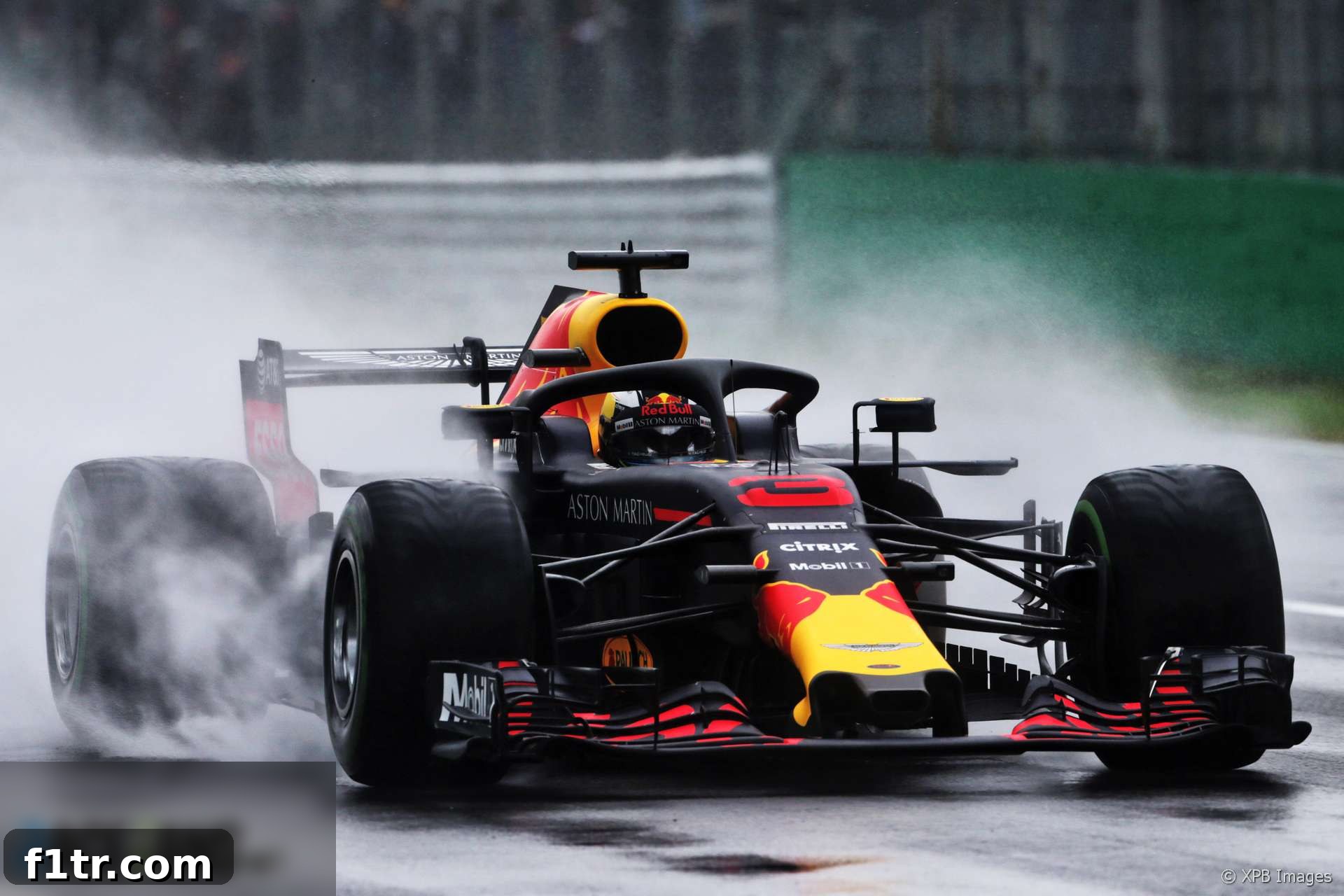
The iconic Monza circuit, revered as the “Temple of Speed,” is set to host the Italian Grand Prix, but an unexpected twist in the weather forecast promises to inject an additional layer of drama and strategic complexity into the weekend. With predictions of rain for qualifying, Formula 1 could witness its third consecutive wet qualifying session, setting the stage for a truly unpredictable spectacle.
For drivers like Lewis Hamilton, such conditions often translate into an advantage. Hamilton himself has previously credited wet Saturday sessions at the Hungaroring and Hockenheimring for enabling him to outpace the formidable Ferraris and secure pole position. However, for all teams, the prospect of a wet qualifying followed by a confidently dry race day presents a significant dilemma: how to optimise car setup? The crucial decision rests on whether to prioritise a strong qualifying performance in the wet or to gamble on a dry race setup, potentially compromising grid position but gaining an edge on Sunday.
The Wet Qualifying, Dry Race Conundrum: A Strategic Tightrope
The intricate challenge of balancing car setup was a hot topic of discussion among the paddock. Pirelli’s head of F1 and Car Racing, Mario Isola, articulated the core dilemma on Friday evening: “It’s interesting to see tomorrow which is the set-up they try to use. If it is dry tomorrow, there is no doubt; Sunday should be dry and they go on a dry set-up.”
However, the forecasted rain reshapes the strategic landscape entirely. “If tomorrow is wet again, it’s a compromise because the car is in parc ferme after qualifying,” Isola explained. “So, we have to understand if they prefer to have good quali and then maybe during the race the performance of the car is not so good, or the opposite. Maybe they take a risk in quali and then the car is good in race conditions.” This ‘parc ferme’ rule, which locks in car setups after qualifying, amplifies the risk involved. Teams must decide whether to run a higher downforce setup for better grip in the wet, potentially suffering on Monza’s long straights in the dry, or opt for a low downforce configuration, excelling in a dry race but struggling for traction and balance in the rain.
Advert | Become a Supporter & go ad-free
Should the rain indeed arrive, qualifying positions won’t just hinge on aerodynamic choices, but also on the agility of tyre strategy on a progressively drying track. Pirelli has provided crucial benchmarks for teams: the track is deemed dry enough for slick tyres when lap times consistently fall into the 1’37-1’38 range. The sweet spot for slicks, where they offer optimal performance, is reached once lap times drop to 1’31. The ability to make the correct crossover call between Intermediate, Wet, and Slick tyres at the opportune moment could be the difference between pole position and a mid-pack start, especially on a circuit known for its minimal degradation in dry conditions.
Aerodynamic Philosophies and Team-Specific Challenges
Teams have already begun to signal their intentions regarding set-up. At Monza, a circuit characterised by its long straights and fast chicanes, minimising drag is paramount. Red Bull, known for their aerodynamically efficient chassis but slightly less powerful engine compared to Mercedes and Ferrari, has adopted an aggressively slim rear wing configuration, as observed on Daniel Ricciardo’s car. This strategy aims to compensate for any straight-line speed deficit by reducing drag, a calculated risk that pays dividends if a dry race materialises.
Similarly, Nico Hulkenberg, who faces a grid penalty for his incident at Spa, opted for Renault’s low downforce set-up during practice. With his starting position already compromised, focusing on optimising the car for race performance in dry conditions becomes a more logical choice. In contrast, his teammate Carlos Sainz Jnr ran a more conventional setup. Sainz later highlighted a critical challenge for Renault: “We still need to work in many other areas of the chassis. When we come down on downforce, our stability problems are exposed even more. We are suffering a bit with entry stability, a lot of oversteer like I was struggling in Spa.” This insight reveals the fine line teams walk between achieving top speed and maintaining car stability, especially under the extreme loads experienced at Monza.
Advert | Become a RaceFans supporter andgo ad-free
Race Day Tyre Strategy: A Foregone Conclusion Unless Chaos Strikes
Assuming a dry race, tyre strategy at Monza is anticipated to be a relatively straightforward affair, as articulated by Carlos Sainz. “At the moment there’s no tyre deg[radation] at all. It should be an easy one-stop race for everyone unless the heat arrives, the blisters arrive and all of a sudden it’s chaos like it was in Austria.” This sentiment is echoed by Pirelli’s information, which suggests most teams will deliberately avoid the medium tyre compound. Monza’s high-speed, low-wear characteristics typically lend themselves to a single pit stop, making tyre management less of a variable unless unforeseen circumstances, such as extreme heat leading to blistering, disrupt the conventional approach. The minimal tyre degradation observed during practice reinforces the expectation of a tactical, rather than tyre-limited, race.
The Championship Battle: Ferrari’s Home Advantage vs. Mercedes’ Relentlessness
The impending Italian Grand Prix is not just a standalone race; it’s a pivotal chapter in the intense championship battle between Ferrari and Mercedes. Ferrari displayed a strong performance margin during Friday’s practice, reminiscent of their pace at Spa. Last week, dry qualifying saw a nail-biting contest between the two titans, suggesting that regardless of the weather, fans are in for a gripping fight for supremacy. Valtteri Bottas, reflecting on practice, noted, “In the dry, Ferrari definitely seems quick, as expected. It’s not going to be an easy weekend, but we knew it coming here.” This acknowledgment from Mercedes underscores the challenge they face on Ferrari’s home turf.
However, the weekend hasn’t been entirely smooth for the Scuderia. Sebastian Vettel endured a couple of unsettling incidents, including a spin on his long-run on super-soft tyres during practice. This marked his second mishap in as many days, following a slip-up during a show run in Milan earlier in the week. While seemingly minor, such incidents can dent confidence and, more critically, disrupt crucial data collection for race simulations.
With limited track time for race simulations due to morning rain and a red flag caused by Marcus Ericsson’s crash, and further rain anticipated during final practice, Ferrari could find themselves heading into Sunday’s race with less comprehensive tyre data than desired. While this might have been a greater concern earlier in the season, at this stage, with the tyres being a largely known quantity, it might not significantly derail Ferrari’s ambitions. The fervent home crowd and the raw pace of the SF71H still place a home win firmly on the cards, setting up a thrilling confrontation for the Tifosi. The pressure, however, will be immense.
Advert | Become a RaceFans supporter andgo ad-free
Longest Stint Comparison – Second Practice
This chart provides a visual breakdown of drivers’ lap times (in seconds) during their longest unbroken stints in second practice, with exceptionally slow laps omitted for clarity. Interact with the chart by scrolling to zoom, dragging to pan, and right-clicking to reset the view, offering insights into long-run pace and tyre management.
Complete Practice Times
Below is a detailed table summarizing the complete practice times from the Italian Grand Prix weekend, offering a comprehensive overview of each driver’s performance across both free practice sessions.
| Pos | Driver | Car | FP1 | FP2 | Total laps |
|---|---|---|---|---|---|
| 1 | Sebastian Vettel | Ferrari | 1’37.867 | 1’21.105 | 31 |
| 2 | Kimi Raikkonen | Ferrari | 1’34.550 | 1’21.375 | 59 |
| 3 | Lewis Hamilton | Mercedes | 1’36.546 | 1’21.392 | 37 |
| 4 | Valtteri Bottas | Mercedes | 1’36.238 | 1’21.803 | 43 |
| 5 | Max Verstappen | Red Bull-TAG Heuer | 1’35.665 | 1’22.154 | 38 |
| 6 | Daniel Ricciardo | Red Bull-TAG Heuer | 1’35.207 | 1’22.296 | 41 |
| 7 | Esteban Ocon | Force India-Mercedes | 1’34.593 | 1’22.930 | 47 |
| 8 | Sergio Perez | Force India-Mercedes | 1’34.000 | 1’22.942 | 50 |
| 9 | Charles Leclerc | Sauber-Ferrari | 1’36.648 | 1’22.965 | 30 |
| 10 | Nico Hulkenberg | Renault | 1’36.107 | 1’23.063 | 45 |
| 11 | Romain Grosjean | Haas-Ferrari | 1’37.683 | 1’23.077 | 44 |
| 12 | Carlos Sainz Jnr | Renault | 1’35.995 | 1’23.193 | 47 |
| 13 | Kevin Magnussen | Haas-Ferrari | 1’37.066 | 1’23.233 | 41 |
| 14 | Pierre Gasly | Toro Rosso-Honda | 1’35.438 | 1’23.402 | 53 |
| 15 | Sergey Sirotkin | Williams-Mercedes | 1’37.929 | 1’23.514 | 38 |
| 16 | Brendon Hartley | Toro Rosso-Honda | 1’35.024 | 1’23.531 | 33 |
| 17 | Lance Stroll | Williams-Mercedes | 1’38.253 | 1’23.566 | 37 |
| 18 | Fernando Alonso | McLaren-Renault | 1’37.426 | 1’23.741 | 37 |
| 19 | Stoffel Vandoorne | McLaren-Renault | 1’24.084 | 30 | |
| 20 | Marcus Ericsson | Sauber-Ferrari | 1’37.790 | 13 | |
| 21 | Lando Norris | McLaren-Renault | 1’38.282 | 9 |
Quotes courtesy of Dieter Rencken
Go ad-free for just £1 per month>> Find out more and sign up
More on the 2018 Italian Grand Prix
- Ferrari suffering longest-ever home race victory drought
- 2018 Italian Grand Prix Star Performers
- Hamilton wins again as Mercedes break Ferrari hearts at home
- Paddock Diary: Italian Grand Prix day four
- Vote for your 2018 Italian Grand Prix Driver of the Weekend
Browse all 2018 Italian Grand Prix articles