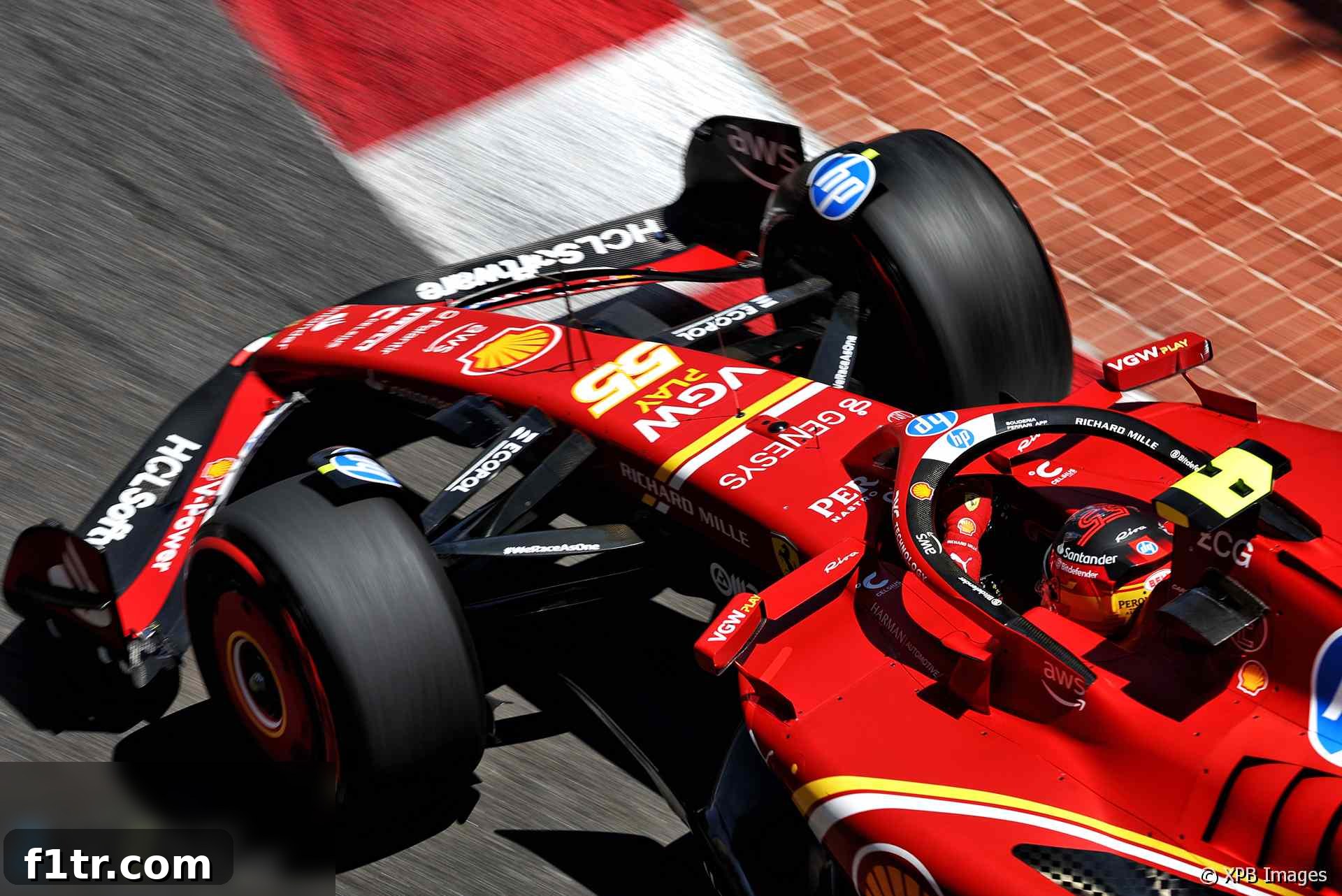
The prestigious Monaco Grand Prix, known for its unforgiving street circuit and high-stakes qualifying sessions, once again delivered its share of drama and controversy. Following the intense Saturday qualifying, two prominent drivers, Carlos Sainz Jnr of Ferrari and Nico Hulkenberg of Haas, found themselves under the scrutiny of the FIA stewards for alleged impeding incidents. Despite the initial concerns and subsequent investigations, both drivers were ultimately cleared, albeit under very different circumstances that underscore the complexities of Formula 1 regulations and the unique challenges of the Monte Carlo track.
Carlos Sainz Jr. Incident: A Fine Line at Piscine
Carlos Sainz Jnr’s incident involved Williams driver Alexander Albon during a crucial phase of qualifying. The alleged impeding occurred at the notoriously tight and fast Piscine section, a sequence of corners where clear track ahead is paramount for a competitive lap time. As Albon approached, closing rapidly on Sainz, the Ferrari driver was deemed to have “impacted” Albon’s lap. The stewards launched an investigation to determine if Sainz had unnecessarily impeded his rival, a breach that typically carries a grid penalty.
The steward’s report meticulously detailed the sequence of events and the reasoning behind their verdict. It highlighted that Sainz’s team had indeed informed him of Albon’s approach. In response, Sainz “attempted to move as quickly as he could off the racing line to give car 23 [Albon] space at the exit of turn 16.” However, the inherent “tight nature of the chicane and the Monaco circuit” meant that Albon’s lap was undeniably affected by Sainz’s presence on the racing line.
Crucially, the testimonies from both drivers played a significant role in the stewards’ decision. Sainz acknowledged that, in hindsight, he “could perhaps have gone off the track and thereby given car 23 more room.” Yet, he maintained that he did not “unnecessarily impede car 23” as he took “the necessary steps on the track to give him space.” This nuanced explanation points to the split-second decisions drivers must make in the heat of qualifying.
Alexander Albon’s perspective was equally pivotal. While he conceded that he might have lost approximately 0.15 seconds due to the incident, he described the situation as “grey.” Albon stated that he was not convinced it was a “clear case of impeding,” acknowledging the extreme difficulty of the circuit, particularly its sequence of blind corners. He recognized that Sainz “could not have seen car 23 approaching any sooner” given the lack of visibility at that specific part of the track. This understanding between fellow drivers, coupled with their detailed accounts, led the stewards to exercise leniency. Ultimately, they concluded that the threshold for an “unnecessary” impede was not met, clearing Sainz to retain his competitive grid position.
Nico Hulkenberg’s Ordeal: Radio Troubles and a Technical Infringement
Nico Hulkenberg’s situation presented a different set of complexities, involving not only an alleged impeding incident but also critical technical issues. The Haas driver was investigated for impeding Alpine’s Esteban Ocon at the Massenet corner, another challenging section of the Monaco circuit.
The investigation into Hulkenberg revealed a significant mitigating factor: persistent radio communication problems. The stewards noted that Haas had “attempted to warn car 27 [Hulkenberg] of the arrival of car 31 [Ocon] on a fast lap but the radio communication system was not working reliably and the driver of car 27 did not receive the messages.” They further confirmed this by hearing the radio messages from the team, which evidently failed to reach the car. This was not an isolated incident, as Ocon himself “confirmed that he too had issues with the communication system,” and “similar reports of intermittent radio messages from another team” were also received during the session.
Esteban Ocon’s testimony mirrored Albon’s in its reasonableness and played a crucial role. Ocon “acknowledged that, because the entry of turn three is blind, the driver of car 27 could not have known of his approach without the benefit of a radio warning.” Furthermore, despite catching Hulkenberg, Ocon stated he “was not materially impacted during that lap by car 27 because car 27 picked up the pace at turn four.”
Considering the genuine technical issues with team radio communications, the team’s earnest attempts to warn their driver, and Ocon’s admission of not being materially impacted, the stewards decided to take no further action against Hulkenberg for impeding. This ruling highlights the FIA’s consideration of extenuating circumstances beyond a driver’s direct control, particularly when safety and fair play are at stake due to technical malfunctions.
The Twist: Hulkenberg’s Post-Qualifying Disqualification
However, Hulkenberg’s reprieve from the impeding penalty proved to be short-lived and ultimately moot. Following the qualifying session, the Haas pair, including Hulkenberg, faced a separate and more severe penalty. Both Haas cars were disqualified from the qualifying results due to a technical infringement related to their rear wings failing legality checks. This meant that despite being cleared of impeding, Hulkenberg would not retain any of his qualifying positions and was instead relegated to starting the Monaco Grand Prix from the pit lane.
This dramatic turn of events underscores the multi-faceted scrutiny F1 teams and drivers face throughout a Grand Prix weekend. While the stewards meticulously assess on-track incidents, technical regulations are equally stringent, and any deviation can lead to severe penalties, completely overshadowing prior decisions. For Carlos Sainz, the clearance meant he proudly retained his impressive third place on the grid, a crucial advantage on a circuit where overtaking is notoriously difficult. For Hulkenberg, it was a bitter pill, as his efforts in qualifying were nullified by a technicality, regardless of his acquittal for impeding.
Implications for the Monaco Grand Prix and F1 Regulations
These steward decisions, particularly the detailed explanations provided, offer valuable insight into the interpretation of F1’s sporting regulations. They emphasize the importance of driver testimony, the unique characteristics of each circuit (especially Monaco’s blind corners and tight confines), and the consideration of external factors like team radio reliability. The “unnecessary impeding” rule is not always black and white; it often resides in a grey area where intent, impact, and surrounding circumstances are meticulously weighed.
The Monaco Grand Prix qualifying is a spectacle in itself, where every tenth of a second and every grid position is fought for with intense precision. The stewards’ careful deliberation in these cases ensures that penalties are applied fairly, distinguishing between genuine negligence and unavoidable incidents or technical mishaps. While Sainz benefited from a well-reasoned defense and a rival’s candid assessment, Hulkenberg’s situation highlighted the delicate balance between sporting integrity and technical compliance. The outcomes set the stage for a compelling race, with Sainz starting at the sharp end and Hulkenberg facing a monumental challenge from the pit lane. Such incidents serve as a constant reminder of the ever-present drama and regulatory complexity that defines the pinnacle of motorsport.
2024 Monaco Grand Prix: Further Reading and Analysis
- Formula 1 will fix red flag rule loophole which ruined Monaco GP – Domenicali
- Magnussen ‘could have backed off but didn’t’ in Monaco crash, says team boss
- Ocon defends his driving after ‘hurtful abuse’ over Monaco GP crash with Gasly
- How the midfield’s hottest team mate rivalry boiled over
- “He’s really dangerous”: Unheard driver radio from F1’s slow show in Monaco
Browse all 2024 Monaco Grand Prix articles