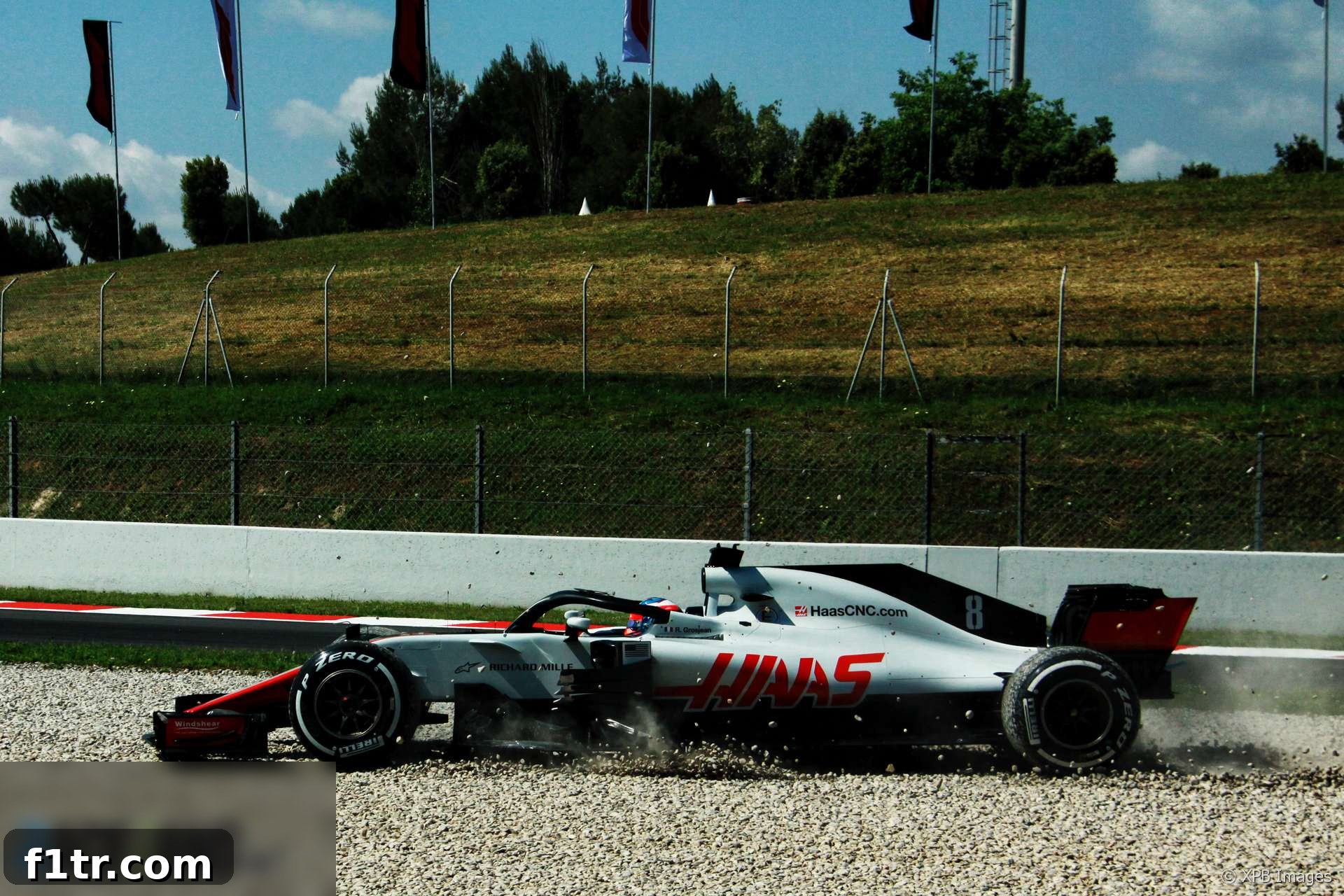
In a day of contrasting emotions and outcomes, Romain Grosjean expressed overall satisfaction with the handling and balance of his Haas F1 car, despite an inexplicable early spin during the second free practice session. The seasoned French driver managed to recover impressively, eventually securing a respectable seventh-fastest time, positioning the American team firmly within the coveted ‘best of the rest’ contingent, just behind the dominant Mercedes, Ferraris, and Red Bulls.
The Enigmatic Spin: A Deep Dive into Romain Grosjean’s FP2 Incident
The incident that most puzzled Grosjean and the Haas pit wall occurred at the very outset of FP2. As he began his flying lap, the VF-18 unexpectedly spun, bringing his initial run to an abrupt halt. “We’ve got no idea,” a visibly perplexed Grosjean stated when questioned about the peculiar event. “At the minute there is no rational explanation. It’s a bit of a strange one.” This admission highlights the frustrating unpredictability that can sometimes plague even the most experienced drivers and advanced machinery in Formula 1. Such unforeseen spins can be caused by a multitude of factors, from momentary loss of tire temperature, especially on cold out-laps, to a sudden gust of wind, or even a micro-slip on a dusty patch of track. However, for a driver of Grosjean’s calibre, known for his meticulous feedback and understanding of car dynamics, to be utterly mystified points towards an unusual anomaly. The team will undoubtedly delve deep into the telemetry data to uncover the root cause, ensuring that such an event does not recur during the crucial qualifying or race sessions. While the spin cost him precious track time early on, Grosjean’s ability to quickly regain composure and return to the session, subsequently laying down competitive lap times, speaks volumes about his mental fortitude and the underlying pace of the Haas package.
Haas F1’s Puzzling Progress: Finding the Sweet Spot for Car Balance
Despite the earlier setback, Grosjean’s prevailing sentiment was one of optimism regarding his car’s handling characteristics. His feedback revealed a significant shift in the car’s balance, addressing a persistent issue that had plagued him in previous outings. “The whole session the car was very much on the nose on the entry of the corner,” he explained. This phrase, “on the nose,” describes a car with a strong front end, prone to oversteer or a tendency for the rear to step out, particularly under braking or turn-in. Crucially, Grosjean noted, “I’ve been complaining about understeer [before], here there’s no more understeer which is good.” This indicates that the engineering team at Haas has successfully tackled the previous understeer issues, a common complaint where the front tires lose grip, causing the car to push wide in corners. Eliminating understeer is often a critical step towards unlocking ultimate lap time, allowing a driver to attack apexes with greater confidence and carry more speed through the corner. However, the newfound front-end aggression introduced a new challenge: “we just need to understand how to make the car a bit more stable on entry then I can attack the corner a bit harder.” This suggests the team now needs to fine-tune the setup to manage the increased front grip, ensuring stability without reintroducing understeer. Achieving this delicate balance is the perennial quest of every F1 engineer and driver, as it directly impacts tire degradation, driver comfort, and ultimately, raw pace over a race distance. The fact that the car felt “competitive” even with this slight instability underscores the potential of the Haas VF-18 once these minor adjustments are perfected.
Aiming for ‘Best of the Rest’: Haas F1 Team’s Ambitions for the Weekend
Grosjean’s eventual seventh-fastest time in FP2 was not merely a good individual performance but a strong indicator of the Haas F1 Team’s competitive standing. Finishing behind only the three leading constructor teams – Mercedes, Ferrari, and Red Bull – firmly establishes Haas at the front of the midfield battle, often referred to as the ‘best of the rest.’ This position is crucial for teams like Haas, as points are predominantly scored by cars finishing within the top ten. Consistently leading this midfield pack is a significant achievement and a testament to the team’s engineering prowess and operational efficiency. Grosjean’s confidence stems from this clear understanding of the car’s potential. “I think the feeling is pretty good and we know where to work on the car to get it better,” he affirmed. This belief in the team’s ability to extract further performance is vital as they head into the decisive qualifying session. The goal for Haas is not just for Grosjean, but for both cars, including teammate Kevin Magnussen, to secure strong grid positions. “It wasn’t the lap of the year so hopefully we’ll stay where we are with both cars.” This comment suggests that there was still more to come from his lap, implying that the Haas car has untapped performance waiting to be unleashed with further setup refinement. Maintaining a presence at the sharp end of the midfield in both qualifying and the race will be key to accumulating valuable championship points and solidifying their position as a formidable force outside of the ‘big three’ teams. The battle for supremacy within the midfield is often just as intense and unpredictable as the fight at the very front, making every tenth of a second in practice and qualifying critical.
Strategizing for Success: What Lies Ahead for Haas F1
The insights gathered during Friday’s practice sessions, particularly Romain Grosjean’s feedback, will be meticulously analysed by the Haas F1 engineers overnight. Their immediate focus will be on addressing the slight instability Grosjean identified during corner entry. This might involve subtle adjustments to suspension settings, aerodynamic balance, or even differential settings to provide the driver with more confidence to push harder. Grosjean noted that the “long run was OK,” which is an encouraging sign for Sunday’s Grand Prix. Strong long-run pace indicates that the car can manage its tires effectively and maintain competitive lap times over an extended period, which is paramount for a successful race strategy. The team will be working diligently to translate their Friday pace into a robust qualifying performance on Saturday. With the competitive nature of the F1 midfield, even a marginal improvement can mean several grid positions. Their ability to quickly identify and rectify issues, as demonstrated by the improved understeer characteristics, suggests they are well-equipped to make the necessary adjustments. The aim will be to optimize the car for a single, fastest lap in qualifying, while simultaneously ensuring the setup remains kind to the tires for race day. Factors like track evolution, potential weather changes, and competitor performance will also play into their strategic considerations. Haas will be keen to maximize their opportunities and ensure both their cars are in a strong position to score points, building on the promising foundation laid by Grosjean’s Friday efforts.
Romain Grosjean’s Resilience and Experience in F1
Romain Grosjean’s journey in Formula 1 has been marked by both brilliance and challenge, and his response to the peculiar spin in FP2 perfectly encapsulates his resilience and seasoned approach. Despite the mystifying nature of the incident, he quickly regrouped and focused on the crucial task of understanding the car’s performance. His detailed feedback, pinpointing the shift from understeer to a more “on the nose” characteristic, is invaluable for the engineering team. An experienced driver like Grosjean provides the nuanced input necessary for fine-tuning the car, allowing the team to make precise adjustments that would otherwise be impossible with just telemetry data. His ability to articulate these subtle differences in car behaviour is a significant asset, particularly in the cut-throat environment of Formula 1 where every millisecond counts. This experience will be vital as Haas seeks to consolidate its position as a front-runner in the midfield, with Grosjean leading the charge to extract every ounce of performance from the VF-18.
Conclusion: A Promising but Perplexing Start for Haas
All in all, Friday’s practice sessions presented a mixed bag for Romain Grosjean and the Haas F1 Team. While the perplexing spin remains a topic for analysis, the overriding positive was the significant improvement in car balance and the competitive long-run pace. Grosjean’s confidence in the car and the team’s ability to further optimize its performance sets a promising tone for the remainder of the weekend. With meticulous data analysis and targeted setup changes, Haas will be aiming to convert this strong practice showing into solid qualifying positions and a successful points haul on race day, solidifying their status as a genuine contender at the head of the midfield pack.
Don’t miss anything new from RaceFans
Follow RaceFans on social media:
- Join RaceFans on Facebook
- Follow RaceFans on Twitter
- Get daily email updates from RaceFans
2018 F1 season
- F1 feared “death knell” for Drive to Survive after Ferrari and Mercedes snub
- McLaren staff told us we were “totally crazy” to take Honda engines in 2018 – Tost
- ‘It doesn’t matter if we start last’: How Red Bull’s junior team aided Honda’s leap forward
- Honda’s jet division helped F1 engineers solve power unit problem
- McLaren Racing losses rise after Honda split
Browse all 2018 F1 season articles