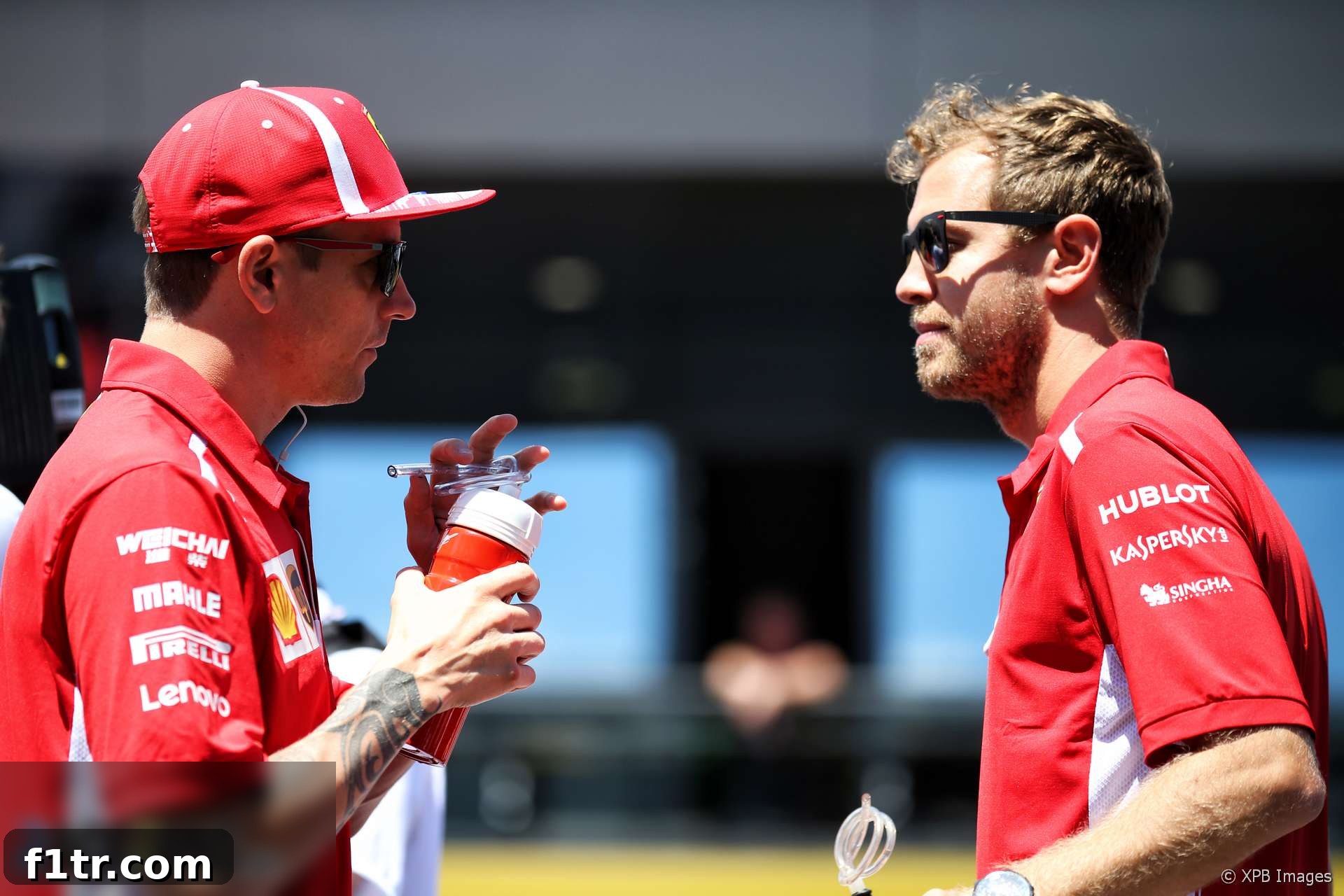
Ferrari’s Strategic Crossroads: Kimi Raikkonen on Team Orders in the 2018 F1 Championship
The exhilarating world of Formula 1 is a relentless battle of speed, skill, and strategy. For Scuderia Ferrari, a team steeped in racing history and constantly striving for championship glory, the 2018 season presented a familiar dilemma: when, if ever, to deploy team orders. Following the Austrian Grand Prix, where Kimi Raikkonen finished just ahead of his championship-contending teammate Sebastian Vettel, questions regarding Ferrari’s strategic approach inevitably arose. However, Raikkonen, the ‘Iceman’ himself, remained resolute, emphasizing that while team orders are an integral part of Ferrari’s operational playbook, the time for such decisive action had not yet arrived.
At that juncture of the 2018 Formula 1 season, Sebastian Vettel held a slender one-point lead in the drivers’ championship standings, a testament to his consistent performance and the potent capabilities of the Ferrari challenger. Kimi Raikkonen, despite demonstrating flashes of his renowned speed, found himself 45 points adrift of his German teammate. This points differential naturally fueled speculation among fans and media alike: why wouldn’t Ferrari leverage its strategic advantage by instructing Raikkonen to cede a position to Vettel, thereby maximizing Vettel’s championship points haul? Raikkonen’s response was clear and unequivocal, rooted in the long-standing understanding within the Maranello-based squad.
The Nuance of Team Orders: Ferrari’s Unwritten Rules
Team orders, a contentious yet often necessary aspect of Formula 1, involve a team instructing one driver to allow another to pass or hold position, typically to benefit the championship aspirations of one driver or to secure the Constructors’ Championship. While they have historically sparked debate and controversy, with memorable incidents like the 2002 Austrian Grand Prix involving Rubens Barrichello and Michael Schumacher, or Ferrari’s own “Fernando is faster than you” radio message at the 2010 German Grand Prix, most teams acknowledge their place in the high-stakes world of elite motorsport. Ferrari, in particular, has a history of prioritizing team objectives when the championship battle reaches a critical juncture.
Raikkonen articulated Ferrari’s internal philosophy with characteristic candor: “We have, we always said, very clear rules and that’s what we go by since I always been in this team. We know what will happen when and if it comes to that, it’s pretty normal for us.” This statement underscores a crucial understanding within the team: team orders are not a matter of if, but when. The Finnish driver perceived the media’s heightened interest as overblown, characterizing it as journalists “making big stories” out of a predictable facet of championship racing. He firmly reiterated that while such strategic decisions would eventually materialize, the early stages of the 2018 season were simply “not the time yet.”
This perspective aligns with Raikkonen’s previous stance from the 2017 season, where he explicitly stated his willingness to support Vettel in the championship pursuit only once he had been mathematically eliminated from contention himself. This professional approach highlights the complex dynamic within a top F1 team: two highly competitive drivers, each aiming for personal glory, but ultimately bound by the overarching goals of the Scuderia. The unwritten rules, known to all within the team, dictate that individual ambition must, at a certain point, yield to collective success, especially when a championship is on the line.
The Unforgiving Cost of Reliability: Raikkonen’s Setbacks
While Raikkonen’s championship position was partly influenced by Vettel’s stellar form, a significant factor contributing to his 45-point deficit was a string of unfortunate incidents beyond his control. The 2007 world champion had failed to finish in two races during the 2018 season, each DNF (Did Not Finish) representing a substantial loss of valuable points and momentum. In Bahrain, a botched pit stop resulted in a collision with a mechanic, forcing his premature retirement and causing injury, a stark reminder of the inherent dangers in the fast-paced pit lane. Later, a power unit problem forced him out of the Spanish Grand Prix, an exasperating technical failure that further hampered his title aspirations.
In stark contrast, Sebastian Vettel had managed to score points in every single race leading up to the Austrian Grand Prix, a testament to his consistency and the overall reliability of his car. Raikkonen acknowledged the cruel reality of these retirements, describing them as “part of the game, unfortunately.” However, he also emphasized the critical importance of preventing such incidents from recurring. In modern Formula 1, where reliability across the grid has reached unprecedented levels, every DNF carries an immense penalty. “It could be always better,” Raikkonen reflected, “but the problem with those is more than it doesn’t give us any… we need to make sure that those things doesn’t happen again because you can’t just expect that everybody has days like that.”
The ‘Iceman’ drew a crucial distinction between contemporary F1 and eras past: “Maybe 10 years ago it was more likely that every team, every car will stop the race at some point. But we’ve seen in the last years that it’s usually very unlikely. It happens sometimes but you can’t just count on this – ‘OK it happened to you, it will happen to somebody else’ – it doesn’t work like that any more.” This observation underscores a fundamental shift in the sport. In an era of highly sophisticated machinery and stringent technical regulations, mechanical failures are rarer and therefore more impactful. The expectation is that cars will finish races, making every retirement a profound blow to a driver’s and team’s championship hopes. For Ferrari, ensuring both cars consistently reach the checkered flag was, and remains, paramount for their ambitions in both the drivers’ and constructors’ championships.
Ferrari’s Balancing Act: Championship Pursuit vs. Driver Freedom
The 2018 Formula 1 season was shaping up to be a thrilling championship battle, with Ferrari, Mercedes, and later Red Bull all vying for supremacy. For Ferrari, the strategic decisions regarding team orders are not just about driver standings; they also heavily influence the Constructors’ Championship, a prestigious title that brings significant financial rewards and bragging rights. Managing two highly competitive drivers like Raikkonen and Vettel, both of whom possess the skill and hunger to win, requires a delicate balancing act from the team’s management.
Maintaining a degree of individual freedom for drivers early in the season fosters competition and pushes the technical envelope, ultimately extracting maximum performance from the cars. However, as the championship progresses and the stakes rise, a more unified, team-centric approach often becomes necessary. Ferrari’s leadership faced the perennial challenge of nurturing driver ambition while preparing for the inevitable moment when collective strategy must take precedence. Raikkonen’s comments offered a glimpse into this internal understanding, acknowledging that while the team supports fierce competition among its drivers, there is a clear threshold when team objectives will dictate strategy.
As the 2018 season unfolded, every point became increasingly critical. Raikkonen’s commitment to “keep it up and do the best we can and hopefully keep scoring good points” reflected his professional approach. Despite the setbacks, his focus remained on maximizing his performance for the team, understanding that his contributions, even if not leading to a personal title bid, were vital for Ferrari’s overall championship aspirations. The question of team orders for Ferrari was not about a lack of commitment from Raikkonen, but rather a strategic decision point that the team would only cross when the championship permutations made it absolutely necessary. Until then, both drivers were expected to push their limits, demonstrating the raw competitive spirit that defines Formula 1.