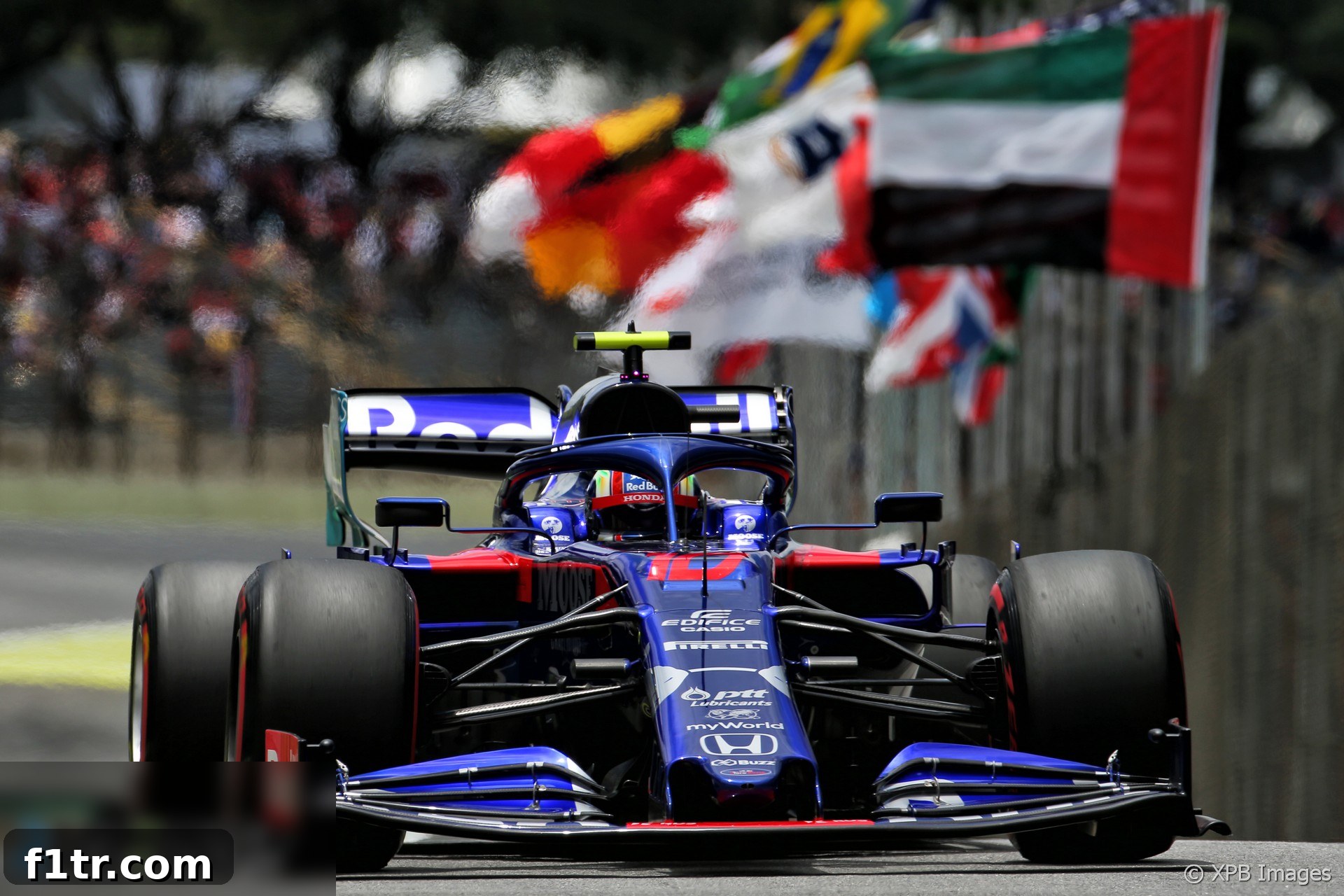
Pierre Gasly expressed genuine surprise and immense satisfaction following his stellar qualifying performance at the Brazilian Grand Prix, where he secured a prominent spot at the forefront of the fiercely competitive Formula 1 midfield. The young Frenchman’s achievement was a significant highlight for his team, Toro Rosso, amidst a challenging and often unpredictable 2019 season. His P7 qualifying slot, a testament to both his driving skill and the team’s strategic execution, was not only unexpected but also highly celebrated within the paddock, underscoring the relentless battle for supremacy among the sport’s middle-tier contenders.
Advert | Become a Supporter & go ad-free
Driving the Toro Rosso, Gasly delivered a sensational lap around the iconic Autódromo José Carlos Pace circuit, placing his car seventh on the grid. This remarkable effort positioned him directly behind the dominant cars of Red Bull, Ferrari, and Mercedes, effectively making him the ‘best of the rest’. The jubilant atmosphere in the Toro Rosso garage was further amplified by the news that Gasly would benefit from a grid penalty incurred by Charles Leclerc. Consequently, instead of starting from seventh, Gasly was promoted to an impressive sixth position, providing him with an even stronger platform from which to launch his race campaign. This elevation not only boosted his morale but also significantly improved his prospects for scoring crucial championship points in what promised to be an exciting Grand Prix.
A ‘Midfield Pole Position’ for Gasly at Interlagos
Speaking after the qualifying session, a beaming Gasly couldn’t contain his excitement. “I’m super-happy,” he declared, his words reflecting the immense pride he felt in his performance. “For a midfield team like us, it’s our midfield pole position. It feels great to put this lap and get my best qualifying of the season with Toro Rosso on such a track where we knew it would be really, really small margins to make it. It feels great to qualify seventh.” His description of the result as a “midfield pole position” perfectly encapsulated the spirit of the intense competition among the teams vying for positions outside of the top three constructors. In a sport where every tenth of a second can separate multiple cars, achieving such a prominent position for a smaller team like Toro Rosso is akin to a major victory. The Interlagos circuit, known for its short lap length and challenging characteristics, often magnifies the smallest errors and rewards absolute precision, making Gasly’s flawless lap even more commendable amidst the Brazilian Grand Prix qualifying intensity.
Gasly elaborated on the team’s expectations and the inherent unpredictability of the midfield battle. While acknowledging that Toro Rosso had shown promising pace during practice sessions, suggesting they could be competitive, he remained acutely aware of the incredibly narrow margins that typically define qualifying at circuits like Interlagos. “To be fair we knew we were kind of competitive. But we knew at any point we could be out in Q1, like it happened for Danny [Kvyat], or maybe make it to Q3,” he explained. This candid assessment highlights the knife-edge nature of Formula 1 qualifying, where a minor misjudgment or a slight variation in track conditions can dramatically alter a driver’s fortunes. The fact that his teammate, Daniil Kvyat, failed to make it past the first qualifying segment underscored just how fine the line was between success and early elimination, making Gasly’s Q3 appearance and seventh-place finish all the more remarkable for Toro Rosso.
Navigating the Fine Margins of F1 Qualifying
The battle in the midfield in 2019 was arguably one of the most enthralling aspects of the season, with multiple teams – including McLaren, Renault, Racing Point, Alfa Romeo, and Haas – all capable of challenging for points on any given weekend. Gasly perfectly captured this intensity, noting, “Yesterday between seventh and 15th [it was] three tenths.” This microscopic time difference across eight cars exemplifies the technical prowess and driver talent concentrated throughout the grid. Such tight competition demands absolute perfection, not just from the drivers but also from the engineers in optimizing car setup and engine performance. It’s common knowledge in Formula 1 that teams often unleash additional engine power specifically for qualifying, turning up the engine modes to extract maximum performance for a single flying lap, something Gasly alluded to: “And then we know usually on Saturday others find a bit more performance in quali, turning the engine up a bit more.” This practice, while strategic, also adds another layer of complexity to predicting qualifying outcomes and makes a strong performance from a smaller team like Toro Rosso even more impressive.
The element of surprise, Gasly confessed, significantly amplified his joy. “We didn’t expect it so probably that’s why it feels even better. And then with Charles’ penalty, we start sixth so it’s really good.” This unexpected boost, combined with Leclerc’s grid drop, transformed a strong qualifying into an exceptional starting position. Leclerc’s penalty, issued for exceeding power unit component limits, is a common occurrence in the modern era of Formula 1 and serves as a reminder of the delicate balance teams must maintain between performance and reliability. For Gasly, it was an invaluable opportunity, placing him directly into the mix with the front-runners and significantly increasing his chances of securing a substantial points haul for Toro Rosso. Starting from sixth position at a track like Interlagos, which offers challenging overtaking opportunities but also potential for chaos, provides a strategic advantage that few midfield drivers could hope for, especially in the context of the Brazilian Grand Prix.
Pierre Gasly’s Season of Resilience and Redemption
Pierre Gasly’s 2019 Formula 1 season had been a rollercoaster of emotions and challenges. Having started the year with the senior Red Bull Racing team, he faced immense pressure and struggled to consistently match the pace of his teammate, Max Verstappen. This ultimately led to his demotion back to Toro Rosso mid-season, a move that could have severely impacted a driver’s confidence and career trajectory. However, Gasly approached this setback with remarkable resilience and determination, using the opportunity to rebuild his confidence and showcase his undeniable talent. His return to Toro Rosso marked a turning point, as he gradually rediscovered his form, culminating in this outstanding qualifying performance in Brazil. This result was not just about a single lap; it was a powerful statement of his mental fortitude, his ability to adapt, and his unyielding pursuit of excellence despite adversity. It highlighted his journey of redemption and reaffirmed his place as a highly capable and competitive driver in Formula 1. This stellar qualifying effort at Interlagos was a testament to his unwavering spirit and an encouraging sign for his future in the sport.
The Brazilian Grand Prix and the Iconic Interlagos Circuit
The Autódromo José Carlos Pace, more commonly known as Interlagos, is one of Formula 1’s most revered and challenging circuits. Its relatively short 4.309-kilometer (2.677-mile) lap length, coupled with significant elevation changes, a mix of fast straights, and tight, technical corners, creates a unique spectacle. The circuit’s layout means that qualifying often sees incredibly close times, as drivers push their cars to the absolute limit across just a handful of corners and short acceleration zones. Overtaking can be difficult but is certainly possible, particularly into Turn 1 (Senna S) and through the DRS zones. A strong starting position at Interlagos is therefore paramount for any team, especially those in the midfield, as it allows them to avoid potential first-lap incidents and establish track position early on. For Toro Rosso, securing P6 on the grid was not merely a good result; it was a strategic masterstroke that set them up perfectly for a potentially fruitful race, offering a rare opportunity to compete directly with and perhaps even upset some of the larger, better-funded teams at the Brazilian Grand Prix. The unpredictability of Interlagos further elevates the importance of a clean start from such a high grid slot.
Don’t miss anything new from RaceFans
Follow RaceFans on social media:
- Join RaceFans on Facebook
- Follow RaceFans on Twitter
- Get daily email updates from RaceFans
Advert | Become a RaceFans supporter andgo ad-free
Race Day Outlook and Future Implications for Pierre Gasly
Starting from sixth position provides Pierre Gasly and Toro Rosso with an exceptional chance to convert their qualifying pace into valuable championship points. From this vantage point, Gasly would be positioned to battle with drivers from teams like McLaren and Renault, which were direct competitors in the constructors’ championship. The strategy for the race would be critical, considering Interlagos is a circuit that often features unpredictable weather, safety car periods, and high degradation for tyres. Holding track position early would be key, as would making smart decisions regarding pit stops and tyre management. A strong points finish here would not only be a significant boost to Toro Rosso’s standing in the championship but also solidify Gasly’s reputation further, proving his capability to perform under pressure and deliver when it matters most. His performance in Brazil was a testament to his growth as a driver and a positive indicator for his future prospects within the demanding world of Formula 1. This result, coming after a season of significant personal and professional transitions, offered a potent blend of vindication and renewed hope for the French driver.
The competitive nature of the 2019 season’s midfield meant that every point was hotly contested. For Toro Rosso, a team operating with a smaller budget compared to the giants of the sport, maximizing opportunities like these was crucial. Gasly’s qualifying heroics in Brazil represented one of those pivotal moments, potentially setting the stage for a memorable race and contributing significantly to the team’s year-end objectives. The excitement surrounding his performance resonated throughout the paddock, underscoring the universal appreciation for an underdog story and the sheer talent required to shine even in the most challenging of circumstances. As the lights prepared to go out for the Brazilian Grand Prix, all eyes would certainly be on Pierre Gasly and his Toro Rosso, eager to see if he could maintain his impressive form and cap off a remarkable weekend with a well-deserved strong finish, further cementing his place among F1’s elite.
2019 F1 season – Related Articles
- Crying in the Melbourne car park at 2019 grand prix was my career low – Ocon
- McLaren Racing reports reduced £71 million loss in 2019
- Kvyat: Hockenheim podium last year was “my biggest achievement” so far
- How the FIA’s new encrypted fuel flow meter targets Ferrari’s suspected ‘aliasing’ trick
- “He smashed my office door”: 23 must-see moments from ‘Drive to Survive’ season two
Browse all 2019 F1 season articles