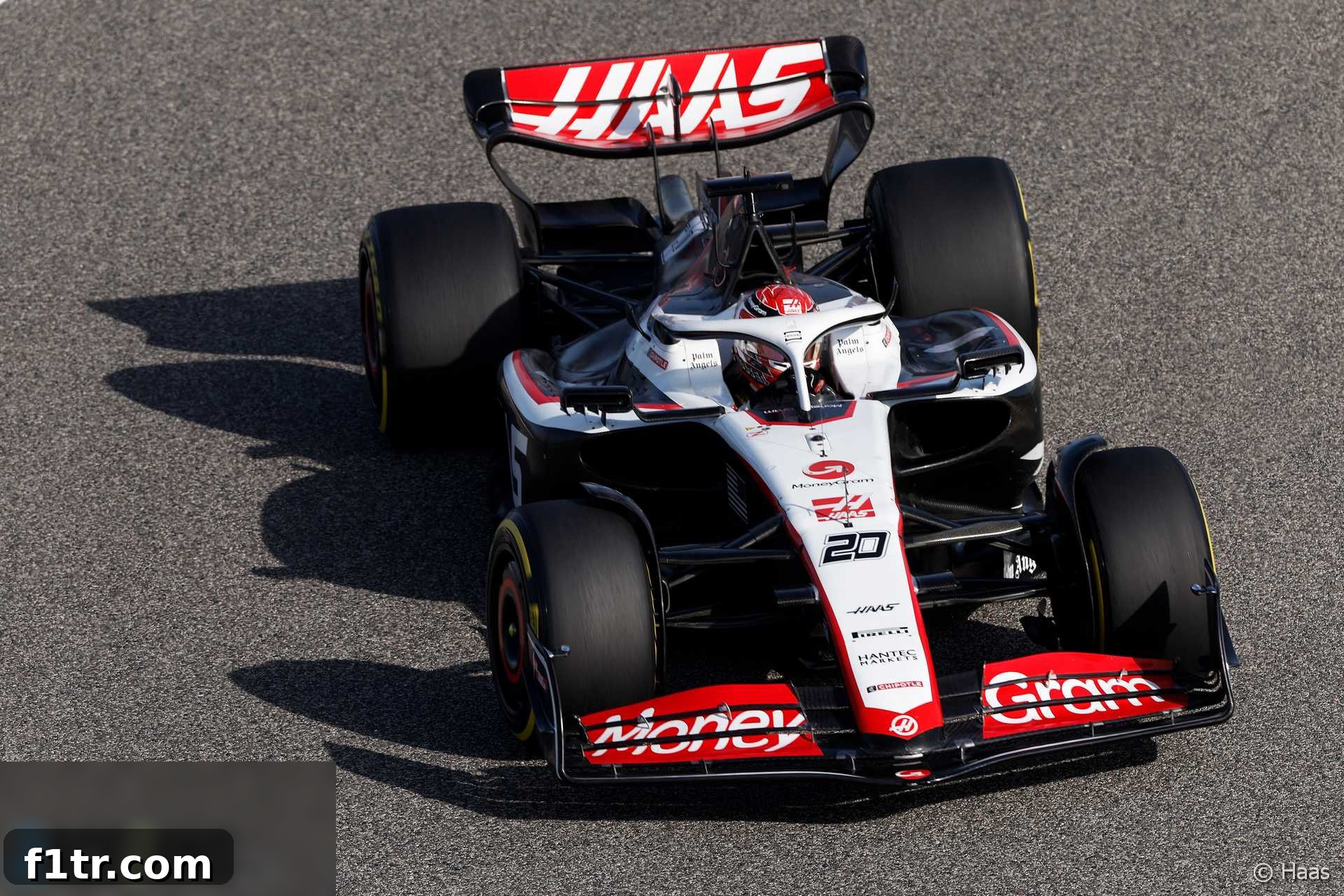
The Haas Formula 1 team, alongside its parent company Haas Automation, has vehemently denied recent allegations that it violated export restrictions by supplying crucial machine tools to Russia following the country’s invasion of Ukraine. This comprehensive rebuttal comes in response to a report by the American news channel PBS, which claimed significant shipments occurred after sanctions were imposed.
Haas F1 Team and Haas Automation are both owned by the prominent American businessman, Gene Haas. The controversy ignited when PBS Newshour aired a report on Tuesday, March 14, alleging that Haas Automation products were transported to Russia between March and October of last year. This timeframe is critical, as Russia initiated its full-scale invasion of Ukraine on February 24th, 2022, prompting widespread international sanctions and export controls.
In a swift and unequivocal response, the Haas F1 Team issued a statement insisting that “the story is simply false, both in its overall impression and in many of its particular statements.” This was echoed by Haas Automation, which launched a robust defense against what it described as a “poorly-sourced hit piece.” Peter Zierhut, Vice President of Outside Operations for Haas Automation, specifically refuted PBS’s central claim that “at least 18 shipments were made to Russia directly from Haas worth $2.8 million from March 4 though October of last year,” branding it a “complete falsehood.”
Zierhut further criticized the report’s journalistic integrity, concluding, “It is irresponsible in the extreme for PBS to present this poorly-sourced hit piece, which ignores basic facts and asserts other facts that are clearly false.” The company emphasized its unwavering commitment to international law and its strong support for Ukraine in the face of Russian aggression.
The geopolitical landscape following Russia’s invasion had immediate and severe implications for the Haas F1 Team. At the time, the team was heavily sponsored by the Russian chemicals giant Uralkali. In a decisive move to align with international condemnation, Haas F1 promptly terminated its association with its title sponsor and, consequently, ended the contract of driver Nikita Mazepin, the son of Uralkali chief Dmitry Mazepin. Haas Automation revealed that the cancellation of this significant sponsorship deal alone cost the company “millions of dollars,” underscoring the financial sacrifices made in adherence to ethical and geopolitical standards.
Haas Automation’s Official Statement on the PBS Story: Addressing Allegations of Sanctions Violations
On Tuesday, March 14, a story aired by PBS alleged that Haas Automation had directly provided machines and parts to Russia, thereby violating U.S. export control and sanctions regulations. Haas Automation categorically states that this story is simply false, both in its overall impression and in many of its specific claims. Our operations and compliance efforts demonstrate a clear commitment to adhering strictly to all applicable laws and regulations.
Key Points of Clarification:
- Haas is, and always has been, in full and absolute compliance with all U.S. Government export control regulations and sanctions. Our robust internal compliance program has been in place for decades, ensuring strict adherence to international trade laws.
- No machines have been shipped directly from any Haas factory to Russia since March 3, 2022, a full week after Russia’s large-scale invasion of Ukraine. This cessation of direct shipments predates many formal sanctions and reflects our voluntary commitment.
- The 18 machines referenced in the PBS report, which allegedly formed the basis of the violation claims, demonstrably left the Haas factory prior to the Russian invasion of Ukraine. These were sales completed before the geopolitical shift and subsequent sanctions.
- Haas Automation made the voluntary decision to terminate its relationship with its Russian distributor, Abamet Management. This proactive measure was taken even though it was not explicitly required by any existing U.S. sanctions at that specific time, highlighting our proactive stance.
- Haas unequivocally supports Ukraine and its people in their courageous defense against Russia’s unwarranted aggression. Our company stands in solidarity with the global community condemning these actions.
It is important for the public to understand that Haas Automation, similar to many U.S. and international manufacturing companies, does not engage in direct sales to end-user customers in Russia or any other country. Instead, our business model relies on a global network of independent distributors who purchase machines from Haas and then resell them to their own customer base. This model is consistently applied worldwide, encompassing operations in the U.S. and over 50 other countries where we maintain distributor partnerships.
While Haas’ distributors operate as independent entities, not owned or controlled by Haas Automation, every distributor, including Abamet Management – our sole independent distributor for Russia and Belarus at the time – is contractually obligated to comply with all applicable U.S. export control and sanctions regulations. Furthermore, Haas has, for several decades, meticulously implemented a comprehensive export and sanctions compliance program. This program incorporates extensive screening and additional checks designed to ensure that all machines or other items sold by Haas are only exported, re-exported, or transferred in full compliance with U.S. law. This includes rigorous verification that machines are supplied exclusively to permissible end customers and are designated solely for permissible end-uses, preventing any diversion to sanctioned entities or purposes.
On March 3, 2022, shortly after the Russian invasion of Ukraine began, Haas Automation took decisive action by terminating its relationship, in its entirety, with its then sole existing independent distributor for Russia and Belarus, Abamet Management. Since that critical date, Haas has neither sold nor shipped any machines, parts, or software to Abamet, or indeed to anyone else in Russia. This crucial timeline and the definitive cessation of business were clearly communicated to the PBS reporter before the story was aired, making their subsequent claims particularly misleading.
In addition to terminating our distributor relationship, Haas voluntarily cancelled 50 existing machine orders from Abamet in March 2022. This cancellation occurred despite the fact that many of these orders may have been permissible under the U.S. export control and sanctions regulations in effect at that precise moment. This demonstrates Haas’s commitment to exceeding minimum legal requirements in response to the crisis.
The PBS report acknowledges that Haas terminated its relationship with Abamet in March 2022 but then attempts to cast doubt on this account by referencing customs records. The report claims that “at least 18 shipments were made to Russia directly from Haas worth $2.8 million from March 4 though October of last year.” Haas Automation reiterates that this assertion is a complete falsehood. Haas made absolutely no direct or indirect sales or shipments to Russia after March 3, 2022.
It is imperative to understand the mechanics of Haas’s sales to Abamet: ownership and physical possession of the goods transferred to Abamet when the items were picked up by Abamet from Haas’s factory in Oxnard, California. Therefore, at the time Haas terminated its relationship with Abamet, Abamet was already in possession of, and held full title and control over, a number of machines and spare parts it had lawfully acquired from Haas prior to Russia’s invasion of Ukraine. While Haas no longer had physical control over such products after the point of sale, all these products were subject to Abamet’s contractual certification to Haas that it would not export any Haas products in violation of applicable U.S. export control and sanctions laws. Haas is certainly not aware of any instances where Abamet breached this certification.
Simply put, if any shipments of Haas-manufactured machines or components occurred after March 3, 2022, such shipments were made, unbeknownst to Haas, by Abamet or potentially one of Haas’s numerous other global customers. Any such shipments would have been made in direct contravention of Haas’s express policy regarding Russia following its February 2022 invasion of Ukraine. The responsibility for ensuring compliance at the point of re-export lies with the entity holding title and possession of the goods.
To be unequivocally clear, Haas has, both voluntarily and in compliance with regulations, ceased doing business with Russian companies on all fronts. Beyond terminating its relationship with Abamet and prohibiting exports or re-exports of Haas products to Russia, the company also incurred substantial costs, totaling millions of dollars, by terminating the Russian company’s sponsorship of the Haas Formula 1 racing team. These actions demonstrate a comprehensive and costly commitment to disengagement.
Haas has been manufacturing high-quality machines for over 30 years, with more than 200,000 Haas machines currently in active use across the world. Throughout this extensive period, Haas has consistently been a strict adherent to all U.S. export control and sanctions regulations. Furthermore, the company has been an even stronger supporter of the U.S. policy goals that many of these regulations are designed to address, reflecting a deep commitment to global stability and ethical commerce.
In particular, Haas, as a corporate entity, has deplored Russia’s invasion of Ukraine and has taken every conceivable step within its control to cease doing business with Russia or Russian companies. Beyond the cessation of business, Haas has also implemented affirmative measures to support Ukraine. This includes, in full compliance with U.S. export control and sanctions regulations, providing Haas’s distributor in Ukraine and its Ukrainian customers with expedited delivery of Haas-manufactured machines. These newly delivered machines, along with earlier provided Haas equipment, are directly and indirectly supporting Ukraine’s critical efforts to defend itself against Russia’s unwarranted and aggressive invasion, demonstrating practical solidarity.
It is a bitter irony, therefore, that the PBS report seeks to portray Haas as being supportive of the Russian military, an assertion that could not be further from the truth. At a critical time when Americans are united in developing the most effective course of conduct in support of Ukraine, it is profoundly irresponsible for PBS to present this poorly-sourced, misleading report. The piece demonstrably ignores basic, verifiable facts and asserts other “facts” that are clearly false, undermining public trust and misrepresenting the actions of a compliant American company.
Further Insights into the F1 Season and Related Topics
- FIA president cleared of alleged interference in two 2023 races
- First week viewing figures for new Drive to Survive season fall again
- Max who? Drive to Survive season six prefers its favourite faces
- RaceFans’ complete 2023 season review
- The F1 drivers who pulled off the 10 biggest charges through the field in 2023
Browse all 2023 F1 season articles