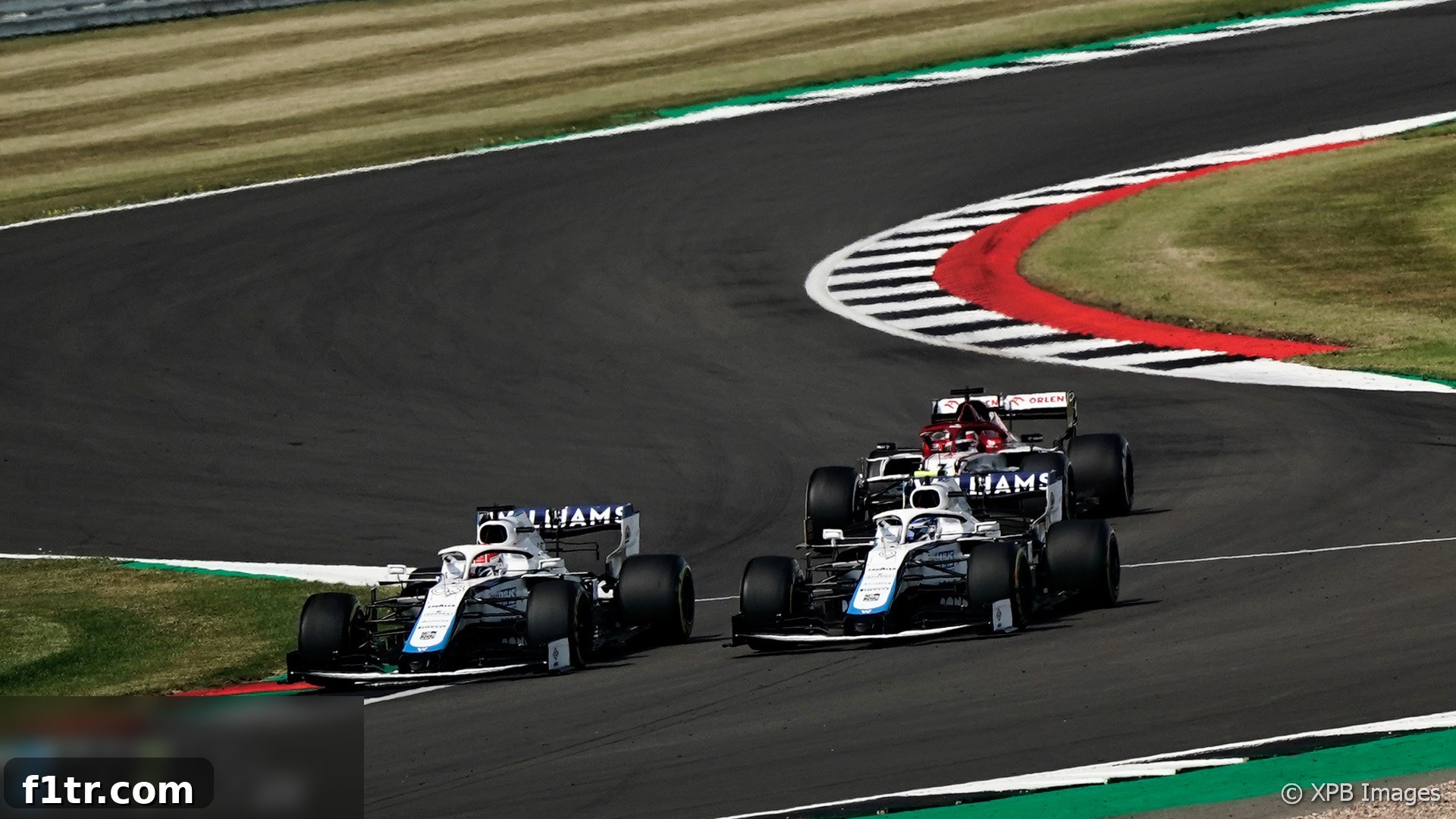
The 2020 Formula 1 season, marked by unprecedented challenges and a condensed calendar, offered a unique lens through which to evaluate driver performance across the grid. As the dust settled and the final chequered flag waved, the battle within each team became a critical measure of individual talent and progress. For Williams Racing, a team navigating a pivotal transitional period, the intra-team contest between George Russell and rookie Nicholas Latifi provided compelling insights into both the drivers’ potential and the underlying capabilities of the FW43 chassis.
While the Grove-based outfit continued to grapple with being at the back of the field, the performance of its drivers was anything but uneventful. George Russell, already establishing a formidable reputation as “Mr. Saturday,” delivered a qualifying masterclass throughout the season. His sheer speed over a single lap frequently propelled the Williams car into Q2, a feat that often appeared beyond the car’s inherent pace. His new teammate, Nicholas Latifi, faced a steep learning curve in his debut season, but steadily demonstrated improvement, particularly on Sundays.
Advert | Become a Supporter & go ad-free
Williams F1 2020 Driver Battle: Russell’s Pace vs. Latifi’s Resilience
George Russell’s qualifying advantage over Nicholas Latifi was nothing short of absolute. Throughout the 2020 campaign, Russell consistently outqualified his teammate, maintaining a perfect 16-0 record. This stark dominance mirrored his performance against Robert Kubica the previous year and cemented his reputation as one of the grid’s brightest qualifying talents. The average gap between the two drivers in representative sessions was a staggering 0.563 seconds, the largest of any teammate pairing in Formula 1 during 2020. This significant disparity underscored Russell’s exceptional ability to extract every ounce of performance from the Williams FW43 on a single flying lap, often pushing the car far beyond its expected limits.
The qualifying gap was so pronounced that it sometimes approached a full second, excluding outliers like the Turkish Grand Prix where Latifi’s significant deficit was partly due to an unfortunate Q1 crash. Russell’s consistent ability to reach Q2, a remarkable achievement for a car struggling at the rear of the grid, meant he often had more opportunities to hone his single-lap pace on fresh tires in the second qualifying segment. As Dave Robson, Williams’ Head of Vehicle Performance, wisely pointed out, Russell’s consistent Q2 appearances created a self-perpetuating cycle, limiting Latifi’s chances to practice high-pressure flying laps when he was routinely eliminated in Q1.
Nicholas Latifi’s Steady Progression in Race Trim
While Saturdays proved to be a significant hurdle for Nicholas Latifi, his race performances painted a more encouraging picture. The Canadian rookie showed commendable resilience and race craft, steadily improving as the season progressed. Latifi was the first Williams driver to cross the finish line on two occasions, demonstrating his ability to manage races and capitalize on opportunities. At the Italian Grand Prix in Monza and later at the Russian Grand Prix in Sochi, Latifi brought his car home ahead of his more experienced teammate, a testament to his growing comfort and understanding of Formula 1 racing.
One of Latifi’s standout performances came at Imola, where he secured an impressive 11th place. This was his second 11th-place finish of the season, and on this particular occasion, he was agonizingly close – less than a second – to scoring the team’s first point of the year, narrowly missing out to Antonio Giovinazzi. His ability to maintain a clean race, manage tires, and make progress through attrition highlighted a disciplined approach that bodes well for his future development in the sport. While the raw qualifying pace was not there, Latifi’s capacity to deliver solid, consistent race performances justified his place on the grid and offered a positive counterpoint to Russell’s outright speed.
Challenges with the FW43: Starts and Traffic Woes
The 2020 season was undoubtedly a challenging one for Williams Racing as a whole, and the FW43 chassis presented significant hurdles for both drivers. A recurring weakness for the team was the car’s performance off the starting line. Both Russell and Latifi frequently struggled to get the FW43 away cleanly, often losing positions in the opening laps. This made life incredibly difficult, especially given the car’s inherent lack of pace. Furthermore, the car’s handling in heavy traffic was often suboptimal, exacerbating the problem and making it difficult to recover lost ground.
These limitations meant that whatever qualifying heroics George Russell managed – consistently dragging the FW43 into Q2 against all odds – often came to naught on Sunday. A strong qualifying position would frequently be undone by a poor start, pushing him back into the thick of the midfield where the car’s performance limitations became even more apparent. This dynamic underscored the broader struggles of the Williams team and highlighted the immense pressure on the drivers to perform flawlessly under challenging circumstances.
George Russell’s Future and the Sakhir Grand Prix Revelation
The 2020 season concluded with significant speculation surrounding George Russell’s future, particularly after his sensational stand-in performance for Mercedes at the Sakhir Grand Prix. In the absence of Lewis Hamilton, Russell seized the opportunity with both hands, immediately demonstrating his exceptional talent by dominating practice sessions, narrowly missing pole position, and leading the race convincingly before unfortunate circumstances denied him a memorable victory. This one-off appearance emphatically showed the world that Russell was not only ready for a top team but capable of fighting for wins and championships.
Despite the clamor for his immediate promotion, Mercedes firmly denied Russell a full-time seat alongside Valtteri Bottas for the 2021 F1 season, confirming his return to Williams for another year. This decision meant that the current teammates would continue their battle in 2021, providing another season for Latifi to narrow the qualifying gap and for Russell to further showcase his abilities while waiting for his inevitable move to a front-running team. Russell’s Sakhir outing served as a powerful declaration of intent, affirming that his Williams performances were not flukes but true indicators of an elite talent.
Jack Aitken’s Brief Debut
In Russell’s absence at the Sakhir Grand Prix, Williams provided a single-race opportunity to their reserve driver, Jack Aitken. On his Formula 1 debut, Aitken performed admirably, qualifying within a mere tenth of a second of his teammate Nicholas Latifi. His race started promisingly, but an early incident saw him tag a barrier and damage his front wing, necessitating an unscheduled pit stop. Despite the setback, Aitken demonstrated commendable resilience to bring his car to the chequered flag, even as an oil leak prematurely ended Latifi’s race. Aitken’s brief but spirited appearance offered a glimpse into his capabilities and underlined the depth of talent within the F1 feeder series.
Advert | Become a RaceFans supporter andgo ad-free
Looking Ahead: The Road for Russell and Latifi
As the 2020 season drew to a close, the outlook for both Williams drivers was clear. For Nicholas Latifi, the top priority for the upcoming season would undoubtedly be to significantly shrink that yawning qualifying gap to his teammate. His race pace and consistency were encouraging, but finding more outright speed over a single lap would be crucial for his long-term prospects in Formula 1. The experience gained in his rookie year, coupled with the stability of remaining with Williams, provided a solid foundation for further growth.
George Russell, meanwhile, continued to operate with his sights firmly fixed on a future promotion to a top team. His performances, particularly the Sakhir Grand Prix, had unequivocally demonstrated his readiness for such a move. His ongoing tenure at Williams offered him another year to refine his skills, lead the team, and continue to prove his mettle against the best in the business. The 2020 season, despite Williams’ position, was a pivotal year for both drivers, showcasing Russell’s extraordinary potential and Latifi’s steady development as a Formula 1 competitor.
Positive gap: Latifi was ahead; Negative gap: Russell was ahead (Detailed race performance data for the 2020 F1 season)
Race-by-race results summary: Russell and Latifi
(Detailed race-by-race qualification and race results for the 2020 season would typically be displayed here, showcasing individual performances and intra-team comparisons across each Grand Prix.)
| AUS | STY | HUN | GRE | 70T | SPA | BEL | ITA | TUS | RUS | GER | POR | EMI | TUR | BAH | ABU | ||
| George Russell | Q | ||||||||||||||||
| R | |||||||||||||||||
| Nicholas Latifi | Q | ||||||||||||||||
| R |
Advert | Become a RaceFans supporter andgo ad-free
Join the RaceFans Supporters Drive!
If you’ve enjoyed RaceFans’ motor sport coverage during 2020, please take a moment to find out more about our Supporter Drive. Your contribution helps us continue to deliver in-depth analysis and exclusive content.
We’re aiming to welcome 3,000 new Supporters to help fund RaceFans so we can continue to produce quality, original, independent motorsport coverage. Here’s what we’re asking for and why – and how you can sign up:
- Join the RaceFans Supporters Drive!
2020 F1 season review: Explore More Driver Performances
Delve deeper into the 2020 Formula 1 season with our comprehensive driver rankings and team analyses. Understand how each competitor stacked up against their rivals and the rest of the grid.
- 2020 F1 season driver rankings #1: Lewis Hamilton
- 2020 F1 driver rankings #2: Max Verstappen
- 2020 F1 driver rankings #3: Charles Leclerc
- 2020 F1 driver rankings #4: Carlos Sainz Jnr
- 2020 F1 driver rankings #5: Daniel Ricciardo
Browse all 2020 F1 season review articles for in-depth analysis and insights.