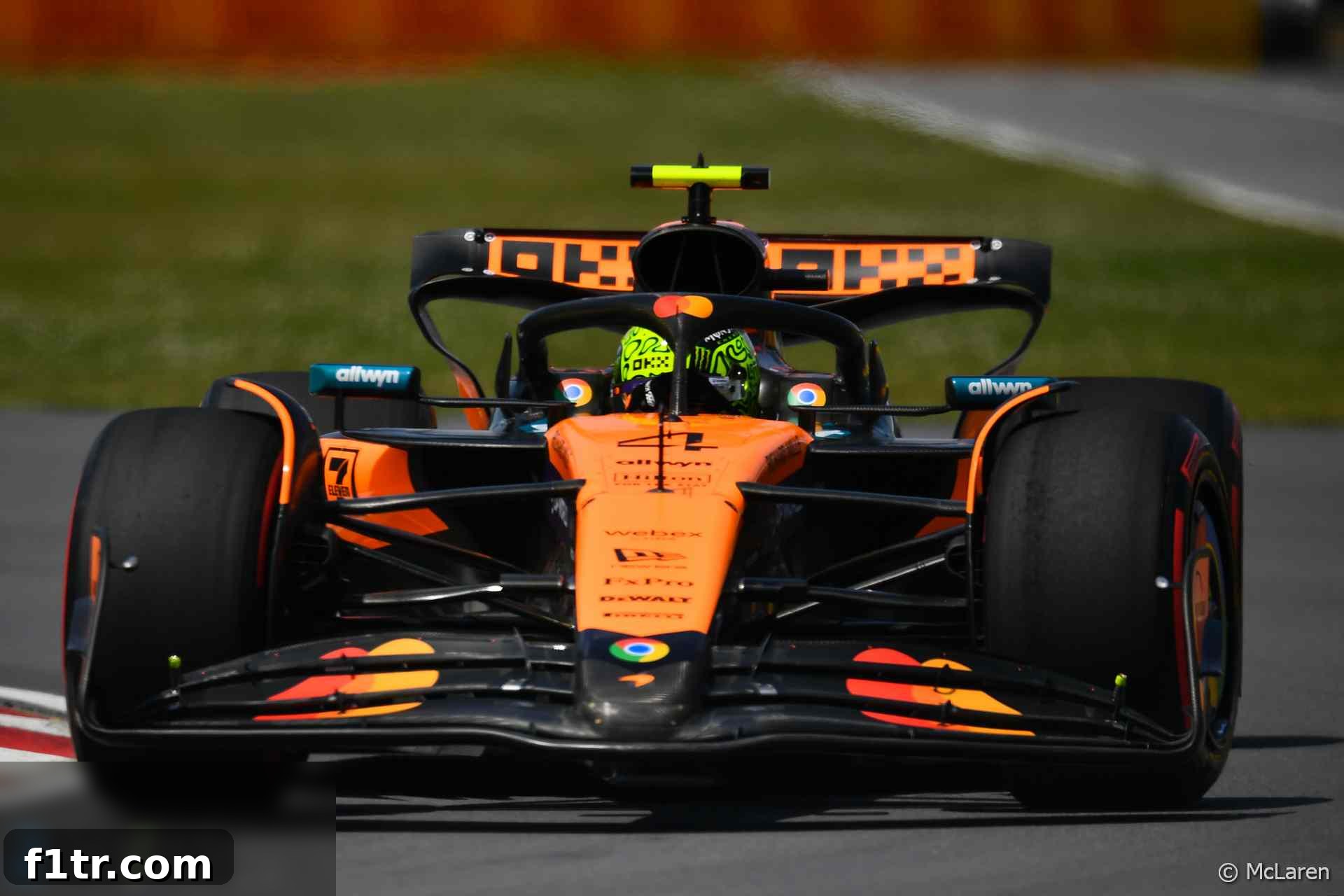
McLaren experienced an unusually difficult pair of practice sessions on Friday in Montreal, marking a challenging start to the Canadian Grand Prix weekend for the Woking-based team. Despite ending the day second-fastest, Lando Norris candidly described the sessions as McLaren’s “worst Friday of the year so far” in terms of driveability and consistency.
McLaren’s Tricky Start in Montreal: Norris Faces Uphill Battle Despite Pace
The iconic Circuit Gilles Villeneuve, known for its challenging layout, bumps, and varying grip levels, presented McLaren with a significant puzzle during Friday’s Free Practice sessions. While the headlines might suggest a strong showing for Lando Norris, who recorded the second-fastest time, his post-session comments painted a picture of deep frustration and a car proving exceptionally difficult to tame. This unexpected struggle comes at a crucial juncture, as teams vie for crucial performance advantages in the highly competitive Formula 1 season.
Norris’s Candid Assessment: “Worst Friday of the Year” for Driveability
Norris’s day concluded with a commendable P2 on the timesheets, placing him as the quickest driver to set his best lap on the soft compound tyre. He was narrowly edged out by George Russell, who went two-hundredths of a second quicker on the medium rubber, highlighting the fine margins at play. However, the raw pace didn’t tell the full story of the McLaren MCL38’s behaviour. Across both Free Practice 1 and Free Practice 2, Norris reported a series of minor errors and a pervasive feeling that the car was particularly “tricky to drive” around the demanding Montreal street circuit.
“We need to get the car in a better place,” Norris stated to the official F1 channel after the sessions, his voice betraying a hint of dissatisfaction. He acknowledged the universally challenging nature of the track, noting, “Everyone’s in the same boat on the track, the track’s difficult.” Yet, he singled out McLaren’s experience as uniquely problematic for their season thus far. “It’s definitely been our worst Friday of the year so far. Maybe not worst in terms of pace but just most difficult to put [a lap] together and most tricky. We’re not miles away, we just need to make it a little bit easier to drive.” This frank assessment underscores the operational difficulties the team faced, where extracting consistent performance was a far greater challenge than achieving a single quick lap.
The Discrepancy Between Pace and Feel: A Deeper Dive
The paradox of Norris’s second-fastest time amidst his complaints highlights a critical aspect of Formula 1 performance: the distinction between raw speed potential and driver confidence. A car that is difficult to drive, even if capable of a fast lap under optimal conditions, can be detrimental to consistency, tyre management, and outright race pace. Norris’s struggle to string together clean laps suggests that the car’s sweet spot was incredibly narrow, making it prone to errors and difficult to extract maximum performance from on a sustained basis.
The Circuit Gilles Villeneuve, with its unique blend of high-speed sections, heavy braking zones, and notorious kerbs, demands a highly responsive and stable car. The low grip conditions often experienced here exacerbate any handling deficiencies, making a well-balanced chassis paramount. For Norris to admit to making “a series of minor errors” points to a car that was unpredictable on the limit, potentially suffering from snap oversteer, understeer, or instability over the frequent bumps. These characteristics, if not addressed, can severely hamper a driver’s ability to attack corners with confidence and maintain a high level of performance throughout a race stint.
Assessing the New Upgrade Package: Too Early to Call
McLaren had arrived in Montreal with a small upgrade package, specifically designed to address some of the handling characteristics that Lando Norris has found challenging with the MCL38 earlier in the year. The aim was to improve the car’s overall behaviour and provide the drivers with a greater sense of connection and feedback. However, Norris cautioned against drawing immediate conclusions regarding their effectiveness, given the distinct nature of the Canadian track.
“It’s pretty similar, honestly, but I think it’s hard to say just from one track,” he explained, emphasizing the need for more varied circuit data. “I think you have to go to many more. Especially here it’s quite unique with the amount of bumps and kerbs, and the low grip that we have. So it’s a bit too early to tell.” This pragmatic view is common in Formula 1, where track-specific characteristics can mask or amplify the true impact of aerodynamic or mechanical changes. What works well on a smooth, high-downforce circuit might behave entirely differently on a bumpy street track like Montreal.
Despite the initial difficulties, Norris maintained a positive outlook regarding the upgrades’ long-term potential. “But all of the things are aiming to move the car in the right direction and give me more feeling which is a good thing.” This statement suggests that while the immediate benefits might not be overwhelmingly apparent due to the circuit’s idiosyncrasies, the underlying philosophy behind the upgrades aligns with the drivers’ desired handling characteristics. The team will be diligently poring over the data collected from Friday’s sessions, seeking to understand how the new components are interacting with the car and the track, and to optimize the setup for Saturday’s crucial qualifying session.
Oscar Piastri’s Outlook: Confidence Amidst Challenges
While Lando Norris voiced significant concerns, his teammate Oscar Piastri presented a more composed perspective, despite finishing the day in sixth position. Piastri, who has been steadily building his reputation in Formula 1, acknowledged the challenges but seemed less alarmed by the situation, attributing some of the deficit to his own performance rather than solely to the car’s inherent difficulties.
“The new parts have done what we expected them to but hopefully we can find a bit more,” Piastri commented, indicating a degree of satisfaction with the initial data from the upgrade package. This contrasts slightly with Norris’s “pretty similar” assessment, perhaps suggesting Piastri found it easier to adapt or that the upgrades provided a more tangible benefit from his perspective. He also highlighted the team’s progress throughout the day: “I think we’ve made a good step from FP1 to FP2 and we just need to try and make the same step again.” This incremental improvement indicates a systematic approach to problem-solving, which is vital in a Grand Prix weekend.
Crucially, Piastri emphasized the absence of “alarm bells,” conveying a sense of calm and control within the team. “There’s no alarm bells, just trying to get the car in a better window and get me in a better window.” This dual focus on both car setup and driver optimization is key. It implies that a significant portion of the untapped potential lies in refining the car’s balance to suit the demanding conditions, alongside Piastri’s own adaptation and fine-tuning of his driving style to extract the maximum from the package. His words resonate with a team confident in its engineering capabilities and its ability to turn around a challenging Friday.
The McLaren Engineering Challenge: Bridging the Gap to Consistency
Friday’s practice sessions underscore the formidable challenge facing McLaren’s engineers and strategists overnight. The core objective will be to transform a “tricky to drive” car into one that is more compliant and predictable for both Norris and Piastri. This involves a meticulous analysis of telemetry data, driver feedback, and simulated scenarios. Adjustments to suspension settings, aerodynamic balance, and even brake bias will be under scrutiny to enhance stability and improve responsiveness.
Finding this elusive “better window” for the car is paramount, particularly heading into Saturday’s qualifying session, where confidence and precision are rewarded. A car that instills confidence allows a driver to push closer to the limit without fear of unexpected behaviour. The unique characteristics of the Montreal track – its mix of temporary street circuit elements and permanent track sections, coupled with ever-evolving grip levels – demand a flexible approach to setup. The team will also need to consider potential weather changes, as rain has often played a role in Canadian Grand Prix weekends, further complicating setup decisions.
Looking Ahead: Qualifying and Race Prospects
While Friday presented a tougher challenge than anticipated for McLaren, the fact that Lando Norris could still post the second-fastest time, even with a difficult car, suggests underlying potential. The key to a successful weekend now hinges on the team’s ability to unlock this potential consistently. If they can improve the car’s driveability for Saturday, both drivers will be in a much stronger position to extract maximum performance during qualifying. Grid position is especially vital at the Circuit Gilles Villeneuve, where overtaking can be challenging, though DRS zones offer some opportunities.
The engineers will be working tirelessly, analyzing every data point from the two practice sessions. The goal is clear: to provide Norris and Oscar Piastri with a car that is easier to handle, more predictable, and allows them to attack the circuit with full confidence. A significant step forward in setup could transform McLaren’s fortunes, turning a challenging Friday into a competitive Saturday and Sunday. The expectation remains that McLaren, a team on an upward trajectory this season, will leverage their engineering prowess to address these initial difficulties and aim for strong points finishes in the Canadian Grand Prix.