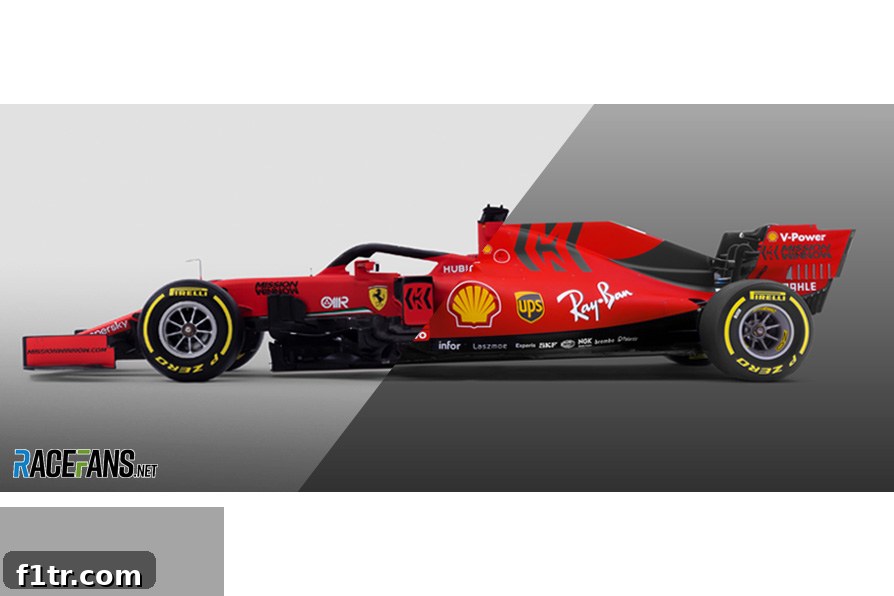
Ferrari, the iconic Maranello-based Formula 1 constructor, unveiled its 2020 challenger, the SF1000, with ambitious claims from team principal Mattia Binotto. The new car, launched amidst great anticipation, was described as featuring “extreme concepts” as the Scuderia set its sights on dethroning Mercedes-AMG Petronas, who had enjoyed an unprecedented six-year reign of dominance in the sport. This highly-anticipated reveal marked a pivotal moment for Ferrari, as they aimed to recapture the Constructors’ and Drivers’ Championships, a feat that had eluded them for over a decade. The SF1000, named in anticipation of Ferrari’s 1000th Grand Prix start, carried the hopes and expectations of millions of Tifosi worldwide.
Despite the revolutionary aspirations, Binotto clarified that the SF1000’s fundamental architecture retained a strong connection to its predecessor, the SF90. “The SF1000 has the SF90 of last year as a starting point,” Binotto explained, emphasizing the continuity in design philosophy. This evolutionary approach was largely dictated by the stable technical regulations for the 2020 season. In a sport where every millisecond counts, teams often opt for incremental improvements on a known quantity rather than a complete redesign when regulations remain largely unchanged, allowing them to fine-tune and optimize existing concepts. However, Ferrari acknowledged the inherent weaknesses of the SF90 and set out to rigorously address them within this framework of stability.
The primary area targeted for significant improvement in the SF1000 was the car’s peak aerodynamic performance, particularly its downforce generation. The SF90, while excelling in straight-line speed, often struggled in high-downforce corners and in extracting maximum grip, a deficiency that proved costly against rivals like Mercedes. Binotto articulated this focus, stating, “The entire project has been trying to get as much aero performance as possible, certainly in terms of downforce level.” This wasn’t a superficial aesthetic redesign but a deep dive into the car’s core structure to maximize its interaction with the airflow. To achieve this, extensive work was carried out on optimizing the packaging of all internal components. “The entire chassis, monocoque, gearbox, power unit packaging has been designed so as to have a very narrow car and a very narrow shape, body shape,” Binotto added.
Creating a “narrow car” in Formula 1 is an intricate engineering challenge. It involves compressing critical components like the engine, gearbox, and cooling systems into the smallest possible volume to allow for a more aggressive and aerodynamically efficient bodywork design. A narrower car typically presents less frontal area to the wind, reducing drag, and, more importantly, frees up significant real estate at the rear of the car for better airflow management around the crucial diffuser and rear wing elements. This meticulous packaging allows designers to sculpt more extreme contours, channeling air precisely over and around the car to generate enhanced downforce. The visual evidence of this effort could be observed in the slimmer rear end of the SF1000 and its reshaped sidepods, which appeared more tightly integrated and sculpted compared to the SF90. These external alterations were direct manifestations of the intensive internal repackaging aimed at unlocking greater aerodynamic potential.
Beyond aerodynamics, another critical area of focus for the SF1000 was its suspension system. Formula 1 suspension is not merely about comfort; it’s a sophisticated system designed to maintain the car’s aerodynamic platform, manage tire performance, and provide drivers with the necessary feedback and adjustability. Binotto confirmed, “The suspension have been reviewed to give us some more flexibility at the race track in terms of set-up.” This increased flexibility is vital for engineers to fine-tune the car’s handling characteristics for varying track layouts, ambient conditions, and tire degradation patterns. The ability to quickly and effectively adjust suspension parameters – such as camber, toe, ride height, and damper settings – allows the team to optimize the car’s performance window, ensuring it can operate at its peak across different scenarios, a crucial factor in a championship battle where marginal gains accumulate over a season. Improving this aspect meant that the SF1000 could potentially adapt better to a wider range of tracks and conditions, addressing another subtle weakness that had sometimes limited the SF90’s ultimate performance.
Significantly, the changes were not limited to the chassis and external bodywork; the heart of the car, its power unit, also underwent a comprehensive overhaul. “The internal combustion engine architecture has been changed as well,” revealed Binotto. Modern Formula 1 engines are incredibly complex hybrid powertrains, and the internal combustion engine (ICE) remains a critical component for raw power delivery. A key driver for these engine modifications was the evolving technical regulations. Binotto specified, “The combustion chamber, to cope as well with the new regulation where the oil consumption has been reduced by half.” This regulatory change presented a substantial engineering challenge. Reducing oil consumption by 50% meant redesigning elements within the combustion chamber and lubrication system to maintain performance and reliability while adhering to stricter environmental and efficiency guidelines. This intricate work involved optimizing fuel injection, ignition timing, and piston design to ensure efficient combustion with less oil ingress, a testament to the continuous innovation required even under stable rules. These powertrain advancements aimed to provide more consistent power delivery, improved thermal efficiency, and greater reliability over the demanding course of a Formula 1 season.
Binotto’s summation captured the essence of Ferrari’s approach with the SF1000: “So a lot of work has been done on that car, which in a way is a very extreme car compared to the car of last year.” This declaration highlights that “extreme” doesn’t necessarily mean a visually radical departure, but rather an extreme level of detailed engineering and optimization applied to every facet of the car’s design. It represents an unrelenting pursuit of performance gains, pushing the boundaries within the existing regulatory framework. While external comparisons with the SF90 revealed subtle but distinct differences – such as the sleeker sidepods, a more compact engine cover, and revised front wing elements – many of the most impactful changes, particularly concerning internal packaging and engine architecture, remained beneath the surface. These hidden innovations were arguably the most significant, promising to unlock the performance Ferrari desperately sought.
Ferrari’s journey in Formula 1 is steeped in history and an unwavering commitment to excellence. The SF1000 represented not just another car launch, but a symbol of the team’s relentless ambition to reclaim its rightful place at the pinnacle of motorsport. Under the leadership of Mattia Binotto, who had taken the helm in 2019, the pressure was immense to deliver a championship-contending machine. The strategic decision to build upon the SF90, while aggressively addressing its known weaknesses through “extreme” engineering concepts, showcased a pragmatic yet determined approach. The focus on improved aerodynamic efficiency, enhanced suspension flexibility, and a more potent, compliant power unit were all critical steps in challenging Mercedes and fending off other competitive threats from teams like Red Bull Racing. The SF1000 was more than just a race car; it was Ferrari’s statement of intent for the 2020 Formula 1 season, a meticulously crafted piece of machinery designed to conquer the track and bring glory back to Maranello. The team and its passionate fanbase eagerly awaited to see if these extreme concepts would translate into the competitive edge needed to end the long wait for championship success.
2020 F1 season
- Grosjean to make F1 test return tomorrow for first time since Bahrain horror crash
- Pictures: Wrecked chassis from Grosjean’s Bahrain fireball crash to go on display
- Bottas vs Rosberg: Hamilton’s Mercedes team mates compared after 78 races each
- F1 revenues fell by $877 million in Covid-struck 2020 season
- Hamilton and Mercedes finally announce new deal for 2021 season
Browse all 2020 F1 season articles