Carlos Sainz’s Tumultuous Yet Triumphant 2023 Formula 1 Season: A Deep Dive into His Performance
At first glance, it might seem surprising to find a Ferrari driver positioned in the upper-mid section of the highly competitive 2023 Formula 1 driver rankings. For many, the expectation for a Scuderia driver is consistently at the sharp end, challenging for podiums and victories. Yet, Carlos Sainz’s 2023 campaign was a captivating, often frustrating, yet ultimately historic journey that defied simple categorization.
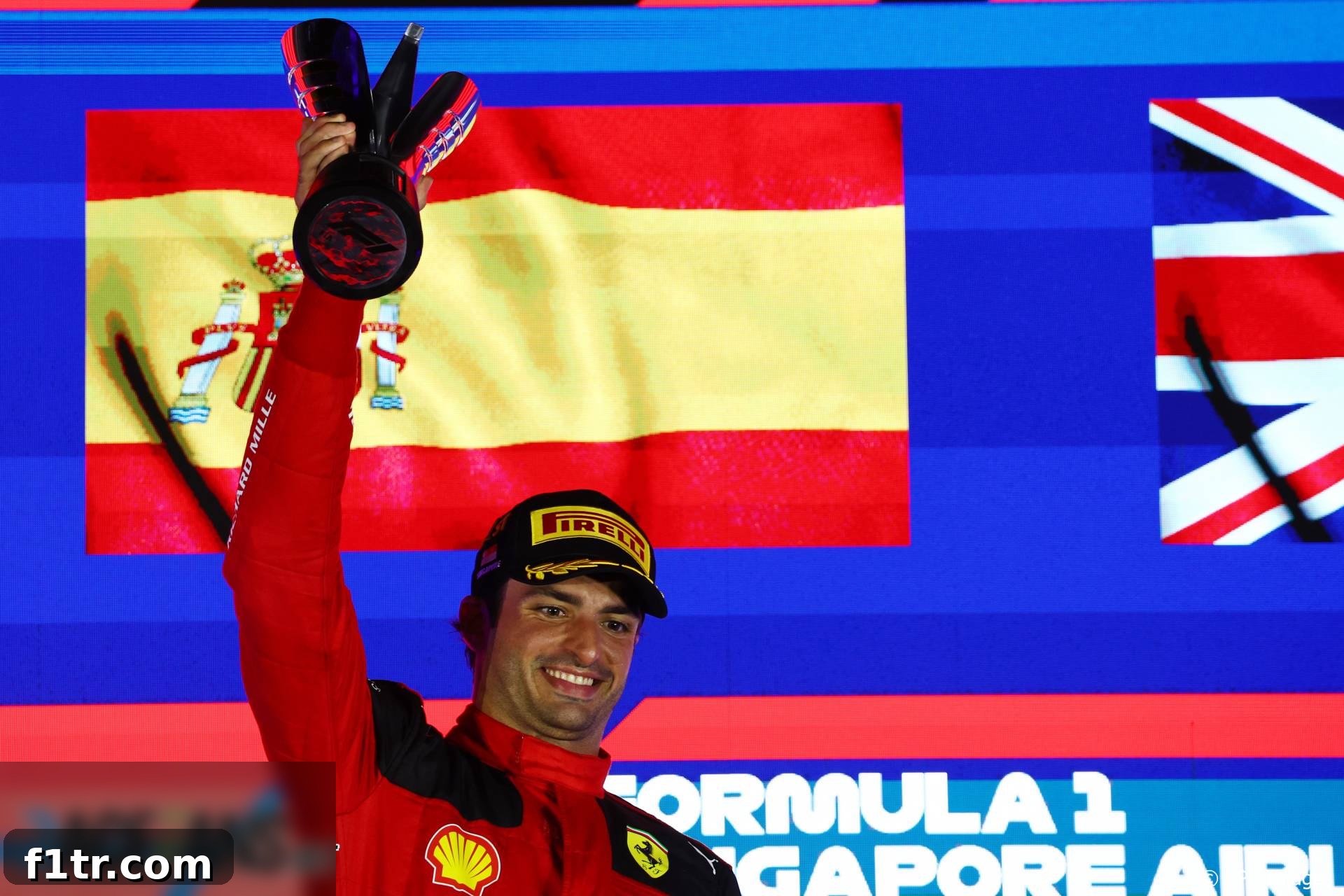
Indeed, Carlos Sainz Jnr etched his name into the annals of Formula 1 history during this season. He will forever be remembered as the sole driver in 2023 to decisively defeat both dominant RB19s, steering his Ferrari to an unforgettable victory at the Singapore Grand Prix. This extraordinary achievement stands as a testament to his skill and strategic acumen, marking a rare break in Red Bull’s otherwise impenetrable winning streak and creating a moment that will resonate with fans for years to come.
Advert | Become a Supporter & go ad-free
However, while Sainz orchestrated a feat no other driver could replicate on that humid September night in Singapore, the broader narrative of his season was undeniably characterized by stark contrasts. A rollercoaster of dazzling highs and perplexing lows, it painted a picture of inconsistency. In a 2023 grid teeming with talent and fiercely competitive machinery, these moments of struggle and missteps became increasingly difficult to overlook, shaping the perception of his overall performance.
Ferrari’s Inconsistent SF-23: A Challenging Foundation
The Ferrari SF-23 proved to be a notoriously temperamental machine throughout 2023, failing to meet the lofty expectations of Sainz, his highly-rated teammate Charles Leclerc, and new team principal Frederic Vasseur. The car’s performance was often a roll of the dice; some weekends it would unlock its blistering pace, while others saw it grappling with a narrow operating window, tire degradation, and a lack of overall consistency. This inherent unpredictability meant that fighting for top honors was a constant uphill battle, especially in the face of Red Bull’s overwhelming dominance, which left only fleeting opportunities to genuinely contend for victories and regular podium finishes.
Early in the season, Ferrari found themselves not only significantly adrift of the formidable Red Bull but also lagging behind the resurgent Aston Martin and the ever-present Mercedes. The initial rounds highlighted the SF-23’s struggles, particularly its sensitivity to varying track conditions and tire wear. While Charles Leclerc accumulated a mere six points in the first three races compared to Sainz’s twenty, it was Leclerc who often appeared to extract more raw pace from the difficult car, demonstrating a more consistent, albeit often unrewarded, level of performance during the championship’s nascent stages.
Early Season Struggles: Bahrain, Jeddah, and Melbourne Mishaps
The season opener in Bahrain set a challenging tone. Sainz consistently trailed Leclerc throughout the weekend, both in qualifying and race pace. He ultimately secured a fourth-place finish only because Leclerc suffered a heartbreaking late-race engine failure while running strongly. In Jeddah, the gap in raw pace was evident again, with Sainz half a second slower than Leclerc in qualifying. Despite starting ahead due to a grid penalty for his teammate, Sainz then allowed Lance Stroll to execute a bold overtake around the outside of Turn 13 on the opening lap. He finished one place ahead of Leclerc, who had started a daunting eight positions further back, underscoring the missed potential.
Melbourne proved to be a nightmare for the Spaniard. After a chaotic race riddled with red flags, Sainz found himself restarted in fourth place for the final sprint to the finish. In an aggressive move, he made contact with Fernando Alonso at the first corner, sending the Aston Martin spinning. Although Alonso recovered, the stewards swiftly deemed Sainz at fault, handing him a contentious five-second time penalty. With the race controversially ending under Safety Car conditions, this penalty effectively became a ten-second stop-and-go equivalent, dropping him outside the top ten and cruelly denying him a valuable points finish. This incident sparked significant debate and frustration for Sainz and Ferrari.
Continuing Inconsistencies: Baku and the Brief Barcelona High
The underwhelming results continued into the early phase of the year. In Baku, a street circuit where Leclerc impressively claimed pole position for both the sprint and grand prix qualifying sessions, Sainz struggled to replicate his teammate’s outright speed. He seemed to wrestle with a different car, unable to unlock the same level of performance. Although his fifth-place finish was a perfectly reasonable result given the circumstances, the significant gap of almost half a minute behind Leclerc by the chequered flag was a clear indicator of a challenging weekend where he failed to maximize the car’s potential.
However, Spain, his home Grand Prix in Barcelona, offered a brief but powerful resurgence. Sainz delivered a very strong performance, narrowly missing out on pole position and fighting valiantly in the race. Despite finishing in fifth, it was considered a highly commendable result, placing him behind only the two dominant Red Bulls and the formidable Mercedes, which were undeniably the two quickest teams over that particular weekend. This race showcased flashes of the “Smooth Operator” at his best, combining speed with intelligent race craft.
Mid-Season Mistakes and Missed Opportunities
Yet, the Spanish Grand Prix appeared to be an anomaly rather than a turning point. As the season progressed, Sainz began to accumulate a series of uncharacteristic mistakes, perhaps more than one would expect from a driver of Ferrari calibre. The glamorous streets of Monaco saw him crash heavily at the Swimming Pool section during practice, adding unnecessary pressure and repair work for his mechanics. In the race itself, when the rain descended, he slid off track, ultimately finishing behind Leclerc despite having started ahead – again, after a Leclerc grid penalty. These moments highlighted a struggle to adapt to changing conditions and maintain consistent focus.
Advert | Become a RaceFans supporter andgo ad-free
The Canadian Grand Prix in Montreal presented further challenges. Sainz provided his mechanics with more repair work following another practice shunt. Throughout the weekend, he was investigated multiple times for impeding rivals at the tight chicane, reflecting a lapse in situational awareness on track. Austria proved particularly costly; he lost fourth place in the Grand Prix after accumulating a staggering 15 seconds of time penalties for six separate track limits offenses. This demonstrated a critical inability to keep the car within the white lines, squandering valuable points and highlighting a recurring issue with precision and discipline.
The pattern of errors continued into Hungary, where Sainz again slid off into the barriers during practice, compromising his weekend. This directly contributed to him missing Q3, qualifying a disappointing 11th – one of only three times he failed to reach the final qualifying session in 2023. He then headed into the mandatory summer break on a low note, forced to retire from the Belgian Grand Prix at Spa-Francorchamps after sustaining significant damage from a chaotic turn one clash with Oscar Piastri. Although he was only seven points adrift of Leclerc in the championship standings at that point, this narrow gap failed to truly reflect the untidy and inconsistent nature of Sainz’s performances throughout the first half of the season.
The Second Half Resurgence: Finding His Steel
However, upon returning to the cockpit for the second half of the season, a noticeable shift occurred in Carlos Sainz’s approach and performance. It was as if he had rediscovered his inner steel, driving with renewed confidence and determination. When he arrived at Ferrari’s spiritual home race at Monza, the Italian Grand Prix, he was absolutely on fire. He topped the time sheets in the final two practice sessions, showcasing genuine pace and excellent car control.
The qualifying session was nothing short of sensational. Sainz stunned the dominant Max Verstappen and the Tifosi alike by clinching a spectacular pole position with what many consider his most memorable qualifying lap to date. While he ultimately couldn’t hold off the relentless Red Bulls in the race, he engaged in a thrilling, wheel-to-wheel battle with his teammate Leclerc, defending vigorously to secure a hard-fought third place. This was his first podium of the season, a powerful statement of intent that signaled a dramatic turnaround in his form.
A Historic Victory in Singapore: Breaking the Red Bull Dominance
Just one weekend later, in the demanding street circuit of Singapore, a precious and rare opportunity presented itself. For reasons still debated, Red Bull struggled profoundly to find a suitable setup for their car, failing to get it into its optimal operating window. This unexpected vulnerability opened up the coveted number one position to any driver daring and capable enough to claim it. Over a weekend where Ferrari, McLaren, and Mercedes were incredibly closely matched, it was Sainz’s exceptional driving that made the decisive difference on both Saturday and Sunday.
From pole position, he led every single lap of the race, demonstrating an extremely cool head and impeccable management under immense pressure during a long, physically grueling event. Crucially, Sainz executed some incredibly clever tactics in the closing laps. Recognizing the threat from the pursuing Mercedes, he deliberately slowed his pace slightly, keeping Lando Norris within DRS range. This strategic move allowed Norris to defend against George Russell, breaking the DRS train and denying Russell the opportunity to attack Sainz directly. This masterful piece of race craft ultimately allowed Sainz to maintain his lead and cross the finish line first, breaking Red Bull’s unprecedented winning streak and securing one of the truly outstanding performances of the season. Given the immense pressure, the strategic brilliance, and the fact that this victory was achieved through genuine pace rather than sheer luck, Sainz’s triumph in Singapore was a defining moment not only for his season but for the entire 2023 championship.
Post-Singapore Consistency and a Disastrous Finale
The remainder of the season, post-Singapore, saw a notably more solid and consistent performance from Sainz. While Charles Leclerc often continued to hold an edge over him in both raw qualifying speed and overall race pace, Sainz was at least making significantly fewer of the costly mistakes that had plagued the earlier part of his year. He had every reason to feel hard done by when he was forced to take an unjust grid penalty in Las Vegas. The penalty was incurred after hitting a loose track covering on the brand-new street circuit during practice, which necessitated a chassis change. This dropped him from a front-row start to 12th on the grid, an unfair setback that severely hampered his race.
Carlos Sainz Jnr: 2023 Season at a Glance
| Best | Worst | |
|---|---|---|
| GP start | 1 (x2) | 16 |
| GP finish | 1 | 18 |
| Points | 200 | |
Despite this injustice, Sainz showcased strong pace during the Las Vegas Grand Prix, only for a misjudged first corner on a slippery track to lead to contact with Lewis Hamilton. This incident resulted in a spin, dropping him to 18th place and further eroding his chances of a strong points finish. It was a race of cruel ironies and lost opportunities, highlighting how external factors and momentary lapses could combine to derail an otherwise promising performance.
However, after all the commendable work and improved consistency he had demonstrated throughout the second half of the season, Sainz ended the year with perhaps his most challenging weekend of all in Abu Dhabi. He crashed heavily in practice after losing control over a bump on the circuit – which, to his credit, was smoothed out before the third practice session – but the incident clearly rattled his confidence. Throughout the rest of the weekend, he completely lacked pace, struggling to get to grips with the Yas Marina circuit. He was shockingly knocked out of Q1 in 16th position, a rare and deeply disappointing outcome. His race strategy, a desperate gamble relying on a sudden Safety Car that never materialized, ultimately failed. He retired in the closing laps, never once coming close to the points. This disastrous end to the season had significant consequences, costing him three crucial places in the final championship standings, dropping him to seventh overall.
Reflecting on Sainz’s 2023 Campaign: A Memorable Anomaly
Although Carlos Sainz concluded the 2023 season just six points adrift of his teammate Charles Leclerc, this narrow points difference did not accurately reflect the significant difference in consistency between the two Ferrari drivers throughout the year. Leclerc, despite his own share of bad luck and car issues, generally delivered a more consistently high level of performance, particularly in qualifying. While Sainz undoubtedly stepped up his game over the second half of the year, it was telling that following his glorious Singapore victory, he never again out-qualified or finished ahead of Leclerc in any subsequent race. This suggested that while he could hit extraordinary peaks, sustained outperformance of his teammate remained elusive.
Advert | Become a RaceFans supporter andgo ad-free
Ultimately, long after the detailed statistics and minute analyses of the 2023 Formula 1 season are confined to the history books, Carlos Sainz’s campaign will not be predominantly remembered for its numerous low points, its challenging inconsistencies, or its frustrating errors. Instead, it will be immortalized for that one glorious night in Singapore, a masterclass of driving and strategy that stood alone as the brightest beacon in a season of contrasting fortunes, a victory that proudly showcased the true potential of the “Smooth Operator” and provided a thrilling highlight in an otherwise dominant Red Bull era.
RaceFans 2023 Formula 1 Driver Rankings
- 2023 mid-season F1 driver rankings part 1: 20-17
- 2023 mid-season F1 driver rankings part 2: 16-13
- 2023 mid-season F1 driver rankings part 3: 12-9
- 2023 mid-season F1 driver rankings part 4: 8-5
- 2023 mid-season F1 driver rankings part 5: 4-1
- 2023 Formula 1 driver rankings #22: Nyck de Vries
- 2023 Formula 1 driver rankings #21: Logan Sargeant
- 2023 Formula 1 driver rankings #20: Sergio Perez
- 2023 Formula 1 driver rankings #19: Lance Stroll
- 2023 Formula 1 driver rankings #18: Kevin Magnussen
- 2023 Formula 1 driver rankings #17: Daniel Ricciardo
- 2023 Formula 1 driver rankings #16: Liam Lawson
- 2023 Formula 1 driver rankings #15: Zhou Guanyu
- 2023 Formula 1 driver rankings #14: Yuki Tsunoda
- 2023 Formula 1 driver rankings #13: Nico Hulkenberg
- 2023 Formula 1 driver rankings #12: Valtteri Bottas
- 2023 Formula 1 driver rankings #11: Esteban Ocon
- 2023 Formula 1 driver rankings #10: Pierre Gasly
- 2023 Formula 1 driver rankings #9: Carlos Sainz Jnr
- 2023 Formula 1 driver rankings #8: George Russell
- 2023 Formula 1 driver rankings #7: Oscar Piastri
- 2023 Formula 1 driver rankings #6: Alexander Albon
- 2023 Formula 1 driver rankings #5: Lewis Hamilton
- 2023 Formula 1 driver rankings #4: Charles Leclerc
- 2023 Formula 1 driver rankings #3: Lando Norris
- 2023 Formula 1 driver rankings #2: Fernando Alonso
- 2023 Formula 1 driver rankings #1: Max Verstappen
Who was the best driver of the 2023 Formula 1 season? Cast your vote in our annual poll here:
- Vote for your 2023 Formula 1 Driver of the Year
More from Formula 1
- “Overtaking is overtaking”: Domenicali denies F1’s yo-yo racing is “artificial”
- The crashes F1 is trying to prevent may be rare – but the danger is obvious
- F1 returning to India soon after 2027 sounds like wishful thinking
- Verstappen loathes F1’s new generation of cars – but what do his rivals reckon?
- The ‘throwback weekend’ is back in fashion. But it’s a flawed concept – especially for F1
Browse all Formula 1 articles