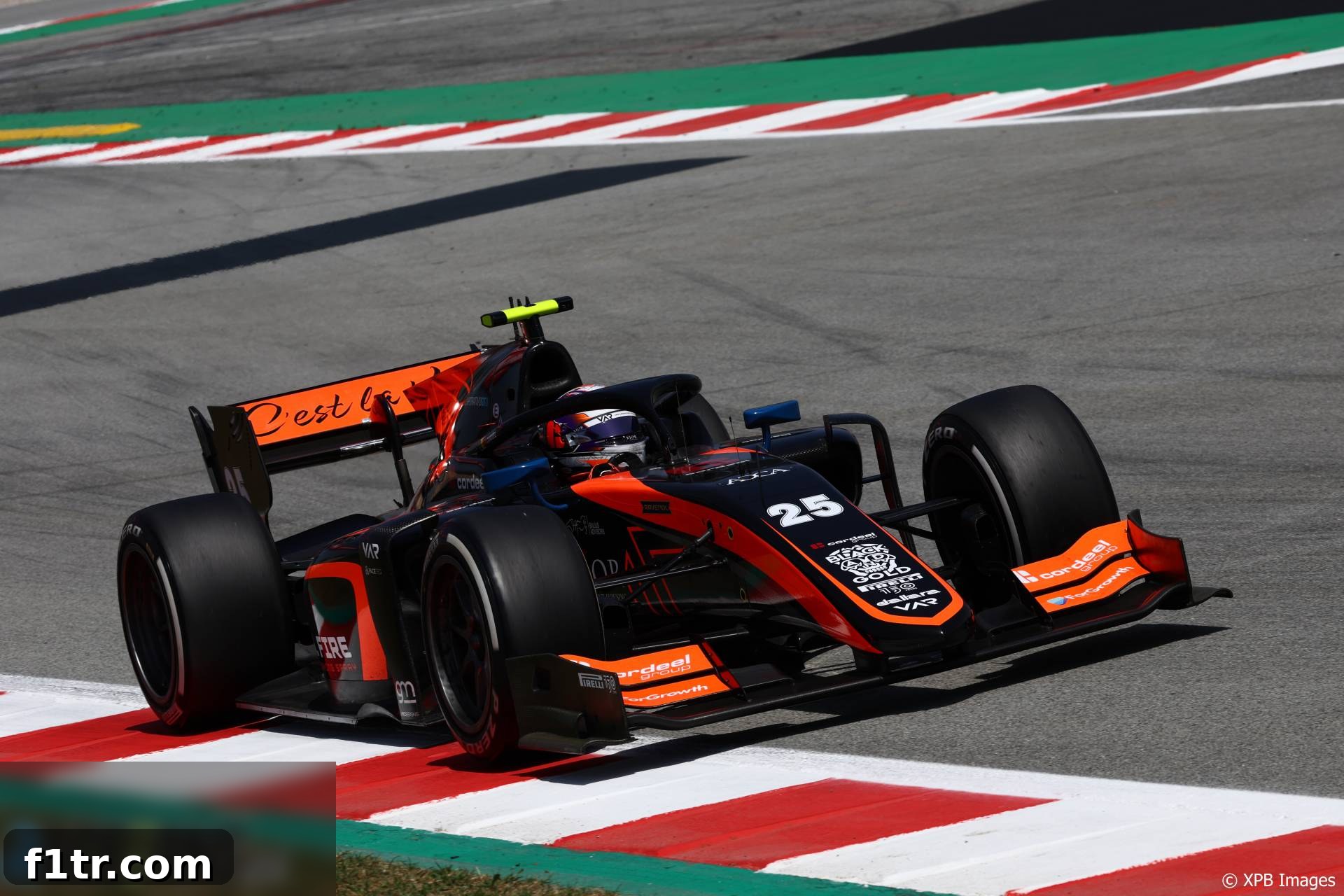
In the high-stakes world of Formula 2, where aspiring talents vie for a coveted spot in Formula 1, every race and every decision carries immense weight. For Amaury Cordeel, the young Belgian driver representing Van Amersfoort Racing, the pressure has intensified dramatically. With a staggering 11 penalty points accumulated over just seven races this season, Cordeel now stands precariously on the brink of an automatic race ban, requiring him to navigate the remaining 21 races with absolute, flawless discipline.
The FIA’s penalty point system in junior categories like Formula 2 is designed to maintain order, promote safe driving, and ensure that young drivers develop the consistency and adherence to rules necessary for professional motorsport. Reaching 12 penalty points triggers an immediate exclusion from the next competitive event, a severe sanction that can significantly derail a driver’s championship aspirations and reputation. Cordeel’s current tally means a single misstep, a minor infraction, could cost him an entire race weekend, jeopardizing his progress and that of his team.
Advert | Become a Supporter & go ad-free
Cordeel’s latest addition to his growing penalty count came during the first race weekend in Barcelona. He was handed two penalty points for being out of position prior to the start of Saturday’s sprint race. This particular infringement, often seen as a fundamental error in race procedure, occurred when he failed to ensure his car was in the correct grid order by the time he crossed safety car line one. Starting from a 15th-place grid slot, a slow getaway left him scrambling, ultimately leading to a 10-second stop-and-go penalty during the race, in addition to the crucial two penalty points.
The rules governing grid procedures are unequivocal for good reason: they are crucial for safety and fair competition, particularly during the chaos of a race start. Drivers who find themselves out of position at this critical juncture are typically required to enter the pit lane to begin the race, thereby avoiding any potential disruption on the main grid. This was a fate suffered by Calan Williams in the same race, who, after stalling on the pole spot, was forced to start from the pit lane. Cordeel’s failure to adhere to this basic protocol underscored a worrying lack of attention to detail that has, unfortunately, become a recurring theme in his early F2 season.
The accumulation of 11 penalty points reflects a pattern of infractions, many of which stem from a failure to consistently follow race control’s instructions and regulations. While Cordeel managed to navigate the opening round in Bahrain without incident, his troubles began in earnest at the subsequent event in Jeddah, Saudi Arabia.
A Troubling Start: Incidents and Warnings
In Jeddah, Cordeel received four penalty points for a single, significant offense during qualifying. He was found to have not slowed sufficiently for double yellow flags and later for a red flag incident. These safety protocols are paramount in motorsport, designed to protect drivers, marshals, and track personnel when an incident occurs on track. Failure to comply can lead to extremely dangerous situations. The stewards, recognizing the seriousness of the breach and perhaps Cordeel’s rookie status, issued a stern warning to both the driver and the Van Amersfoort Racing F2 team. Both were new to the championship this year, and the stewards explicitly stated their expectation for a marked improvement in adherence to flag warnings going forward.
Advert | Become a RaceFans supporter andgo ad-free
However, the warnings appeared to have little immediate effect, as Cordeel’s penalty woes escalated dramatically at the Imola round. There, he amassed five more penalty points, bringing his total at that time to nine, predominantly due to repeated violations of track limits. Track limits are a consistent point of contention in modern motorsport, designed to prevent drivers from gaining an unfair advantage by running wide. The FIA employs strict rules, often with progressive penalties, to enforce these boundaries.
Cordeel’s spree of track limits violations at Imola was notable for its frequency and the escalating severity of the sanctions. Initially, he was hit with a five-second time penalty for exceeding track limits more than three times, which automatically came with one penalty point. This should have served as a clear signal to adjust his driving style. Yet, the infringements continued. He was then penalized again with a ten-second penalty and two additional penalty points for his fifth track limits violation. Finally, he incurred a drive-through penalty and a further two penalty points for exceeding track limits a sixth time within the same event. This rapid succession of penalties for the same offense painted a picture of a driver struggling to adapt or heed warnings.
During the issuance of these penalties, the stewards did acknowledge that it was “possible Cordeel’s team had not relayed warnings about track limits to him in time for him to realise his error.” This highlights the crucial role of effective communication between driver and pit wall in the fast-paced environment of racing. However, the stewards were equally clear in their admonition, emphasizing that “it was his sole responsibility to drive the car within the track limits” and issuing a pointed warning that “repeated offences may bring into question his ability to control the car.” This statement from the governing body underscored a deeper concern about the fundamental competence required at this level of motorsport.
Beyond Penalty Points: A Broader Pattern of Infringements
Adding to his collection of official reprimands, Cordeel has also faced four separate penalties for pit lane speeding during his first four weekends in F2. While these specific infringements, such as entering the Imola pit lane at over 99 kph – exceeding the 60 kph speed limit by a significant 39.2 kph – did not result in penalty points, they contribute to a broader narrative of a driver struggling with adherence to procedural regulations. Pit lane speed limits are in place for the safety of personnel, and consistent violations, even if not contributing to a race ban, demonstrate a worrying trend of indiscipline.
The penalty point system in Formula 2, much like its Formula 1 counterpart, serves as a crucial mechanism for maintaining discipline and ensuring fair play. It’s a deterrent against reckless driving and consistent disregard for regulations. Reaching the 12-point threshold is a rare occurrence, highlighting the severity of Cordeel’s current predicament. The last F2 driver to incur a race ban due to penalty points was Mahaveer Raghunathan, who, during the 2019 season, accumulated enough points to trigger two separate bans, underscoring just how unusual and challenging Cordeel’s situation is. Raghunathan’s case serves as a stark reminder of the consequences when a driver repeatedly falls foul of the rules, impacting not just their individual performance but also their team’s standing.
Advert | Become a RaceFans supporter andgo ad-free
The Road Ahead: Pressure on Cordeel and Van Amersfoort Racing
With 21 races still remaining in the championship, the pressure on Amaury Cordeel is immense. Every single lap, every maneuver, and every decision will be scrutinized with an almost forensic intensity. He cannot afford any further mistakes that would result in even a single penalty point. This situation demands an immediate and significant change in approach, focusing on meticulous procedural compliance and a disciplined on-track presence. For Van Amersfoort Racing, a team relatively new to the F2 championship, this situation also presents a considerable challenge. They will need to work closely with Cordeel, reinforcing clear communication, reviewing incident footage, and potentially adjusting strategy to help their driver avoid further sanctions.
The stakes are incredibly high for Cordeel. A race ban at this crucial stage of his career could severely hinder his development, impact his reputation among team principals and talent scouts, and potentially jeopardize his long-term prospects in motorsport. Formula 2 is a proving ground, a stage where drivers are expected to demonstrate not only raw speed but also maturity, consistency, and a deep understanding of racecraft and regulations. Cordeel’s journey through the remainder of the season will be a true test of his ability to learn, adapt, and demonstrate the discipline required to succeed at the highest levels of racing.
Formula 2 Insights & Related Articles
- Formula 2 Unveils Exciting New Calendar Additions for Upcoming Season
- Former McLaren Junior Driver Confirmed for Alpine Academy Role
- IndyCar Driver Compares Car Handling to F2 Experience
- Exploring the Unique Driver Line-up of a Veteran F2 Team
- FIA Announces Changes to Superlicence Points System for 2026
Browse all Formula 2 articles