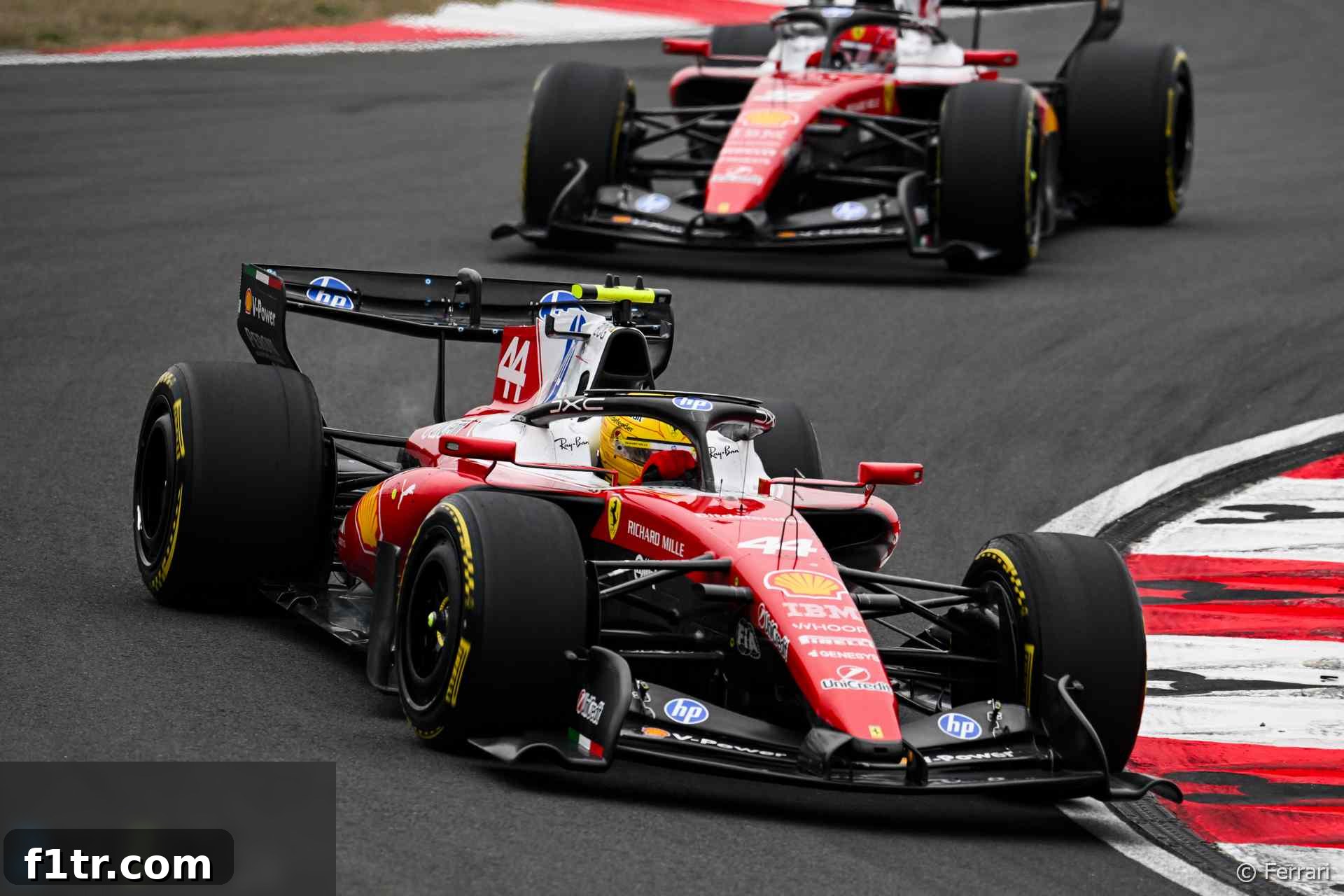
George Russell Details Near-Miss Ferrari Duel at Chinese Grand Prix: A Battle of Aggression and Missed Opportunities
The 2026 Chinese Grand Prix delivered a captivating spectacle of Formula 1 racing, with Mercedes driver George Russell finding himself in the thick of the action. However, not all the drama unfolded in his immediate pursuit for victory. Russell offered a candid reflection on the intense, almost collision-course battle between the two Ferrari drivers, Charles Leclerc and Lewis Hamilton, during the race, admitting he was convinced they were destined to crash.
The Ferocious Ferrari Fight: A Glimpse into High-Stakes Rivalry
From Russell’s vantage point, the on-track skirmish between the Scuderia Ferrari teammates was nothing short of electrifying – and concerning. The two SF-26s, piloted by Leclerc and Hamilton, engaged in a series of daring overtakes and defensive maneuvers, swapping positions multiple times throughout the Grand Prix. Russell, who had to navigate past this fervent rivalry on two separate occasions – once after the initial start and again following a safety car restart – described the experience as watching a high-wire act.
“I was just waiting for the two of them to collide and somehow they didn’t,” Russell recounted, clearly still incredulous at their ability to maintain control amidst such close-quarters combat. The tension was palpable as the Ferrari machines repeatedly drew near, their tires almost brushing and aero wash disturbing each other’s stability. At one critical juncture in Turn Two, a light but definite contact was made, underscoring the razor-thin margins at play. This wasn’t merely aggressive racing; it was a high-stakes duel where the line between pushing limits and causing an incident was incredibly fine. “It was some of the most aggressive racing I’ve seen for a while,” Russell added, highlighting the ferocity and commitment displayed by both Hamilton and Leclerc as they vied for track position and crucial championship points.
The intensity of an intra-team battle often raises questions about team orders and strategic management. While Ferrari typically allows its drivers to race freely, the closeness of this particular contest would undoubtedly have had strategists on the pit wall holding their breath. For competitors like Russell, witnessing such a spectacle unfold directly in front presented both a challenge and a peculiar form of entertainment, albeit one fraught with potential consequences for his own race.
Navigating the Prancing Horses: Russell’s Dual Challenge for Track Position
The battle between the Ferrari drivers had a direct and significant impact on Russell’s own race strategy and overall performance. Having to contend with two fiercely competing rivals, Russell found himself expending valuable time and tire life in his attempts to clear the red cars. The dynamic of the Ferrari cars – quicker through the corners but slower on the straights compared to Mercedes – created a particularly tricky scenario for Russell.
“Ferrari are definitely very quick. They’re quicker in the corners than us, slower than us on the straight, so it just made it a little bit challenging,” Russell explained. This characteristic disparity meant that while Russell might gain on them in the straights, he would then face a renewed challenge in the twistier sections of the Shanghai International Circuit. The constant ebb and flow of this battle, complicated by the fact he was trying to pass *two* such cars simultaneously, became a significant hurdle. “And when you’re trying to get past two of them at the same point, that wasn’t straightforward.”
This prolonged engagement behind the battling Ferraris meant Russell couldn’t unleash the full potential of his Mercedes car or execute his ideal race strategy. Every moment spent in their aerodynamic wake, every extra lap fighting for position, chipped away at his chances of catching the race leader, Andrea Kimi Antonelli. The loss of clean air, the increased tire degradation from constant battling, and the mental energy required to anticipate and react to the Ferraris’ every move collectively exacted a toll.
The Cost of Delay: Losing Ground to Andrea Kimi Antonelli’s Dominance
While the Ferrari duel provided compelling viewing, for George Russell, it was a source of mounting frustration. The time he spent embroiled in the red cars’ wake directly translated into a widening gap to the front-runner, Andrea Kimi Antonelli. Antonelli, driving an exemplary race, steadily pulled away from the chasing pack, capitalizing on every clear lap he had.
“If I wasn’t trying to win the race, I’d have been enjoying the battle,” Russell admitted, perfectly encapsulating the bittersweet nature of the situation. As much as he might have appreciated the pure spectacle of the Ferrari showdown, his primary objective was victory. “But obviously watching Kimi pull away during those points, it was a little bit annoying.” This annoyance stemmed from the palpable sense that his own potential was being constrained by circumstances largely outside his control. The more he was forced to fend off or navigate around the Ferraris, the less he could focus on hunting down Antonelli.
The time lost was not insignificant. Each lap spent engaged in the Ferrari melee added precious tenths, sometimes even seconds, to Antonelli’s advantage. This cumulative deficit became an insurmountable barrier as the race progressed. Russell eventually managed to clear both Ferraris, but by then, Antonelli had established a commanding lead that was simply too large to bridge. Finishing five-and-a-half seconds behind the eventual race winner, Russell was left to ponder what might have been had his path to the front been clearer.
Assessing the Outcome: Could Victory Have Been Within Reach?
Despite the challenges, George Russell ultimately secured a commendable second-place finish at the Chinese Grand Prix. However, the question lingered: could he have genuinely challenged Andrea Kimi Antonelli for the win had he dispatched the Ferraris more quickly? Russell’s honest assessment suggests it would have been an uphill battle regardless.
“I think it would have been very difficult to challenge Kimi, to be honest,” he conceded. Antonelli’s pace throughout the weekend had been exceptional, marking him as the standout performer. When two cars, like Antonelli’s and Russell’s, possess very similar underlying pace, attempting an overtake on the same tire compounds, especially without a significant tire advantage or strategic offset, becomes incredibly challenging. “He’s been very quick this weekend and when you’ve got two cars that are very similar in pace, trying to get past on the same tyres is a little bit challenging.”
While Russell acknowledged Antonelli’s superior form, he also couldn’t ignore the decisive impact of the Ferrari encounter. “But obviously that time I lost with the Ferraris just gave me no chance.” This statement underscores the fine margins in Formula 1; even a few seconds lost in battle can define the outcome of a race. Nevertheless, Russell maintained a pragmatic and positive outlook on his performance. “But as I said, I’m pleased just to be in P2 because it could have been a lot worse, and overall, it’s been a solid weekend.” This sentiment reflects a seasoned driver’s perspective: maximizing the result on a challenging day is often as valuable as a straightforward victory.
A second-place finish, particularly when facing such intense on-track competition and managing car characteristics against rivals, represents a strong haul of points and a testament to Russell’s race craft and strategic acumen. It also highlights the competitive intensity of the 2026 Formula 1 season, where every position is fiercely contested.
Beyond the Race: Implications for Team Strategy and Future Encounters
The Chinese Grand Prix offered several crucial insights for George Russell and the Mercedes team. Firstly, it highlighted the formidable pace of Andrea Kimi Antonelli, establishing him as a potent force at the front of the grid. Understanding Antonelli’s strengths and weaknesses will be vital for Mercedes in future races as they seek to challenge for top honors.
Secondly, the performance of the Ferrari cars, particularly their cornering speed, provides a clear benchmark and area of focus for Mercedes’ ongoing development efforts. While Mercedes showed strength on the straights, closing the gap in high-downforce sections will be key to unlocking greater race-winning potential. The dynamic between Lewis Hamilton and Charles Leclerc also serves as a reminder of the inherent risks and rewards of allowing drivers to race freely, especially when championship points are at stake for both individual drivers and their respective constructors.
For Russell, the race was a lesson in patience and calculated aggression. His ability to eventually overcome the Ferrari challenge, despite the time lost, showcased his growth as a leader for Mercedes. Looking ahead, the experience gained from navigating such an intense multi-car battle will undoubtedly inform his approach to similar situations in upcoming Grand Prix events. The “solid weekend” he referred to, culminating in a podium finish, provides a strong foundation for future performances and keeps Mercedes firmly in the hunt in what promises to be an enthralling season.
Ultimately, while the victory may have eluded George Russell at the Chinese Grand Prix, his performance, particularly his measured commentary on the dramatic Ferrari internal struggle and his own pursuit, painted a vivid picture of the high-octane world of Formula 1. It was a race defined by thrilling duels, strategic calculations, and the relentless pursuit of perfection on the track.
More from the 2026 Chinese Grand Prix
- What led Stroll to call his Aston Martin “the worst piece of s*** I’ve ever driven”
- Stats: Antonelli is 12th Formula 1 driver to score a ‘hat trick’ with his first win
- “Leclerc just backed Lewis up”: How Russell saw the fight between the Ferraris
- Verstappen reduced his pace unnecessarily due to communications error
- ‘Just an easy pass with Overtake’: Every radio message from Antonelli’s first F1 win
Browse all 2026 Chinese Grand Prix articles