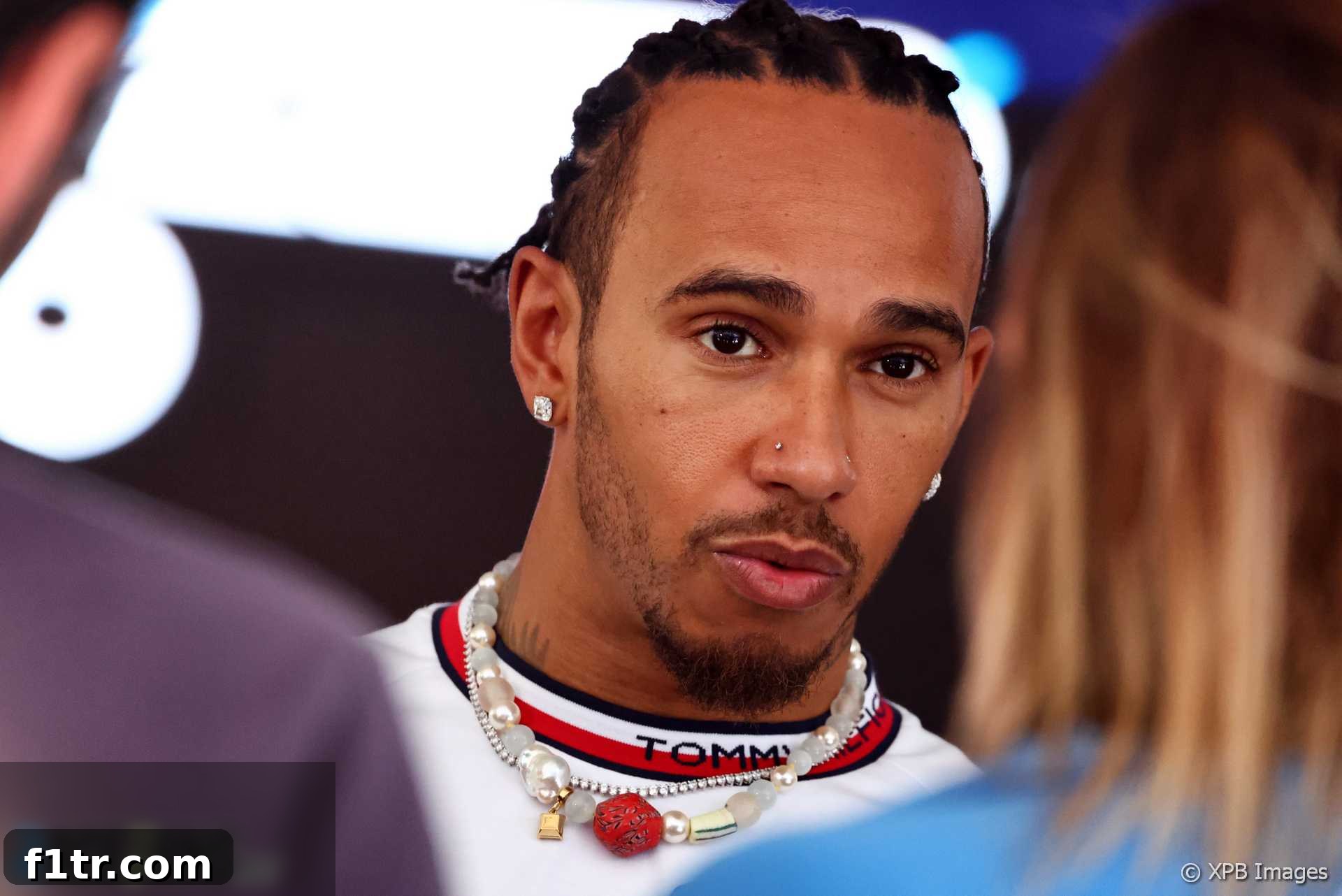
Lewis Hamilton, a towering figure in Formula 1 history, has ignited a crucial debate within the sport, advocating for a stringent cut-off point on car development. His proposal aims to curb the sustained dominance of individual teams, a phenomenon he believes detracts from the competitive spectacle of the championship. Hamilton’s vision is to foster an environment where no single constructor can establish an unassailable lead, thereby ensuring more thrilling and unpredictable racing.
Advert | Become a Supporter & go ad-free
However, this suggestion has met with a direct rebuttal from Max Verstappen, the reigning world champion whose team, Red Bull Racing, has enjoyed a near-unbroken winning streak in recent times. Verstappen, whose team has claimed victory in 18 of the last 19 races, views Hamilton’s proposal as an attempt to artificially level a playing field where inherent disparities are simply a part of life and competition.
Hamilton emphasized that his controversial suggestion was “not aimed at any one particular person or anything,” distancing it from any perceived rivalry or current competitive frustrations. This perspective is particularly noteworthy coming from a driver who commanded an era of unprecedented success himself. Between 2014 and 2020, Hamilton secured six World Championships, a period during which Mercedes-AMG Petronas F1 Team was undeniably the benchmark. In the initial three years of this dominant spell, Mercedes achieved a staggering 51 victories from 59 races, underscoring the very kind of sustained supremacy Hamilton now seeks to mitigate.
Hamilton posits that such enduring success could be effectively disrupted if Formula 1 were to implement a regulatory change preventing teams from commencing development work on their subsequent season’s cars before a pre-determined point in the calendar year. He argues that this strategic shift would fundamentally alter the competitive landscape, compelling teams to focus their resources and innovation within a more constrained timeframe.
“In my 17 years of being here, before even I got here, you see a period, a time of dominance and it continues to happen,” Hamilton explained during a media session, responding to an inquiry from RaceFans. “I was really fortunate to have one of those periods, Max is having that now – but with the way it’s going, it will continue to happen over and over again. And I don’t think that we need that in the sport.” Hamilton’s concern stems from a historical pattern, where once a team establishes a significant advantage, it often translates into multi-year supremacy, potentially diminishing the overall excitement and competitive integrity of the championship.
The core of Hamilton’s argument rests on the strategic advantage gained by leading teams. When a team starts a season in an overwhelmingly strong position, enjoying a comfortable points lead and performance advantage, they are afforded the luxury of shifting their focus and resources towards the development of their next-generation car much earlier in the year. This early start, he contends, allows them to carry over their championship-winning momentum and technological edge from one season to the next, perpetuating their dominance.
Hamilton further elaborated on the mechanics of this advantage, particularly in the context of Formula 1’s financial regulations. “In my personal experience when you are so far ahead, if you’re 100 points ahead, you don’t really need to do a lot more development in your car so you can start earlier on your next car,” he stated. “With the budget cap, that means spending that year’s money on the next year’s car.” The advent of the budget cap, intended to level the financial playing field and limit spending, ironically might be contributing to this issue. By effectively freeing up development budget from the current car, leading teams can allocate those funds towards an early head start on the following year’s challenger, effectively ‘banking’ performance for the future.
Advert | Become a RaceFans supporter andgo ad-free
To counteract this, Hamilton proposes a unified start date for development. “But if everyone had a time [limit], if everyone knew that we can start on whatever date it is – October is way too late, probably, but [say] August 1st – then no one has a head start and then it’s a real race in that short space of time for the future car.” He suggests that by standardizing the commencement of next-year car development, all teams would operate under the same constraints, fostering a more equitable and intense design and engineering competition. This, he believes, would naturally lead to a convergence of performance levels across the grid in subsequent seasons.
“Maybe that would help everyone be more closer in the following year. But I might be wrong,” Hamilton mused, acknowledging the complexity of implementing such a radical change and the potential for unforeseen consequences. Despite this caveat, his conviction remains strong that “something’s got to change” to prevent the pattern of single-team dominance from recurring, echoing previous eras of McLaren, Ferrari, and Mercedes success before Red Bull’s current ascendancy.
Hamilton highlighted another historical example to bolster his case: “When we were winning world championships we could start earlier than everybody else. And then there are teams that weren’t competitive, so then they just didn’t bother working on that current car.” He further referenced the extraordinary Brawn GP story of 2009. “If you look at Brawn, they just focused fully on the next year’s car from the beginning and then they turned up next year and blitzed everybody. And that shouldn’t be possible, in my opinion. That’s for you to judge.” The Brawn GP scenario, where a team capitalized on early development of an innovative car under new regulations to win both championships, serves as a powerful testament to the impact of early planning and resource allocation. Hamilton argues that while impressive, such a sudden leap, fueled by foresight and early development, ultimately detracts from the season-to-season competitive integrity.
“But it’d be cool to see in the next 20 years that we don’t have huge bands of time where one team lead too far ahead, because we want to see better racing,” Hamilton concluded, articulating the fan’s perspective and the broader aspiration for a more tightly contested championship. The pursuit of “better racing” is a consistent theme among drivers, teams, and the sport’s governing bodies, acknowledging that predictable outcomes, while satisfying for dominant teams, can dampen overall audience engagement and the sport’s appeal.
Max Verstappen, however, offered a starkly different, and rather philosophical, perspective on Hamilton’s suggestion of imposing a fixed cut-off date for car development. “Life is unfair as well so it’s not only in Formula 1,” he asserted. “A lot of things in life are unfair so we just have to deal with it.” Verstappen’s dismissal of the proposal reflects a belief that competitive advantage is earned through superior effort, innovation, and execution, and that artificial constraints could undermine the very essence of elite competition. His viewpoint suggests that success, and by extension dominance, is a natural outcome of excelling within the existing framework, and that instead of changing rules to penalize excellence, others should strive to reach a similar level.
The contrasting viewpoints of Hamilton and Verstappen encapsulate a fundamental tension within Formula 1: the desire for groundbreaking innovation and peak performance versus the imperative for competitive balance and compelling entertainment. While Hamilton champions proactive regulatory intervention to level the playing field and enhance racing, Verstappen advocates for a more meritocratic approach, where teams are rewarded for their ingenuity and hard work, even if it leads to periods of unchallenged supremacy. The debate highlights the ongoing challenge for Formula 1’s rule-makers, the FIA and Liberty Media, in striking a delicate balance that preserves the sport’s core values while ensuring its long-term appeal to a global audience hungry for wheel-to-wheel action and unpredictable championship battles.
Bringing the F1 news from the source
RaceFans strives to bring its readers news directly from the key players in Formula 1. We are able to do this thanks in part to the generous backing of our RaceFans Supporters.
By contributing £1 per month or £12 per year (or the equivalent in other currencies) you can help cover the costs involved in producing original journalism: Travelling, writing, creating, hosting, contacting and developing. Your support is instrumental in maintaining our independent voice and our commitment to high-quality, in-depth F1 coverage.
We have been proudly supported by our readers for over 10 years, a testament to the value they place on our unique perspective. If you enjoy our independent coverage, appreciate our commitment to direct reporting, and wish to see Formula 1 news delivered with integrity and insight, please consider becoming a RaceFans Supporter today. As a bonus, all our Supporters can also browse the site completely ad-free, enhancing their reading experience. Sign up or find out more via the links below:
- Become a RaceFans Supporter
- RaceFans Supporter FAQ
Advert | Become a RaceFans supporter andgo ad-free
More from the 2023 Austrian Grand Prix: Key Discussions and Analysis
The 2023 Austrian Grand Prix provided a fertile ground for many of the issues discussed by Hamilton and Verstappen, showcasing the current competitive dynamics of Formula 1. Amidst Red Bull’s continued strong performance, other teams grappled with their development strategies and the quest for pace. The event highlighted the stark realities of the championship, where every team’s approach to car development, budget allocation, and in-season upgrades plays a critical role in their standing. The discussions around dominance and competitive balance were particularly relevant following a race where the leading team once again demonstrated its formidable advantage.
- Mercedes left scratching heads by lack of performance at Austrian GP
- Verstappen’s determination to grab every point makes him a record-breaker
- Austrian GP track limits farce was avoidable like ‘IndyGate’ and Spa 2021 – Brown
- Alpine now “definitely beatable” for McLaren after upgrade – Brown
- Paddock Diary: 2023 Austrian Grand Prix
Browse all 2023 Austrian Grand Prix articles