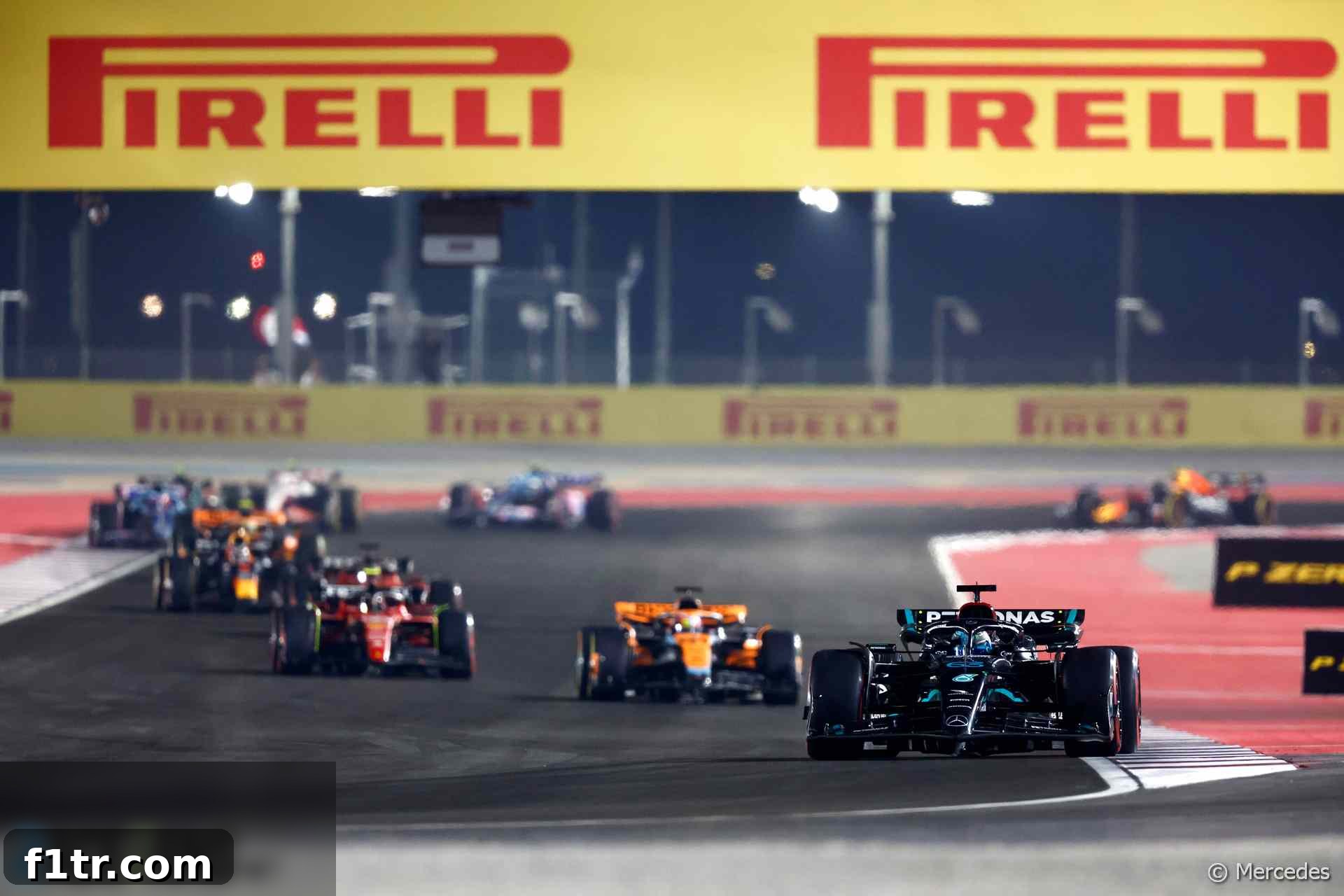
The exhilarating world of Formula 1 often presents unforeseen challenges, and the 2023 Qatar Grand Prix at the Losail International Circuit proved to be no exception. Ahead of Sunday’s main event, a critical safety concern emerged regarding tire integrity, leading to urgent discussions and potential rule changes by the sport’s governing body, the FIA. Mercedes driver George Russell, among others, has voiced strong opinions against the FIA’s consideration of imposing a mandatory three-pit-stop rule for all competitors, arguing that such a drastic intervention might be an overreaction to a situation exacerbated by the unique nature of a sprint race weekend.
The Tire Conundrum at Losail: Safety First
The genesis of this controversy lies in the alarming tire degradation observed during Friday’s solitary practice session. Teams and Pirelli, F1’s official tire supplier, identified significant wear and even structural damage to tires, primarily attributed to aggressive driving over the high-speed kerbs at the Losail International Circuit. This discovery immediately raised red flags, especially concerning driver safety over the arduous 57-lap distance of the Grand Prix. The concern was not just about performance loss but the very real risk of catastrophic tire failures at incredibly high speeds, jeopardizing the lives of drivers and potentially impacting spectators.
In a swift response, the FIA implemented immediate adjustments to the track limits at two critical corners. This modification aimed to deter drivers from exploiting the kerbs excessively, thereby mitigating the primary cause of the observed tire damage. To help teams and drivers adapt, an additional 10-minute practice session was granted, allowing them a brief window to familiarize themselves with the revised track perimeter and understand its implications for car setup and driving style. While a necessary step, these limited sessions still left a significant data vacuum regarding long-run tire performance, which is crucial for Grand Prix strategy.
FIA’s Potential Interventions: A Debate on Strategy and Safety
With insufficient long-run data and the looming threat of tire issues, the FIA indicated it was exploring further measures. Two primary options were on the table: imposing a maximum stint length for tires, or, more controversially, mandating that all drivers make at least three pit stops during the Grand Prix. The latter proposal, a fixed strategy for every team, sparked considerable debate within the paddock, challenging the very essence of strategic competition in Formula 1.
George Russell firmly believes that a mandatory three-stop strategy is an unnecessary and heavy-handed intervention. He highlighted that navigating a Grand Prix weekend with limited tire data is an inherent characteristic of the sprint race format, especially at circuits like Losail, which the series had visited only once before and has since undergone significant refurbishment. “It’s kind of part and parcel of a sprint race weekend,” Russell explained. He contrasted this with traditional race weekends at established tracks like Barcelona, where teams gather extensive data over three practice sessions, allowing them to confidently predict tire wear and optimal pit stop strategies.
At Losail, however, the compressed schedule of a sprint weekend meant teams had only a single practice session before qualifying and the sprint race itself. This scarcity of data meant that traditional predictive models for tire degradation were less reliable. Russell argued that had the full three practice sessions been available, teams would have undoubtedly learned about the tire wear characteristics and adjusted their strategies accordingly, likely concluding that a two or three-stop race was already necessary. Therefore, he sees the FIA’s direct intervention as undermining the strategic acumen of the teams and drivers.
“I think what the FIA did with the small modification to the track was good,” Russell acknowledged, showing support for the initial track limit changes. “But I don’t think they need to intervene to say it needs to be a mandatory three-stop. I think give us the data, see how much wear there was on the soft, the medium and we should all be smart enough to make a decision based on that.” His plea emphasizes faith in the teams’ sophisticated analytical capabilities and the importance of allowing race engineers and strategists to make informed decisions based on available data, rather than having a one-size-fits-all solution imposed from above.
Pirelli’s Data and the Sprint Race Impact
Pirelli had hoped that Saturday’s 19-lap sprint race would provide valuable real-world data on tire performance under race conditions. However, the nature of the sprint race itself, which saw the safety car deployed on three separate occasions, significantly reduced the amount of full-speed running. This disruption meant that the sprint race offered only a limited insight into continuous tire degradation over a longer period, complicating the data analysis.
Nonetheless, Russell, who secured a strong second place on the grid for the Grand Prix, remained confident that sufficient information could be gleaned. “You should be able to see even with the 10 laps we did, how much wear there is, how it would have progressed had there been a 19-lap race, and how that’s going to be into tomorrow,” he stated. He reiterated his belief that the lack of extensive running is simply “part and parcel of not having much running” during a sprint weekend, suggesting it’s a challenge teams are equipped to handle.
Driver Perspectives: Perez and Verstappen Weigh In
Sergio Perez, Russell’s rival at Red Bull Racing, echoed a similar sentiment of hope that further changes would be unnecessary after the initial track limit adjustments. “Today I think Pirelli will have more information on if they think it’s all safe to go then there shouldn’t be any changes,” Perez commented, placing reliance on Pirelli’s expert assessment and hoping for a return to standard race conditions.
Meanwhile, his Red Bull teammate and reigning world champion, Max Verstappen, offered a more critical perspective, acknowledging the gravity of the situation while also subtly critiquing the sport’s responsiveness. He candidly described the evolving tire saga as “never a good look for the sport,” highlighting the negative perception created when fundamental safety issues arise so close to a major event. However, Verstappen was unequivocal about safety being the absolute top priority. “Tomorrow it’s important, of course, that safety is foremost and that we don’t get any punctures or, even worse, accidents,” he stressed, emphasizing the paramount importance of preventing dangerous incidents.
Verstappen awaited the full analysis from the sprint race before forming a definitive opinion on further interventions. “Let’s first wait and see what they come up with, with the analysis after the sprint race, what their findings are,” he said. He did, however, confirm observations of significant tire wear even during the shortened sprint. “For sure even in the sprint race you could see that there was a lot of deg on the front tyre, especially front-left, it was wearing a lot. It’s very tough around here.” This direct observation from a driver reinforces the genuine nature of the tire problem.
Beyond the immediate safety concerns, Verstappen also used the opportunity to voice a broader point about driver feedback and FIA responsiveness. He noted the speed with which the FIA acted to change the track limits at the high-speed corners due to the tire issue. This rapid response, he implied, contrasted sharply with the often-lengthy process of addressing drivers’ requests for track limit modifications or other circuit changes, which are often dismissed as “very hard” to implement. “I find quite interesting how quickly these things can be changed but when we speak about we want to have track limits changed here and there with the white line or whatever, it’s all very hard,” Verstappen remarked. He added, “So I think that’s also something for the future that we need to speak about because I think we need to be heard a bit more.” This statement underscores a perennial tension between drivers and governing bodies regarding the implementation of safety and competition-related changes.
Implications for Race Strategy and Competition
A mandatory three-stop strategy would fundamentally alter the complexion of the Qatar Grand Prix. Typically, teams strive for the fewest possible pit stops to minimize lost time in the pit lane. A two-stop strategy is often the baseline for many races, with teams constantly evaluating the feasibility of a one-stop or the necessity of a three-stop based on tire wear, track conditions, and competitor strategies. Imposing a mandatory three stops would remove this crucial strategic variable, forcing all teams onto the same fundamental pathway. This could lead to a less diverse and potentially less exciting race from a strategic standpoint, as the primary differentiator would shift almost entirely to raw pace and pit stop execution rather than clever tire management or alternative strategies.
While safety is paramount, F1 also prides itself on being the pinnacle of motorsport engineering and strategy. Drivers like Russell advocate for allowing teams to utilize their vast resources and expertise to navigate these challenges. The situation at Losail highlights a delicate balance between ensuring safety, maintaining competitive integrity, and adapting to the unique demands of modern F1’s ever-evolving calendar and circuit designs.
Conclusion: Awaiting the Final Decision
As the Grand Prix approached, the FIA faced a difficult decision. While driver safety is non-negotiable, the method of ensuring it without unduly compromising the sporting spectacle remained a contentious point. The discussions surrounding tire degradation at the Losail International Circuit underscored the complex interplay between circuit design, tire technology, sprint race formats, and regulatory oversight in Formula 1. The drivers, particularly Russell and Verstappen, articulated a desire for intelligent, data-driven solutions and a consistent approach to feedback, rather than blanket rules that might inadvertently stifle strategic innovation. All eyes were on the FIA to see how they would ultimately balance these competing interests to ensure a safe yet thrilling Qatar Grand Prix.
Become a RaceFans Supporter
RaceFans is run thanks in part to the generous support of its readers. By contributing £1 per month or £12 per year (or the same in whichever currency you use) you can help cover the costs of creating, hosting and developing RaceFans today and in the future.
Become a RaceFans Supporter today and browse the site ad-free. Sign up or find out more via the links below:
- Become a RaceFans Supporter
- RaceFans Supporter FAQ
2023 Qatar Grand Prix
- Albon fears Qatar GP conditions risked creating dangerous “wet bulb effect”
- Alonso: New-spec fireproofs and pre-race anthem timing made Qatar heat worse
- Magnussen admits he took “too long to learn” Losail circuit
- Analysis: Sargeant’s Qatar radio reveals his painful struggle to end point-less run
- Alfa Romeo ‘finally understand their upgrade’ Bottas believes as team target Williams
Browse all 2023 Qatar Grand Prix articles