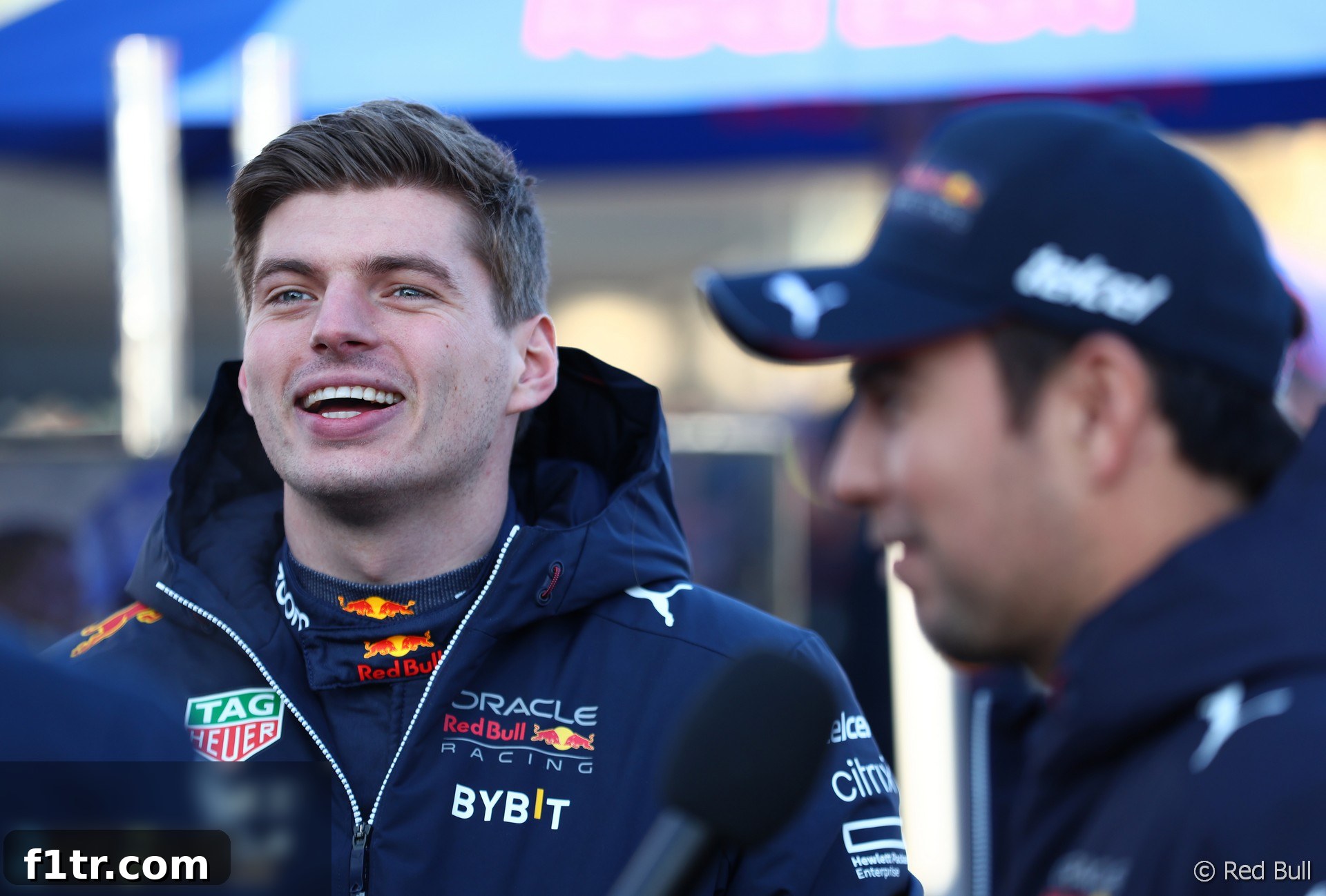
Breaking records often defines a championship-winning season, yet for Max Verstappen, the unparalleled number of victories in his second Formula 1 World Championship campaign was not the most profound source of satisfaction. While his 15 wins in 2022 shattered the previous single-season record of 13, the Red Bull driver found greater fulfillment in the meticulous execution and the journey toward success rather than the numerical achievements themselves.
Max Verstappen: Beyond the Numbers – The True Essence of Victory
The 2022 Formula 1 season saw Max Verstappen clinch his second consecutive drivers’ title with a dominant display, culminating in a record-breaking 15 race victories. However, when reflecting on this remarkable achievement at a team event, Verstappen emphasized that his calmness and the sheer volume of wins were not the core of his contentment. Instead, his focus lay squarely on the relentless pursuit of perfection and the minimization of errors.
“In general, I always stay calm, so that’s not really the thing I’m happy about,” Verstappen stated. “It’s more about just trying to make the minimum amount of mistakes. I think every year I’ve improved in that, and that’s something I always want to try and work on. Because, of course, you can have retirements with engine failures or car failings, but there can also be retirements from yourself making mistakes, and these kinds of things you have to try and minimize when you fight for a championship.” This philosophy underscores a mature approach to racing, where control and precision outweigh raw pace as the ultimate determinants of success.
A “Dominant” Season? Verstappen’s Nuanced Perspective
Despite the overwhelming statistical evidence of his 2022 triumph, which saw him finish 146 points clear of his nearest rival, Charles Leclerc, Verstappen offered a nuanced perspective on what constitutes “true dominance.” In an interview with NBC Sports, he suggested that the season wasn’t as straightforwardly dominant as it appeared.
The early phase of the 2022 season painted a different picture. Ferrari, with Charles Leclerc at the helm, often demonstrated superior one-lap pace, leading to a higher number of pole positions for the Monegasque driver (nine to Verstappen’s seven). Verstappen himself trailed Leclerc in the points standings after retiring from two of the first three races, experiencing frustrating mechanical failures.
“I think I did get pushed this year,” Verstappen explained, acknowledging the pressure from competitors. “It’s just that some teams around us had reliability issues. Yes, it looks like it was a dominating season, but actually, when you look at it, I didn’t even have that many poles because our car over one lap was for most of the season not even the quickest.”
This perspective challenges the conventional understanding of dominance. For Verstappen, true domination would involve consistently securing pole positions and then comfortably pulling away from the field in the race – a scenario he admits was “most of the time not the case” in 2022. He specifically referenced the early part of the season, where despite not always having the fastest car, Red Bull and he managed to secure crucial wins, which he found “really rewarding” because he knew it would be “a tough battle if nobody would have any reliability issues.”
The Art of the Comeback: Turning Setbacks into Strengths
The defining characteristic of Verstappen’s 2022 campaign was not an unbroken streak of victories, but rather the team’s incredible resilience and ability to rebound from adversity. The season’s third race in Melbourne, Australia, served as a stark reminder of the challenges ahead. A disappointing weekend culminated in a retirement, leaving Verstappen with two DNFs in the first three races and a significant points deficit to Leclerc.
“It’s always upsetting when things like that happen,” he reflected on the early setbacks. “You’re not happy about it and also disappointed because you know that in a championship fight, you always have to try and finish the race and try to score as many points as possible. So, to have two DNFs within three races was not good. Besides that, I think also the weekend in Australia itself we were really off the pace. So, all in all, it was just a terrible weekend for us.”
However, what followed was a testament to the strength and character of both driver and team. The very next race at Imola saw a remarkable turnaround. Verstappen and Red Bull delivered a flawless performance, dominating the weekend from start to finish. This dramatic comeback, securing both pole position and the race win, was a psychological masterstroke and a clear declaration of intent. “But then again, it’s about how you come back. And I think the next race we dominated, and that is also the strength of the team, I think,” he added, highlighting the collective effort.
The Red Bull Factor: Precision, Strategy, and Unwavering Support
Verstappen’s success cannot be isolated from the formidable force that is Red Bull Racing. The team’s ability to develop the RB18 throughout the season was pivotal. While Ferrari started strong, Red Bull’s relentless innovation, strategic prowess, and operational excellence, particularly in areas like pit stops, consistently gave Verstappen the edge. Their capacity to identify weaknesses, engineer solutions, and adapt to different track conditions was unparalleled.
The “strength of the team” that Verstappen referred to encompasses not just the technical brilliance in Milton Keynes but also the seamless communication and execution at the track. From race strategy calls to lightning-fast pit stops, Red Bull often operated with a precision that minimized vulnerabilities and capitalized on every opportunity. This symbiotic relationship between driver and team created an environment where Verstappen could consistently perform at his peak, knowing he had unwavering support.
Mastering Consistency: The Evolution of a Champion
Ultimately, Verstappen’s contentment stemmed from his personal growth and the mastery of consistency. His emphasis on “minimizing mistakes” reflects a deeper understanding of championship-winning campaigns. While raw speed is often lauded, the ability to avoid errors, manage races, and consistently extract performance, even when the car isn’t absolutely dominant, is the hallmark of a true champion. The 2022 season showcased a more mature, refined Max Verstappen – a driver who not only possessed incredible natural talent but had also cultivated the mental fortitude and strategic intelligence to navigate the complexities of an F1 season with unparalleled effectiveness.
His record-breaking 15 wins were a symptom of this evolution, rather than the goal itself. Each victory, particularly those secured in the face of strong competition or after initial setbacks, contributed to a profound sense of satisfaction that transcended mere statistics. For Max Verstappen, the 2022 Formula 1 World Championship was less about etching his name further into the record books and more about the flawless execution, the unwavering team spirit, and the continuous pursuit of personal and collective excellence.
Browse More: 2022 F1 Season Insights
- Mercedes told me “you’re wrong” about 2022 car’s problems – Hamilton
- FIA confirms all 10 F1 teams complied with 2022 cost cap
- Steiner “not ashamed” of panning “slow” Schumacher in Drive to Survive
- Albon believes year out of F1 improved him as a driver
- Hamilton sees diversity gains in F1 years on from his ‘traumatising’ experience of racism
Explore all articles related to the 2022 F1 season