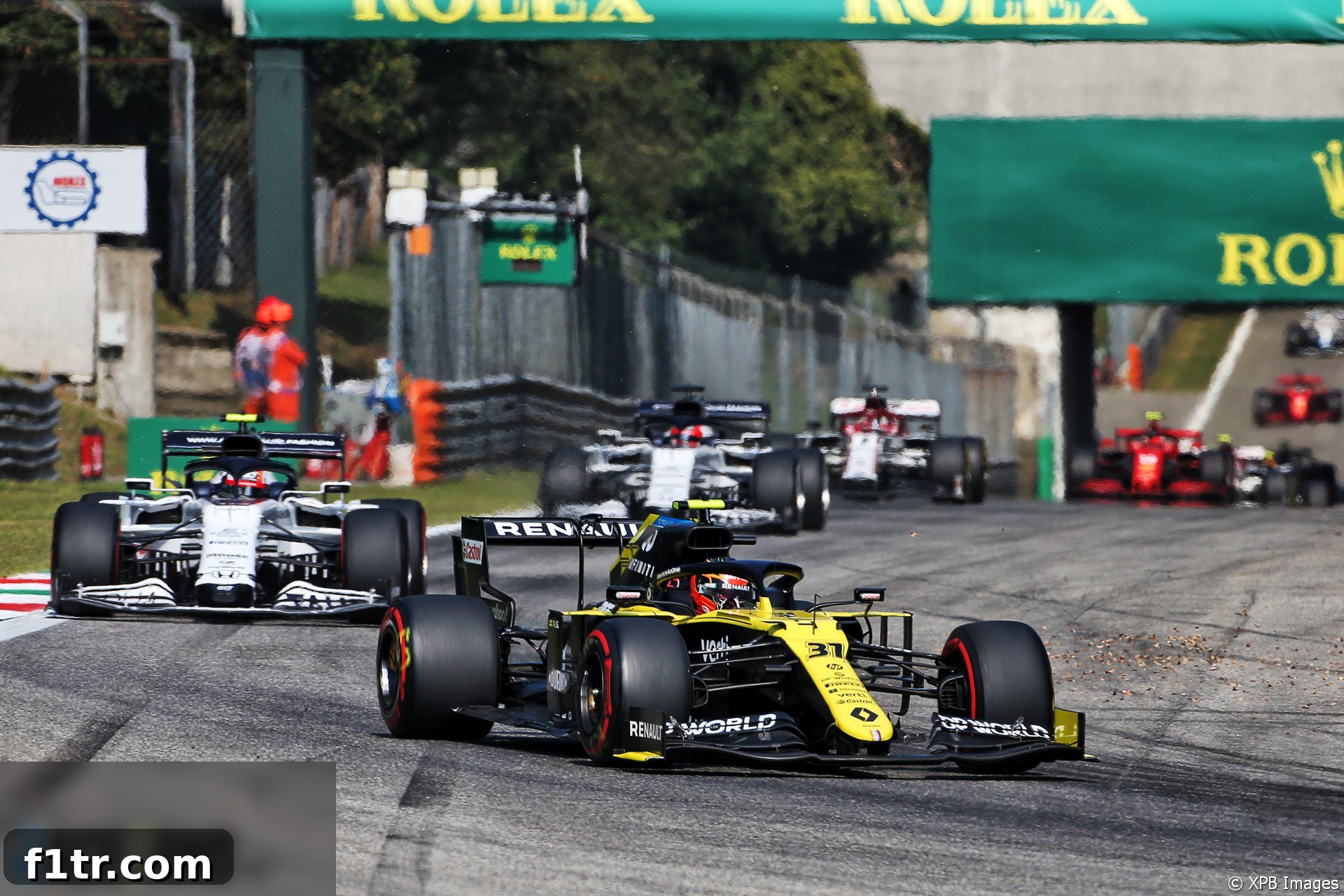
Esteban Ocon endured a challenging Italian Grand Prix in 2020, marked by a critical tyre strategy misstep that left him unable to utilize his preferred compound during a pivotal race restart. The incident, which saw his Renault F1 Team unable to properly warm his chosen medium tyres, forced the young Frenchman onto a set of rapidly degrading softs, significantly impacting his race performance and leading to a tense post-race exchange with his team.
Advert | Become a Supporter & go ad-free
The Chaotic Monza Race and Ocon’s Tyre Predicament
The 2020 Italian Grand Prix at Monza was anything but ordinary. It was a race defined by unexpected twists, safety car periods, and a dramatic red flag interruption that reshaped the entire competitive landscape. In such a high-stakes, unpredictable environment, tyre strategy becomes paramount. Drivers and teams must make split-second decisions that can either vault them up the order or send them tumbling down, making precision and foresight crucial.
For Esteban Ocon, the race proved to be a masterclass in resilience, yet tinged with palpable frustration. Having started from 12th position on the grid, Ocon found himself in a promising position after a chaotic sequence of events, including an early safety car and subsequently a red flag that temporarily halted the race. This red flag period presented all teams with a golden opportunity for a tyre change, essentially a free pit stop, allowing them to reset their strategy for the impending restart. This was a critical moment for every team vying for points.
Ocon’s preference, and indeed the optimal choice for the extended second stint of the race, was a fresh set of medium compound tyres. These tyres offer a better balance of grip and durability, crucial for maintaining pace and fending off rivals over a longer run on the high-speed Monza circuit, known for its demands on tyre wear. However, the Renault team encountered an unforeseen problem: Ocon’s chosen medium tyres were not sufficiently warmed up during the red flag period. In Formula 1, tyre temperature is critical; cold tyres provide little to no grip, making the car difficult to handle, prone to locking up, and significantly slower. The team’s inability to bring the medium compound up to optimal operating temperature meant that Ocon was left with no viable alternative but to bolt on a set of rapidly degrading soft tyres for the crucial restart.
The impact of this forced tyre choice was immediate and detrimental. While the soft compound offers superior initial grip, making for potentially strong starts and rapid acceleration, it degrades far more rapidly than the medium. Ocon himself confirmed this, stating, “It was very good pace the first two laps but on the third lap, it did degrade quite significantly. I was not obviously so happy about the balance and how things evolved after that.” This rapid degradation compromised his ability to attack or defend effectively, forcing him into a more defensive driving style than he would have preferred, all while battling a sub-optimal car balance that made precise driving exceedingly difficult.
Ocon’s Determination Amidst Strategic Setbacks
Despite the significant tyre disadvantage and the challenging conditions, Esteban Ocon demonstrated remarkable skill and determination throughout the remainder of the Italian Grand Prix. He managed to navigate the rapidly fading grip of his soft tyres to bring his Renault home in an impressive eighth place. Climbing four positions from his starting grid slot of 12th in such a tumultuous race, and under such strategic duress, was a testament to his driving prowess and ability to adapt quickly to evolving car characteristics. While teammate Daniel Ricciardo secured a strong sixth place for the team, Ocon’s P8 still contributed valuable points to the team’s constructors’ championship tally, albeit leaving a lingering sense of missed potential for an even better result.
Reflecting on the race, Ocon candidly expressed his frustrations while trying to maintain a balanced perspective. He acknowledged the initial strategic decision to pit during the first safety car period, which ultimately set the stage for the later tyre warming issue. He stated, “I think in terms of execution and taking a decision, I think we’ve been doing the right thing. If obviously we stayed out, we didn’t take the Safety Car, things could have happened. But all in all, if the red flag doesn’t come, we lose time.” This indicates the razor-thin margins of F1 strategy, where a decision made with the best intentions can be undermined by unforeseen circumstances, such as the subsequent red flag and the critical tyre preparation issue that followed.
“It’s a shame obviously we pitted in those circumstances and those things happened but our luck will turn around,” Ocon added, highlighting his belief in the team’s overall strategic thinking while lamenting the execution error that cost him. His final position, while respectable, felt like a compromise given the clear opportunity for a stronger result had the preferred medium tyres been ready and available for the restart.
Advert | Become a RaceFans supporter andgo ad-free
The Tense Post-Race Team Radio Exchange
The profound frustration felt by Esteban Ocon was perhaps most vividly captured in a terse exchange over team radio immediately after the Italian Grand Prix concluded. His engineer initially offered congratulations for a solid performance, attempting to lighten the mood and acknowledge the team’s points haul: “OK Esteban fantastic job there well done mate. eighth from 12th that’s not bad at all. Daniel sixth. Good points for the team again. Well done mate.” However, Ocon’s immediate and unvarnished response revealed his deep disappointment and a strong conviction that a significant opportunity had been squandered:
Ocon: “Yeah, copy. I disagree. I think we missed out completely in this race. There was a massive opportunity.”
This direct criticism, coming moments after crossing the finish line and in front of a potentially wide audience on public team radio channels, immediately prompted a swift intervention from his engineer, signaling the team’s desire to manage such discussions privately and away from the airwaves:
Engineer: “OK just hold it on the radio please. Hold it on the radio. We’ll talk about it in the office.”
Ocon, still clearly emotional and keen to voice his perspective on what he perceived as a crucial strategic misstep, attempted to continue his point, emphasizing the need to acknowledge reality:
Ocon: “No we have to face what the reality…”
But he was cut off, first by his engineer, and then notably by team principal Cyril Abiteboul, both emphatically emphasizing the firm team policy against public airing of grievances or internal disagreements:
Engineer: “(Talking over the top of him) Please. Do not talk. On the radio.”
Abiteboul: “(Talking over the top of him) Esteban, this is not the place.”
The swift and firm response from both the engineer and Abiteboul underscored the high-pressure environment of Formula 1, where any perceived internal discord needs to be handled with extreme care, especially on a public platform like team radio. Ocon, understanding the gravity of the message and the team hierarchy, simply replied “Copy,” bringing an abrupt end to the heated discussion. This incident highlighted the perennial tension between a driver’s personal ambition and desire for optimal performance, and the collective interest of the team in presenting a unified front, along with the strict communication protocols enforced in top-tier motorsport.
Ocon’s Team Radio After the Italian Grand Prix: The Full Transcript
| Engineer: | OK Esteban fantastic job there well done mate. eighth from 12th that’s not bad at all. Daniel sixth. Good points for the team again. Well done mate. |
| Ocon: | Yeah, copy. I disagree. I think we missed out completely in this race. There was a massive opportunity. |
| Engineer: | OK just hold it on the radio please. Hold it on the radio. We’ll talk about it in the office. |
| Ocon: | No we have to face what the reality… |
| Engineer: | (Talking over the top of him) Please. Do not talk. On the radio. |
| Abiteboul: | (Talking over the top of him) Esteban, this is not the place. |
| Ocon: | Copy |
| Engineer: | Please drink as much fluid as you can. Remember we’ll be measuring it afterwards. |
| Engineer: | Finally remember when you come into the pit lane it’s P2, then P1, pause, then P0. |
Strategic Oversight and Future Learnings for Renault/Alpine
The incident at Monza served as a crucial learning experience for the Renault F1 Team, which has since transitioned into the Alpine F1 Team. Ocon himself acknowledged the lapse in tyre preparation, confirming, “They dropped temperature. There’s been a bit of a delay to warm them up, so that’s something we can review.” This highlights a procedural or communication breakdown within the pit crew and strategy team that had significant on-track repercussions, directly impacting the team’s competitive potential in a key race.
In Formula 1, the smallest details can indeed make the biggest difference, and tyre management, including their temperature and readiness, is a fundamental aspect of race strategy. The inability to properly prepare a set of tyres, particularly a preferred compound, points to an area needing immediate and thorough review. For a team aiming for consistent podium finishes and challenging for championships, such errors must be meticulously analyzed and systematically eliminated. The high-pressure environment of a red flag restart demands flawless execution from every member of the team, from the strategists in the garage making critical calls to the mechanics in the pit lane ensuring equipment is perfect.
The implications of such an oversight extend beyond a single race result. It can affect driver confidence, team morale, and the external perception of the team’s operational efficiency. For Esteban Ocon, a driver with immense talent and ambition, every opportunity to maximize performance is critical for his career progression and for demonstrating his full potential. Being forced onto sub-optimal tyres due to a team error, however minor in its genesis, is a tough pill to swallow for any competitive athlete.
Moving forward, incidents like these underscore the importance of robust protocols for every conceivable race scenario, both common and rare. Tyre warming procedures, especially during unexpected stoppages like a red flag, need to be watertight and foolproof. The continuous pursuit of perfection in every aspect of Formula 1 operations, from car design to pit stop execution, is what truly separates the front-runners from the midfield contenders. The lesson from Monza 2020 for the Renault/Alpine team was clear: meticulous attention to detail and flawless execution are not just desirable, but absolutely non-negotiable for success at the pinnacle of motorsport.
Advert | Become a RaceFans supporter andgo ad-free
Conclusion: A Learning Curve in High-Stakes F1
Esteban Ocon’s Italian Grand Prix in 2020 perfectly encapsulated the fine margins and immense pressures of Formula 1 racing. While he demonstrated admirable skill to secure an eighth-place finish despite the odds, the lingering frustration over the unready medium tyres and the subsequent forced switch to rapidly degrading softs highlighted a significant missed opportunity for a stronger result. The post-race team radio exchange further underlined the tension and Ocon’s passionate belief in what could have been achieved with optimal strategy and execution.
This incident served as a critical learning experience for the Renault F1 Team, prompting a necessary and in-depth review of their tyre management protocols and strategic execution during unforeseen race circumstances. For Ocon, it was a stark reminder that even the most talented drivers are reliant on every cog in the complex machinery of an F1 team operating in perfect synchronicity. His professionalism in articulating his concerns while ultimately deferring to team protocol speaks volumes about his character and commitment to the team’s overall goals, even when facing personal disappointment.
As the team, now known as Alpine F1, continues its ambitious journey in Formula 1, lessons from races like Monza 2020 will undoubtedly contribute to their ongoing evolution and pursuit of excellence. The pursuit of perfection is endless in motorsport, and every setback, especially those involving strategic oversights, provides valuable data and impetus for continuous improvement. Ocon’s talent is undeniable, and with refined operational excellence from his team, his “luck will turn around,” as he hoped, paving the way for even stronger performances and maximized potential in the future of his Formula 1 career.
2020 F1 season
- Grosjean to make F1 test return tomorrow for first time since Bahrain horror crash
- Pictures: Wrecked chassis from Grosjean’s Bahrain fireball crash to go on display
- Bottas vs Rosberg: Hamilton’s Mercedes team mates compared after 78 races each
- F1 revenues fell by $877 million in Covid-struck 2020 season
- Hamilton and Mercedes finally announce new deal for 2021 season
Browse all 2020 F1 season articles