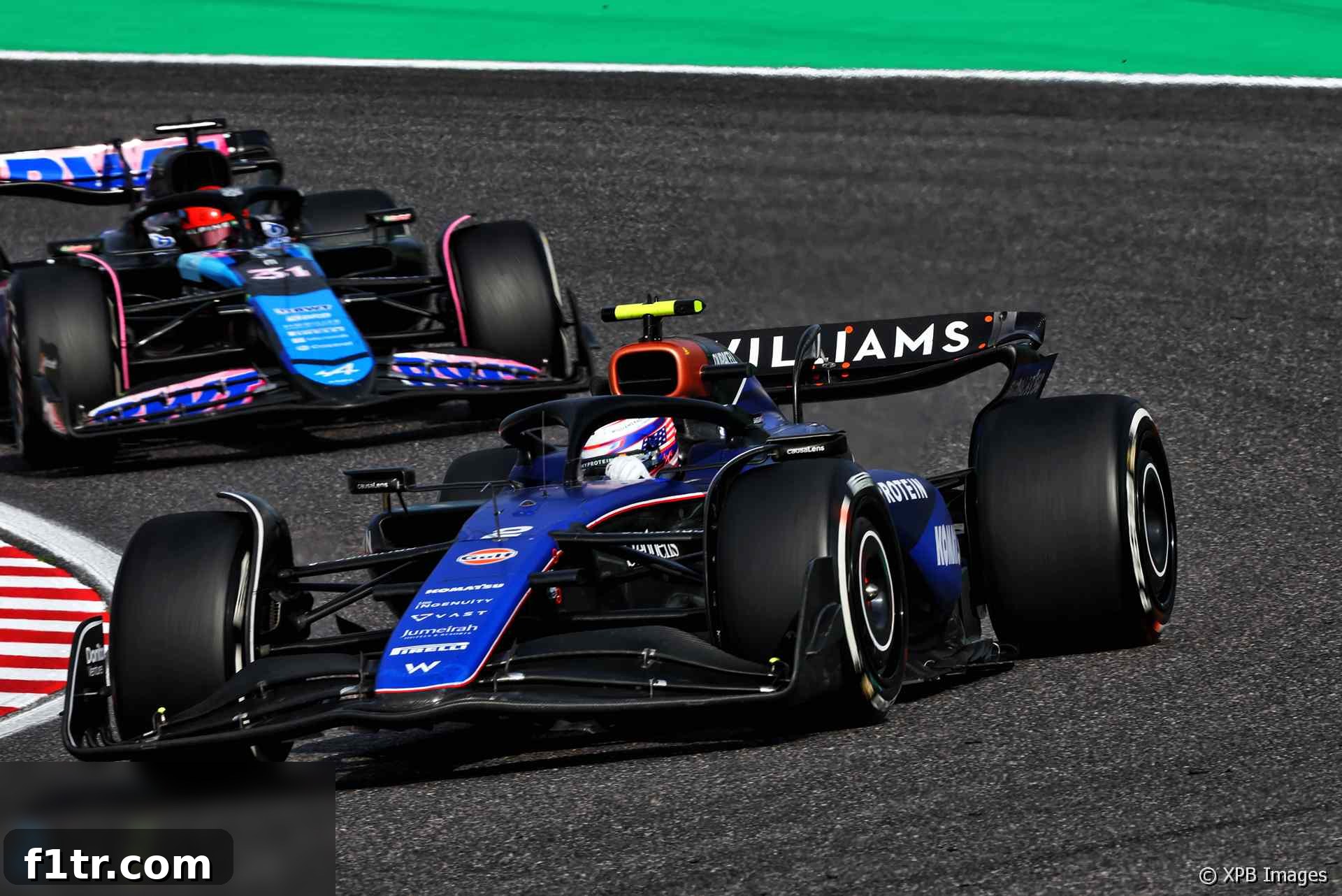
The 2024 Formula 1 season presented a challenging start for Alpine, with the team struggling to find competitive pace amidst a heavily contested midfield. However, the Chinese Grand Prix marked a significant turning point, offering a much-needed glimmer of hope as Alpine managed to outpace a rival for the first time this year, hinting at a potential upward trajectory for the French outfit.
This notable improvement was largely attributed to a crucial floor upgrade, introduced a race ahead of its initial schedule. The enhancement was initially given to Esteban Ocon, who, despite the new parts, surprisingly lapped slower than his teammate in the sprint race qualifying session. This initial discrepancy highlighted the inherent challenge of integrating significant aerodynamic updates and fine-tuning car setups under intense race weekend pressure.
Ocon candidly admitted that he required more time and setup adjustments to fully harness the potential of his new components. Fortuitously for him, the latest iteration of F1’s sprint event regulations proved advantageous. These revised rules allowed teams and drivers more flexibility for setup changes between sprint qualifying and the main qualifying session, a concession that Ocon expertly exploited. Through meticulous adjustments, he successfully optimized his car, subsequently securing his highest starting position of the season with an impressive 13th place on Saturday’s grid.
His qualifying lap of 1 minute 35.223 seconds was not only his best of the season but also critically, just 0.018 seconds faster than Alexander Albon’s effort. This razor-thin margin proved decisive. With Albon’s teammate, Logan Sargeant, failing to advance beyond Q1, Alpine effectively leapfrogged Williams Racing in the qualifying standings, securing a crucial victory in their ongoing midfield battle for the first time in the 2024 campaign. This breakthrough underscored the importance of every thousandth of a second in the fiercely competitive world of Formula 1 and injected much-needed morale into the Alpine garage.
Intense Scrutiny: Unpacking Qualifying Sector Times
While Ocon celebrated his personal best and Alpine’s comparative improvement, the qualifying session painted a complex picture for several drivers, particularly Alexander Albon. Given the narrow gap to Ocon, Albon and Williams would undoubtedly feel that a higher grid position was within reach. A deeper analysis of the sector times reveals why this sentiment might prevail, offering valuable insights into individual driver performance and the underlying pace of their machinery.
The disparity between a driver’s actual fastest lap time and their theoretical best lap – calculated by combining their fastest individual sector times – often highlights areas of optimization or missed opportunities. In China, this gap was notably large for Albon, the biggest of any driver on the grid. While Esteban Ocon managed to get within three-hundredths of a second of his theoretical best, demonstrating a highly optimized and consistent lap, Albon was over a third of a second off his potential benchmark. This significant deficit suggests that despite flashes of speed in certain segments, Albon struggled to string together a perfectly clean or fully optimized lap.
The upshot of this detailed sector analysis was a revealing re-evaluation of the pecking order at the back of the grid. Contrary to the season’s prior narrative, the data indicated that Williams, on pure pace, emerged as the slowest team during this particular weekend in Shanghai, not Alpine. This finding was a crucial development for Alpine, suggesting that their recent upgrades and Ocon’s execution had genuinely shifted the competitive balance, at least temporarily. For Williams, it served as a stark reminder of the challenges ahead and the imperative to extract maximum performance from their package, both through car setup and driver execution.
The nuances of sector performance are critical for teams in understanding car balance, tire management, and driver technique. A large deficit between an actual and theoretical best lap can point to issues like inconsistent braking, mid-corner stability, or sub-optimal power delivery, all of which contribute to tenths of a second lost across a lap. The Chinese Grand Prix’s qualifying session became a micro-study in these fine margins, underscoring the relentless pursuit of perfection in Formula 1.
| P. | # | Driver | S1 | S2 | S3 | Ultimate lap (deficit) |
|---|---|---|---|---|---|---|
| 1 | 1 | Max Verstappen | 24.965 (4) | 28.168 (1) | 40.511 (1) | 1’33.644 (+0.016) |
| 2 | 11 | Sergio Perez | 24.91 (1) | 28.29 (4) | 40.66 (2) | 1’33.860 (+0.122) |
| 3 | 14 | Fernando Alonso | 24.925 (2) | 28.308 (5) | 40.783 (6) | 1’34.016 (+0.132) |
| 4 | 4 | Lando Norris | 24.984 (5) | 28.345 (6) | 40.744 (5) | 1’34.073 (+0.092) |
| 5 | 16 | Charles Leclerc | 25.147 (13) | 28.241 (2) | 40.743 (4) | 1’34.131 (+0.158) |
| 6 | 55 | Carlos Sainz Jnr | 25.044 (8) | 28.361 (7) | 40.74 (3) | 1’34.145 (+0.152) |
| 7 | 81 | Oscar Piastri | 24.996 (6) | 28.263 (3) | 40.926 (8) | 1’34.185 (+0.088) |
| 8 | 63 | George Russell | 25.171 (15) | 28.415 (8) | 40.785 (7) | 1’34.371 (+0.062) |
| 9 | 27 | Nico Hulkenberg | 24.948 (3) | 28.571 (10) | 40.926 (8) | 1’34.445 (+0.159) |
| 10 | 77 | Valtteri Bottas | 25.041 (7) | 28.458 (9) | 40.979 (10) | 1’34.478 (+0.187) |
| 11 | 3 | Daniel Ricciardo | 25.114 (11) | 28.623 (12) | 41.065 (11) | 1’34.802 (+0.132) |
| 12 | 18 | Lance Stroll | 25.059 (9) | 28.595 (11) | 41.154 (13) | 1’34.808 (+0.030) |
| 13 | 23 | Alexander Albon | 25.117 (12) | 28.665 (14) | 41.116 (12) | 1’34.898 (+0.343) |
| 14 | 31 | Esteban Ocon | 25.1 (10) | 28.691 (15) | 41.303 (14) | 1’35.094 (+0.129) |
| 15 | 10 | Pierre Gasly | 25.167 (14) | 28.764 (16) | 41.304 (15) | 1’35.235 (+0.052) |
| 16 | 24 | Zhou Guanyu | 25.416 (20) | 28.766 (17) | 41.323 (16) | 1’35.505 |
| 17 | 20 | Kevin Magnussen | 25.204 (16) | 28.893 (19) | 41.419 (17) | 1’35.516 |
| 18 | 44 | Lewis Hamilton | 25.246 (18) | 28.639 (13) | 41.688 (19) | 1’35.573 |
| 19 | 22 | Yuki Tsunoda | 25.244 (17) | 28.864 (18) | 41.539 (18) | 1’35.647 (+0.099) |
| 20 | 2 | Logan Sargeant | 25.328 (19) | 29.066 (20) | 41.71 (20) | 1’36.104 (+0.254) |
Team Performance Dynamics: Red Bull’s Unyielding Dominance
While the focus at the lower end of the grid was on Alpine’s incremental gains, the situation at the sharp end remained remarkably consistent and, for many, predictable. Red Bull Racing continued to assert its formidable authority over the 2024 season. After a rare instance of missing pole position in Friday’s sprint qualifying, a minor blip that briefly sparked hopes of a more contested weekend, Red Bull emphatically re-established their dominance in Saturday’s sprint race. They achieved the largest margin of victory seen all season so far, lapping almost half a second quicker than any of their rivals.
This overwhelming performance in the sprint race served as a potent reminder of Red Bull’s comprehensive package: a meticulously engineered car, a powerful Honda-RBPT engine, and the exceptional talent of Max Verstappen. Their ability to recover from a minor setback and then decisively outperform the competition underscored their current championship-winning credentials. The consistent and significant performance gap to the rest of the field indicates that while other teams are making strides, Red Bull remains the benchmark by a considerable margin. Ferrari, McLaren, and Mercedes continue their battle for “best of the rest,” but none have yet found a consistent answer to Red Bull’s relentless pace and strategic execution.
Field Performance and the Enigmatic Shanghai International Circuit
The 2024 Chinese Grand Prix marked Formula 1’s long-awaited return to the Shanghai International Circuit after a five-year hiatus. This return was met with keen anticipation, not only for the race itself but also to observe how the current generation of F1 cars would tackle the renowned track. It quickly became evident that the modern machines are considerably slower than their predecessors from five years ago, clocking in over three-and-a-half seconds off the pace. This deficit, however, was not solely attributable to the regulatory changes and car design philosophy.
A significant contributing factor to the slower lap times and the drivers’ unique challenges was an unexpected surface treatment applied to the track just before F1’s return. This unusual application resulted in a significantly lower grip level and a distinctly different feel compared to what teams and drivers had anticipated or remembered. The modified surface exacerbated the performance deficit, forcing teams to adapt their setups quickly and drivers to recalibrate their approach to the circuit’s iconic corners and long straights. This unforeseen variable added another layer of complexity to an already challenging return, testing the adaptability of every team on the grid.
Looking ahead, this specific surface treatment is not expected to be a permanent feature. The Shanghai International Circuit is scheduled for a full resurfacing ahead of the 2025 race, indicating that the track conditions will likely revert to a more conventional state for future F1 events. This planned overhaul suggests that the unique challenges faced in 2024 were a one-off, making this year’s Chinese Grand Prix a distinctive and memorable chapter in the circuit’s F1 history.
2024 Chinese Grand Prix Coverage
- Alonso and Sainz incidents prompt changes to Formula 1’s rules
- Aston Martin fail in bid to have Alonso’s Shanghai penalty reviewed
- Mercedes cleared over Hamilton pit stop infraction as ‘nearly all teams in breach’
- Aston Martin petitions FIA to review Alonso’s penalty for Sainz collision
- “You need to be more on it”: 12 unheard radio exchanges from the Chinese GP
Browse all 2024 Chinese Grand Prix articles