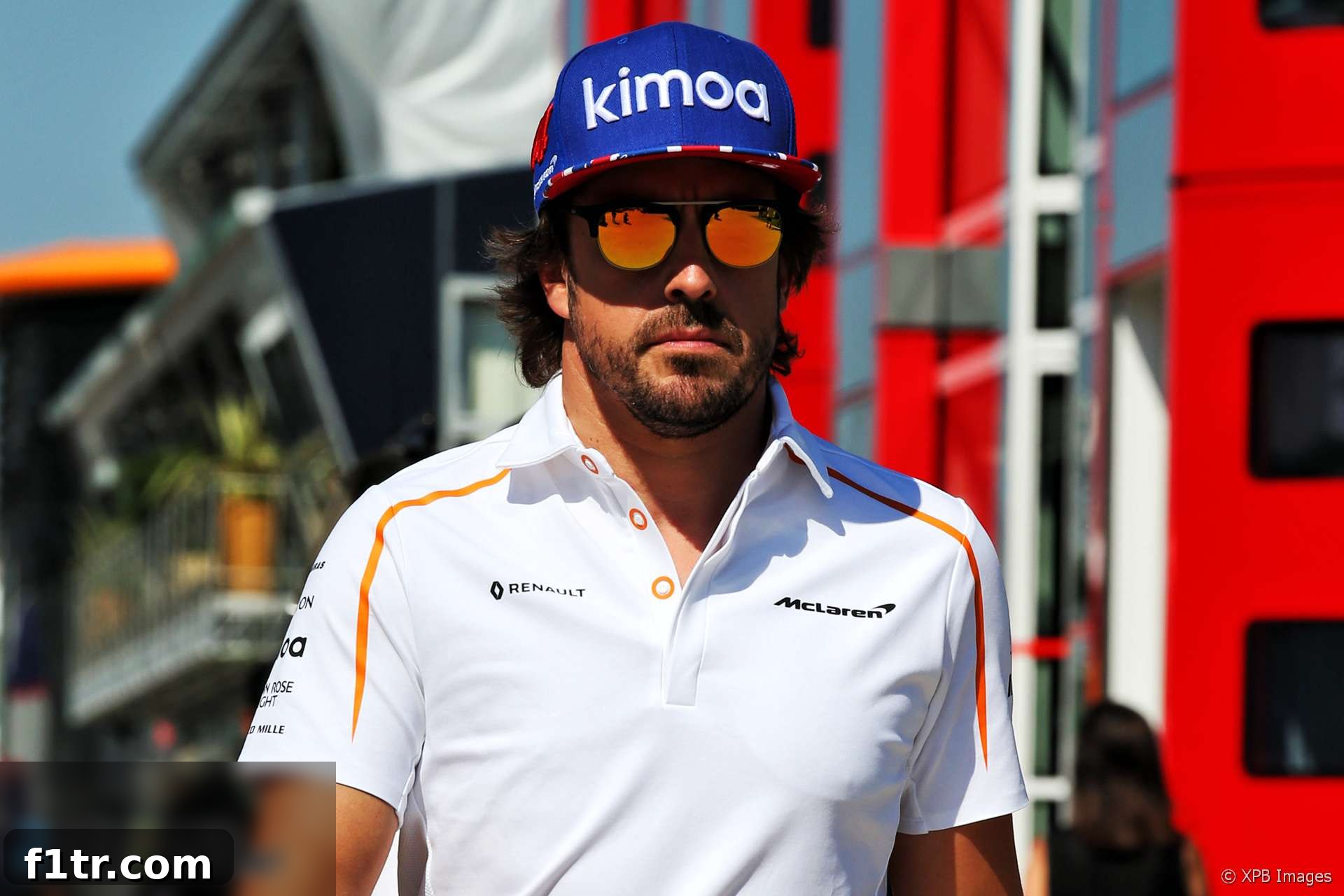
Fernando Alonso Downplays Significant Influence Amidst McLaren’s Pivotal Management Reshuffle
Following a significant management shake-up at McLaren, highlighted by the recent resignation of Racing Director Eric Boullier, two-time world champion Fernando Alonso has sought to temper growing speculation regarding his perceived influence over the team’s strategic decisions. Despite widespread belief in his central role, Alonso insists his responsibilities remain firmly behind the wheel, trusting the leadership to steer the team’s course.
The departure of Boullier, after a four-and-a-half-year tenure, signals a critical juncture for the Woking-based outfit, which has endured a challenging period marked by underwhelming on-track performance. In its wake, a series of internal promotions and new appointments have been announced, stirring discussions about the potential for a fresh strategic direction. Crucially, the promotion of Alonso’s former race engineer, Andrea Stella, to the vital role of Performance Director, has been widely interpreted as further evidence of the Spanish driver’s significant clout within the team’s hierarchy. This, coupled with the extraordinary decision to allow Alonso to skip the prestigious Monaco Grand Prix in 2017 to compete at the Indy 500, and the prominent display of his Kimoa clothing brand on the car, has fueled the narrative of Alonso as a driving force not just in the cockpit, but also in the boardroom.
Advert | Become a Supporter & go ad-free
Alonso’s Candid Stance: “I Just Drive Cars”
Addressing the media at Silverstone, a circuit synonymous with Formula 1 history and high-stakes racing, Alonso was unequivocal in his response to questions about his involvement in the recent changes. His concise statement – “I just drive cars” – aimed to firmly delineate his role, asserting that the operational and strategic decisions rest squarely with McLaren’s senior management.
Alonso elaborated on his perspective, expressing full confidence in McLaren Racing CEO Zak Brown: “If Zak [Brown] thinks that there are other people now doing different jobs in the team, it’s because he thinks that’s the best thing to do. I trust 100% Zak, I trusted 100% Eric, I trust always the bosses because they are the ones that have all the information.” This statement underscores his belief in the leadership’s informed decision-making process, suggesting that those at the helm possess a comprehensive understanding of the team’s needs and the broader competitive landscape.
Informed, Not Consulted: A Nuanced Distinction
The two-time champion was careful to draw a clear distinction between being “informed” about management changes and being “consulted” on them, a subtle but significant difference. Alonso clarified that his involvement extended only to being apprised of the planned shifts, much like his teammate, Stoffel Vandoorne, had been.
“I wasn’t consulted; I was informed about all the changes and all the new possibilities, as Stoffel had been informed,” Alonso stated. He acknowledged that his longer working relationship with Andrea Stella meant Zak Brown sought his opinion on Stella’s capabilities, especially since Brown had only known Stella for a year. However, Alonso highlighted that Brown’s extensive professional history with other key figures, such as Gil de Ferran, provided Brown with a far deeper understanding of their potential contributions.
“He wanted my opinion and how I see also Gil. But obviously he knows Gil for 20 years and I know Gil for one year, so he knows much more than me in terms of what possibilities and what scenarios may make Gil come into play,” Alonso explained. This acknowledgment of Brown’s superior insight into personnel and strategic configurations reinforces his trust in the CEO’s judgment. For Alonso, the paramount objective remains straightforward: “I fully trust whatever decision and just moving forward the most important thing is to improve the car and to be more competitive, and hopefully from this weekend we’ll see a step forward.”
McLaren’s Quest for Competitiveness: A New Chapter
McLaren’s recent history has been a challenging one, characterized by a persistent struggle to regain its former glory. The highly anticipated switch to Honda power units in 2015, intended to rekindle the legendary partnership of the late 1980s and early 90s, ultimately yielded three frustrating seasons of unreliability and underperformance. Even after transitioning to Renault power in 2018, the team continued to lag behind its rivals, failing to consistently challenge for podiums, let alone victories. This prolonged period of underachievement has exerted immense pressure on the team’s leadership to enact meaningful change and deliver tangible results.
The current management reshuffle, therefore, is not merely a cosmetic adjustment but a concerted effort to recalibrate McLaren’s technical and operational framework. The promotion of Andrea Stella to Performance Director is a strategic move, leveraging his extensive experience and deep understanding of car development, honed through years at Ferrari and more recently at McLaren, often working closely with Alonso. This aims to sharpen the team’s focus on extracting maximum performance from the chassis and powertrain integration. Furthermore, the likely enhanced role of Gil de Ferran, a former Indy 500 winner and highly respected figure in motorsport, with whom Zak Brown shares a long-standing relationship, is expected to bring a fresh perspective and strategic acumen to the team’s sporting and technical direction.
The Road Ahead: Technical Focus and Leadership Synergy
With these changes, McLaren is signaling a renewed commitment to technical excellence and a streamlined operational structure. The objective is clear: to enhance the car’s overall competitiveness and enable both drivers, Fernando Alonso and Stoffel Vandoorne, to extract greater potential on track. The focus will be on faster development cycles, more effective troubleshooting, and a cohesive approach to race strategy and execution. The challenge for the new leadership team is immense, given the tightly contested nature of modern Formula 1 and the significant performance gaps that need to be closed.
Alonso’s pragmatic approach, while seemingly detached from the intricacies of management, actually serves to reinforce the notion of a clear chain of command and a unified vision. By publicly endorsing Zak Brown’s decisions and focusing solely on his driving duties, he contributes to a narrative of stability and collective purpose, which is crucial for team morale during periods of significant change. The hope is that this restructured leadership, combined with Alonso’s unparalleled driving talent and feedback, will propel McLaren towards a brighter future, beginning with visible improvements in performance in the immediate races ahead.
Advert | Become a RaceFans supporter andgo ad-free
A Gracious Farewell to Eric Boullier
In addition to discussing the team’s future, Fernando Alonso took a moment to acknowledge the contributions of Eric Boullier, who has departed McLaren after a challenging four-and-a-half-year period. Alonso’s comments were respectful and appreciative, reflecting the professional relationship they shared during a difficult era for the team.
“I think we have to say thanks for all the effort and all the years here,” Alonso remarked. “His decision was to leave, and I’m sure that the team will move forward in the best possibilities, and we will keep moving forward.” This statement reflects a dignified transition, acknowledging Boullier’s efforts while firmly looking ahead to McLaren’s future endeavors under its new leadership structure. It underscores the high-pressure environment of Formula 1, where team leadership often bears the brunt of performance struggles, and changes are an inevitable part of the continuous pursuit of success.
The management changes at McLaren represent a pivotal moment for a team steeped in F1 history. While Fernando Alonso maintains a clear boundary between his role as a driver and the strategic decisions made at the highest levels, his unwavering trust in Zak Brown and the new leadership team signals a united front. The ultimate goal, as Alonso himself articulated, is singular and unambiguous: to improve the car and restore McLaren to its rightful place at the pinnacle of competitive motorsport.
Related Articles: 2018 F1 Season Insights
- F1 feared “death knell” for Drive to Survive after Ferrari and Mercedes snub
- McLaren staff told us we were “totally crazy” to take Honda engines in 2018 – Tost
- ‘It doesn’t matter if we start last’: How Red Bull’s junior team aided Honda’s leap forward
- Honda’s jet division helped F1 engineers solve power unit problem
- McLaren Racing losses rise after Honda split
Browse all 2018 F1 season articles