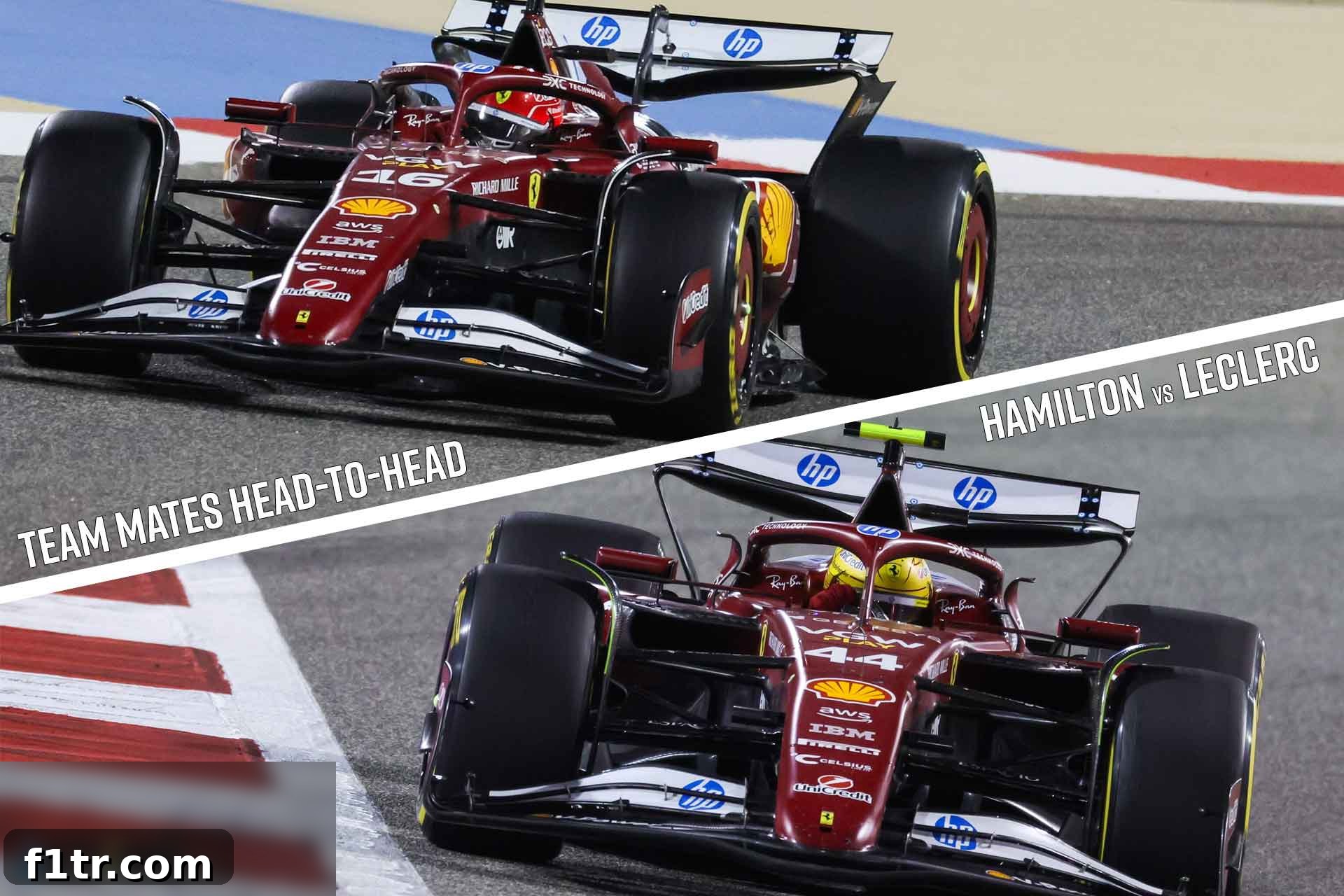
As the Formula 1 season progresses towards its midpoint, the highly anticipated pairing of Lewis Hamilton and Charles Leclerc at Scuderia Ferrari has captivated fans and pundits alike. While the championship points tally currently shows Charles Leclerc slightly ahead with 119 points to Hamilton’s 103, this numerical proximity barely scratches the surface of the intense battle unfolding within the iconic Italian team. This season has been a fascinating study in adaptation, raw talent, and the inherent challenges of integrating a seven-time world champion into a new environment after twelve years with a single constructor.
For Charles Leclerc, this season has largely been a testament to his innate ability to wring every ounce of performance from the SF-25. Despite the car often not being the dominant force it needs to be to consistently challenge for race wins – especially when compared to the formidable machine he commanded at the close of the previous year – Leclerc has consistently delivered performances that have defied expectations. His established comfort within the Ferrari ecosystem, coupled with his deep understanding of the car’s nuances, has allowed him to set a high benchmark for his new teammate. His consistency and sheer pace, particularly on challenging circuits, have underscored his role as a pivotal figure for the Scuderia.
Hamilton’s Challenging Adaptation to the Prancing Horse
Lewis Hamilton’s transition to Ferrari marks his first team change in over a decade, a monumental shift that was always destined to present unique challenges. Fans, perhaps buoyed by Hamilton’s stellar track record and the initial flashes of brilliance, might have anticipated a swifter integration. His brief lead in Melbourne, albeit the result of an aggressive and somewhat optimistic strategy call in a rain-affected race, and a superb sprint race victory in China, hinted at immediate potential. However, the subsequent grand prix in China saw both Ferraris disqualified due to separate technical infringements, bringing the team and Hamilton crashing back to reality and underscoring the steep learning curve ahead.
The intricacies of adapting to a completely new car philosophy after so many years with a single team like Mercedes are immense. Hamilton has frequently expressed how “alien” the SF-25 feels to him, a sentiment that speaks volumes about the distinct handling characteristics of the Ferrari chassis. The braking points, the front-end feel, the way the car manages tire degradation – all represent significant departures from what he was accustomed to. This has necessitated an arduous process of setup exploration, with Hamilton and his engineering team tirelessly experimenting with various permutations to find a sweet spot that aligns with his legendary driving style, or indeed, to adapt his own style to the car’s inherent demands. This painstaking journey is a stark reminder that even the greatest drivers face formidable hurdles when stepping into uncharted territory, requiring patience, resilience, and meticulous technical adjustments.
Leclerc’s Masterclass in Maximising Potential
While Hamilton has been diligently finding his feet and adjusting to his new machinery, Charles Leclerc has seized the opportunity to shine, delivering a series of truly impressive drives that have underscored his status as a top-tier talent in Formula 1. His performances at circuits like Jeddah, Monaco, and Catalunya stand out as particular highlights. In Jeddah, a fast and unforgiving street circuit, he showcased exceptional tire management and race craft to hold off formidable rivals, demonstrating remarkable control. His home race in Monaco was a masterclass in qualifying brilliance and controlled race pace, culminating in a popular and emotional victory, a testament to his precise driving on the narrow streets. In Catalunya, a circuit known for exposing car weaknesses and demanding aerodynamic efficiency, Leclerc again demonstrated his ability to extract consistent pace and manage strategy effectively over a full race distance. These races exemplify his deep connection with the SF-25 and his unwavering capacity to extract its maximum potential, even when it might be marginally off the pace of its direct competitors. The less said about his challenging outing at Silverstone, however, the better, serving as a reminder that even the most consistent drivers face occasional setbacks and that Formula 1 can be an unpredictable beast.
The Evolving Head-to-Head: Qualifying and Race Pace
The head-to-head battle between Hamilton and Leclerc has provided fascinating insights into their individual skills and the development trajectory of Lewis Hamilton within the Ferrari camp, particularly in the critical area of qualifying. Leclerc has, at times, voiced his own dissatisfaction with his qualifying performances this year, a testament to his relentless pursuit of perfection and incredibly high personal standards. Yet, in the early races, Hamilton found himself considerably adrift of Leclerc’s one-lap pace, highlighting the initial struggles in mastering the SF-25’s nuances under extreme pressure. However, the narrative since has been one of measurable and consistent gains for Hamilton. He has steadily closed the gap, and remarkably, he started ahead of his teammate in three of the last four rounds, showcasing significant progress and growing confidence in the car.
This narrowing of the qualifying deficit is a clear indicator of Hamilton’s growing comfort and understanding of the Ferrari, as well as the successful efforts of his engineering team. It’s important to note, however, that in one of those instances where Hamilton qualified ahead, Leclerc made a tactical compromise in his qualifying performance. This strategic decision was made to preserve a better stock of fresh tyres for the demanding race, a gamble that ultimately paid dividends, showcasing Leclerc’s strategic acumen and his ability to prioritise the bigger picture over single-lap glory. Such strategic nuances further complicate the direct comparison but highlight the depth of the rivalry.
Beyond qualifying, the race pace comparison offers another layer of analysis. Hamilton’s ongoing struggle to make the SF-25 feel truly his own has often manifested in inconsistent race performance, particularly in managing tire degradation over longer stints – a domain where he was historically unparalleled at Mercedes. Conversely, Leclerc has frequently demonstrated a profound understanding of the car’s behaviour under race conditions, allowing him to maintain strong pace and execute strategies effectively, often extending tire life or finding pace when others fade. The stream of driving instructions and invaluable feedback from Lewis Hamilton’s race engineer, Ricardo Adami, during the grand prix weekends are clearly proving instrumental in guiding Hamilton through this arduous adaptation period, helping him refine his approach, understand the car’s specific demands, and gradually align with the optimal operating window of the Ferrari.
Team Dynamics and Strategic Skirmishes
The presence of two drivers of such high calibre, both accustomed to being the leading figure in their respective teams, inevitably leads to heightened internal competition. Ferrari has already witnessed a few minor skirmishes over strategic clashes this year, most notably at Shanghai and Catalunya. These incidents, while not escalating into full-blown controversies or team orders, are indicative of the intense desire to win, the fine margins involved in Formula 1 strategy, and the natural competitive instincts of two apex predators. They highlight the delicate balancing act required by the Ferrari pit wall to manage two fiercely competitive individuals who are both striving for individual glory whilst simultaneously working for the team’s success.
Given Lewis Hamilton’s current rate of progress and his increasing comfort within the team, it is highly probable that fans will witness more of these competitive exchanges, both on track and in strategic calls, in the second half of the season. Ferrari, however, cannot have been surprised by this prospect. When the decision was made to pair two drivers of this immense talent, experience, and ambition, the potential for an exhilarating, albeit occasionally challenging, internal rivalry was a known factor. This dynamic, while potentially disruptive if mismanaged, also has the power to push the team forward collectively, fostering innovation, sharpening strategies, and ultimately extracting maximum performance from the car through relentless internal competition, benefiting the Scuderia as a whole.
The SF-25: A Car in Search of Consistency
To fully appreciate the performances of both Hamilton and Leclerc, it’s crucial to consider the context of the Ferrari SF-25 itself. The car has shown flashes of brilliance, capable of challenging for poles and race wins, particularly on circuits that favour its aerodynamic characteristics and traction. Yet, it has also demonstrated a propensity for inconsistency, struggling at times to match the outright pace of rivals like Red Bull and McLaren, especially across different track layouts and tire compounds. This variability means that both drivers are often extracting performance from a car that isn’t always the fastest on the grid, demanding exceptional skill, precise feedback, and adaptability to find its sweet spot.
Leclerc, with his years of experience navigating Ferrari’s development cycles and inherent challenges, seems to have a more intuitive grasp of how to extract the maximum from the car’s fluctuating temperament. Hamilton, on the other hand, is still learning these idiosyncrasies, a complex process that naturally impacts his ability to deliver consistently at the absolute peak of his capabilities. The ongoing development of the SF-25 throughout the season will be critical, not only for Ferrari’s championship aspirations but also for providing Hamilton with a more stable, predictable, and confidence-inspiring platform from which to unleash his full, proven potential. Continued upgrades and a clearer understanding of the car’s operating window will be key.
Looking Ahead: The Second Half of the Season
As the championship calendar unfolds, the second half of the Formula 1 season promises to be even more enthralling for Ferrari fans and motorsport enthusiasts worldwide. The discernible trajectory of Lewis Hamilton’s adaptation suggests he will continue to close the gap to Charles Leclerc, and potentially even surpass him on certain weekends, adding another layer of intrigue to their internal battle. This evolving internal rivalry will undoubtedly be a defining narrative of the year, pushing both drivers to new limits and hopefully yielding stronger overall results for Scuderia Ferrari in their quest for championship glory.
For Ferrari, the ultimate challenge will be to harness this competitive energy constructively, ensuring that the quest for individual supremacy does not detract from the team’s overarching goals in the Constructors’ Championship. The decision to bring Hamilton onboard was a bold statement of intent, signaling their ambition to return to the pinnacle of Formula 1. While the initial phase has been a significant learning curve for Hamilton, and a period of reaffirmed leadership for Leclerc, the potential for a truly formidable partnership remains immense. The remaining races will reveal whether Lewis Hamilton fully masters the complex SF-25 and whether Ferrari can successfully leverage the combined might of its two superstar drivers to consistently challenge at the very front of the grid, turning their internal rivalry into a collective strength for the iconic Italian marque.
Hamilton vs Leclerc: Summary
(Dynamic content for overall summary statistics would typically appear here, comparing key performance metrics throughout the season.)
Hamilton vs Leclerc: Race-by-race
| AUS | CHI | JAP | BAH | SAU | MIA | EMI | MON | SPA | CAN | AUT | GBR | ||
|---|---|---|---|---|---|---|---|---|---|---|---|---|---|
| Hamilton | Q | ||||||||||||
| R |
(This table would typically contain race-by-race qualifying and race results for both drivers.)
Hamilton vs Leclerc: One-lap pace
Unrepresentative comparisons omitted. Negative value: Hamilton was faster; Positive value: Leclerc was faster
(Dynamic content for one-lap pace comparisons would be displayed here, showcasing their performance differences in qualifying sessions.)
More from Formula 1
- F1 returning to India soon after 2027 sounds like wishful thinking
- Verstappen loathes F1’s new generation of cars – but what do his rivals reckon?
- The ‘throwback weekend’ is back in fashion. But it’s a flawed concept – especially for F1
- Is Formula 1’s double race cancellation a blessing in disguise?
- Todt admits Schumacher crashed on purpose – but did it really cost him two titles?
Browse all Formula 1 articles